
Heat Exchanger Types: Air Coolers vs Condensers for Refrigeration
Every commercial refrigeration system depends on two heat exchangers working in opposite directions. The evaporator, often called an air cooler in cold room applications, absorbs heat from the refrigerated space. The condenser releases that heat to the outside environment. Choosing the right type on each side directly affects pull-down time, energy consumption, compressor reliability, and product quality [1].
A Heat Exchanger's Job in the Refrigeration Circuit
A refrigeration circuit moves heat instead of creating cold. The compressor raises refrigerant pressure and temperature, the condenser rejects heat, the expansion device drops pressure, and the evaporator absorbs heat from the room. The evaporator and condenser are both heat exchangers, but they operate on different sides of the circuit and require different design logic.
In a cold room, the air cooler evaporator is the component the operator sees inside the space. Its job is to transfer heat from room air into the refrigerant. The condenser sits outside or in a mechanical area and transfers the total heat load, including compression heat, to ambient air or water.
Core Heat Exchanger Types in Commercial Refrigeration
Air Cooler Evaporator (Unit Cooler)
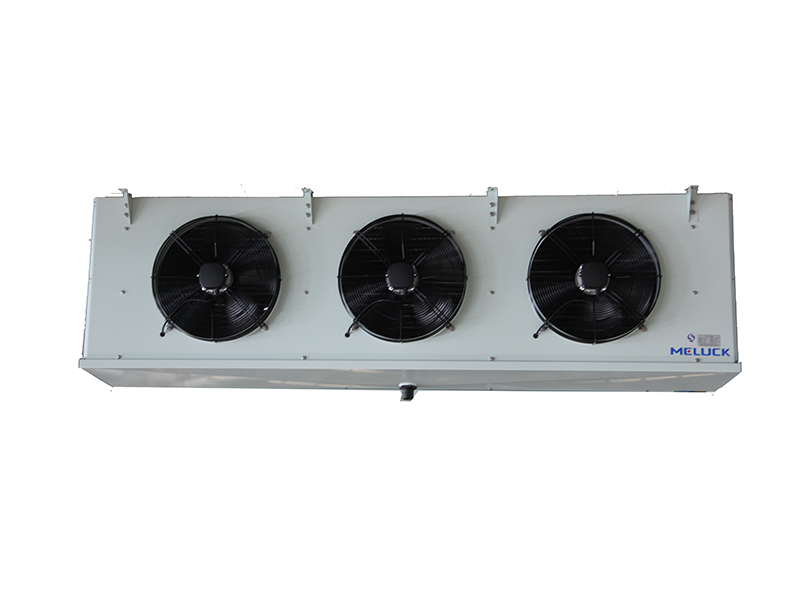
Air cooler evaporators are the standard heat absorption device for most commercial cold rooms. They combine a finned coil, expansion valve, fans, casing, drip tray, and defrost system in one unit. Cold room applications generally use three series by room temperature: DL for chiller rooms, DD for freezer rooms, and DJ for blast freezers and ultra-low temperature rooms.
The coil uses copper tubes and aluminum fins to maximize surface area. Fans draw room air across the coil, and the refrigerant evaporates inside the tubes. The temperature difference between room air and refrigerant, called evaporator TD, is a key selection parameter. A smaller TD holds higher humidity but requires a larger coil surface. A larger TD pulls down temperature faster but dries the air and increases surface frost in freezer rooms [1].
For freezer rooms, fin spacing is wider to reduce frost blockage, and defrost cycles become critical. Electric defrost, hot gas defrost, and air defrost are common options, with electric defrost used widely for DD and DJ series units.
Air-Cooled Condenser

Air-cooled condensers reject heat to outdoor air. They use copper tube and aluminum fin coils with one or more axial fans. Refrigerant enters as hot gas, condenses into liquid as air passes over the coil, and leaves through the liquid line. These condensers are widely used because they do not require a water supply, cooling tower, or water treatment.
Ambient temperature has a strong influence on air-cooled condenser performance. In hot climates, the condenser must be sized with a higher condensing temperature, which reduces compressor capacity and increases energy use. Good airflow, clean coils, and proper clearance around the unit are essential for stable head pressure.
Air-cooled condensers are available as remote condensers, as part of condensing units, or as built-in sections on monoblock units. For medium and large cold rooms, a matched condensing unit with a Bitzer or Copeland compressor and air-cooled condenser is a common configuration [2].
Water-Cooled Shell-and-Tube Condenser
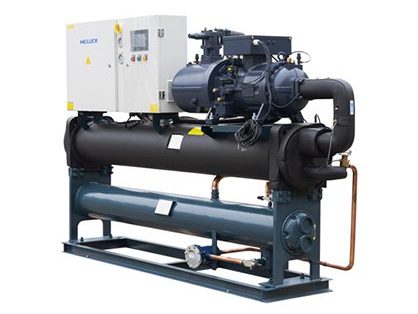
Water-cooled shell-and-tube condensers use water to remove heat from refrigerant. The design places water inside the tubes and refrigerant around the tubes within a cylindrical shell. Water from a cooling tower, chiller plant, or process loop absorbs heat and carries it away.
This type is used where ambient air is extremely hot, where noise must be kept low, or where a central water loop already exists. Shell-and-tube condensers can maintain lower and more stable condensing temperatures than air-cooled units in difficult environments. However, they require cooling water, pumps, filtration, and regular treatment to prevent scale, corrosion, and biological growth.
In commercial refrigeration, water-cooled shell-and-tube condensers often appear in industrial cold storage, large processing plants, and systems where multiple compressors share a central condenser.
Other Types: Brazed Plate and Coaxial Heat Exchangers
Brazed plate heat exchangers are compact and efficient. They are commonly used in small chillers, heat pumps, and condensing units where space is limited. Coaxial tube-in-tube heat exchangers are used in some water-cooled condensing units and small process chillers. These types work well for clean refrigerant and water circuits but are less tolerant of fouling than shell-and-tube designs.
Air Coolers vs Condensers: Key Functional Differences
Air coolers and condensers are not competing products. They are two required sides of the same system. Still, many buyers confuse them because both contain finned coils and fans. The table below separates their roles.
| Factor | Air Cooler Evaporator | Air-Cooled Condenser |
|---|---|---|
| Primary function | Absorbs heat from cold room air | Rejects heat to outdoor air |
| Location | Inside the refrigerated space | Outside, on the roof, or in a mechanical room |
| Refrigerant phase change | Liquid refrigerant evaporates into gas | Hot gas condenses into liquid |
| Air movement | Fans blow room air across the coil | Fans pull ambient air through the coil |
| Typical operating side | Low temperature, low pressure | High temperature, high pressure |
| Main operational risks | Frost, short air throw, ice on coil | Dirt, recirculation, high head pressure |
| Cleaning focus | Defrost and drain pan hygiene | Fin cleaning and airflow clearance |
The evaporator must be selected for the room temperature, humidity, product load, and air distribution pattern. The condenser must be selected for total heat rejection, ambient temperature range, available space, and service access.
How to Select the Right Air Cooler and Condenser
Start with the refrigeration load, not with a horsepower number. A cold room load is calculated from transmission through panels, product heat load, air infiltration, fan motors, lighting, and personnel activity. From this load, the evaporator capacity and condensing unit capacity can be matched.
Key rules for selection:
- Match evaporator capacity at the design evaporating temperature and TD.
- Check the total heat rejection requirement, which equals evaporator load plus compressor heat.
- Size the condenser for the highest expected ambient condition.
- Confirm fan air throw, coil face velocity, and room coverage for the air cooler.
- Verify defrost method and drain line location for freezer applications.
- Confirm refrigerant type, electrical supply, and control compatibility.
Manufacturers publish capacity tables at specific conditions. A condensing unit rated at 5 kW at -10C evaporating temperature will not deliver the same capacity at -30C. The same applies to air coolers. Always compare ratings at the same operating point [2].
Placement, Clearance, and Maintenance
Heat exchanger performance drops quickly when airflow is blocked. An air-cooled condenser needs enough space around the coil face and fan discharge to avoid hot air recirculation. Walls, adjacent units, and roof edges can all reduce airflow and raise head pressure.
Condenser location determines how much ambient air reaches the coil and how hard the compressor must work to maintain setpoint. <Condensing Unit Installation Clearance: Key Spacing Rules> covers spacing rules that keep airflow and service access safe.
For air cooler evaporators, the critical issues are coil clearance from walls and racks, fan throw, and drainage. In freezer rooms, frost management becomes part of daily operation. Defrost cycles must be frequent enough to remove frost but not so frequent that they heat the room or waste energy.
Maintenance should include coil cleaning, fan blade inspection, drain pan cleaning, refrigerant leak checks, and verification of defrost termination sensors. A fouled evaporator coil on one side and a fouled condenser coil on the other can reduce capacity by 20 percent or more before the control system records an alarm [3].
Get a Matched Heat Exchanger Set from MELUCK
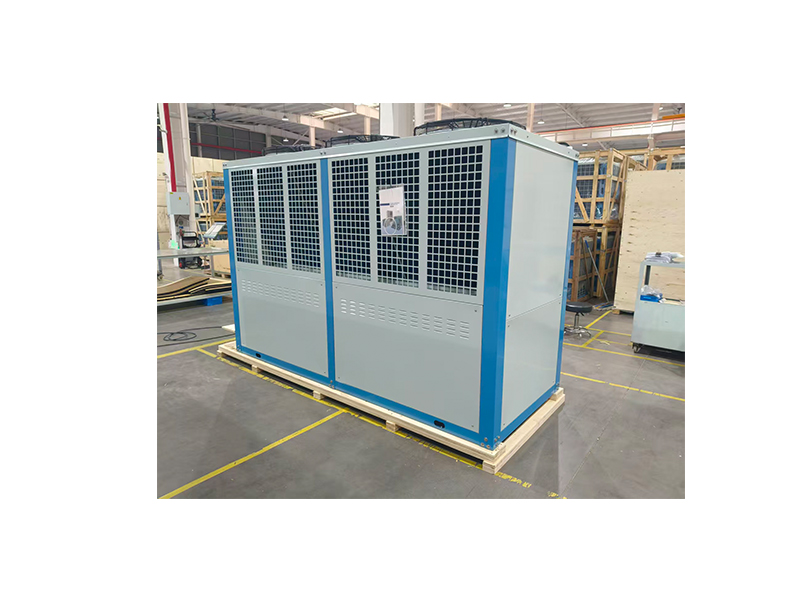
MELUCK supplies matched cold room components rather than isolated parts. The product range includes air cooler evaporators for chiller rooms, freezer rooms, and blast freezers; air-cooled condensers and condensing units from small scroll models to large parallel racks; and water-cooled shell-and-tube condensers for industrial systems.
When you send the room size, storage temperature, product type, daily throughput, and local ambient range, MELUCK engineers can check the evaporator capacity, condenser heat rejection, compressor horsepower, defrost method, and electrical supply as one matched package. This reduces the risk of an oversized compressor on an undersized coil or a condenser that cannot handle summer ambient conditions.
For a technical selection or quotation, contact meluck@meluckcooling.com or call +8617369893087.
Frequently Asked Questions
What is the difference between an air cooler and a condenser in refrigeration?
An air cooler is an evaporator. It absorbs heat from the cold room and causes refrigerant to evaporate. A condenser releases heat to the outside and causes refrigerant gas to condense into liquid. They are often confused because both look like finned coils with fans, but they sit on opposite sides of the refrigeration circuit.
Which is better: an air-cooled or water-cooled condenser?
Air-cooled condensers are simpler, lower cost, and easier to maintain because they do not need water. Water-cooled condensers can maintain lower condensing temperatures in hot environments and are often used in large industrial systems. The better choice depends on ambient climate, water availability, project size, and operating cost tolerance.
How do I size an air cooler evaporator for a cold room?
Start with the room heat load and design room temperature. Select the evaporator capacity at the required evaporating temperature and TD. Check air throw, fin spacing, defrost requirement, and coil placement. It is safer to compare capacity tables at the same conditions than to reuse a previous room size without recalculation.
Can I use an air-cooled condenser in high ambient temperatures?
Yes, but the condenser and compressor must be selected for the highest expected ambient temperature. In hot climates, condensing temperature rises, capacity falls, and energy use increases. Additional condenser surface, fan control, and proper clearance help maintain reliable operation.
How often should heat exchanger coils be cleaned?
Evaporator and condenser coils should be checked at least monthly in continuous commercial operation. Condenser coils in dusty or coastal areas may need cleaning every two to four weeks. Clean coils when visual inspection shows dust, debris, or frost buildup.
References
[1] ASHRAE, ASHRAE Handbook: Refrigeration, Atlanta, GA, USA: American Society of Heating, Refrigerating and Air-Conditioning Engineers, 2022.
[2] AHRI, AHRI Standard 450: Performance Rating of Remote Mechanical-Draft Air-Cooled Refrigerant Condensers, Arlington, VA, USA: Air-Conditioning, Heating, and Refrigeration Institute, 2017.
[3] ASHRAE, ASHRAE Standard 15: Safety Standard for Refrigeration Systems, Atlanta, GA, USA, 2022.
If you're interested, check out these related articles:
Cold Storage Room for Citrus Fruits: From Design to Export
Vietnam Cold Room Projects for Seafood and Agriculture
Cold Room Project in Myanmar for Tomato and Tropical Fruit
With over 15 years of experience as a MELUCK refrigeration engineer, I specialize in the design of cold storage, chillers, ice makers, and cold chain energy-saving systems, providing technical support to distributors and engineering companies worldwide.

meluck