
Chiller Room for Beverage and Dairy Storage: A Buyer’s Guide
Beverage and dairy products are temperature-sensitive in ways that dry goods are not. Milk, yogurt, juice, soft drinks, and fermented dairy products need stable refrigeration to control microbial growth, preserve flavor, and meet food safety requirements. A well-designed chiller room keeps the product in a narrow temperature band rather than simply making the space cold. That difference matters for shelf life, audit compliance, and daily operating cost.

Temperature Zones That Protect Beverages and Dairy Products
For most beverage and dairy storage, the target band is 2°C to 4°C [1]. This range slows spoilage without freezing the product. Milk and pasteurized dairy products are commonly held at 2°C to 4°C to limit bacterial growth [2]. Juices, soft drinks, and bottled water can tolerate a slightly wider band, but keeping them near 3°C to 5°C limits quality changes and improves serve-ready consistency. Wine and beer have different requirements, so they should not be mixed with dairy loads unless the room has independently controlled zones.
| Product group | Common storage band | Main control priority |
|---|---|---|
| Pasteurized milk and yogurt | 2°C to 4°C | Microbial control |
| Cheese and butter | 2°C to 8°C | Texture and mold control |
| Soft drinks and juice | 3°C to 5°C | Flavor and consistency |
| Mixed beverage and dairy loads | 2°C to 4°C | Cross-contamination prevention |
Getting the temperature zones wrong is the fastest path to spoilage and rejected inventory. <Cold Room Equipment Warranties: A Buyer’s Guide to Guarantees> covers the equipment and warranty points to check before you sign.
Chiller Room Design Factors for Dairy and Beverage Storage
A chiller room for beverages and dairy products needs more than a cold box. Air movement, insulation, door use, and drainage all affect whether the room can hold 2°C to 4°C during a full production day.
Insulation is the first line of control. PIR panels provide better fire resistance and thermal performance than ordinary polyurethane panels, especially for low-temperature or high-ambient applications. The panel thickness should match the room setpoint, local climate, and daily door openings. Well-fitted PIR cold room panels reduce heat gain and help the refrigeration system run fewer cycles.
Air distribution is equally important. Cold air must reach every pallet, shelf, and carton. A ceiling-mounted air cooler evaporator should be positioned to wash air across product stacks, not into a dead corner. Avoid placing tall pallets directly against the walls, because that blocks return air and creates warm pockets.
Drainage, floor slope, and door seals matter for food safety. Condensate must flow out quickly. Standing water in a beverage or dairy room invites mold, bacteria, and floor damage. Strip curtains or rapid-close doors reduce warm air entry and help the room recover quickly after loading.
Refrigeration Equipment Selection
A chiller room for beverages and dairy products is a medium-temperature system. The condensing unit, evaporator, and expansion system must be matched to the room heat load. That load includes product pull-down, door openings, lighting, people, and the highest local ambient temperature [3].
Select a condensing unit rated for medium-temperature operation, typically with an evaporating temperature near -5°C to 5°C depending on the room setpoint [3]. Original-brand compressors, such as a Bitzer 4HP Reciprocating Condensing Unit (-5~5°C), give predictable capacity and spare parts support. Pair the condensing unit with an air cooler evaporator that provides even airflow and reliable frost management. The air cooled condenser should be sized for the highest summer ambient at your site, with enough clearance for air to enter and leave the coil.
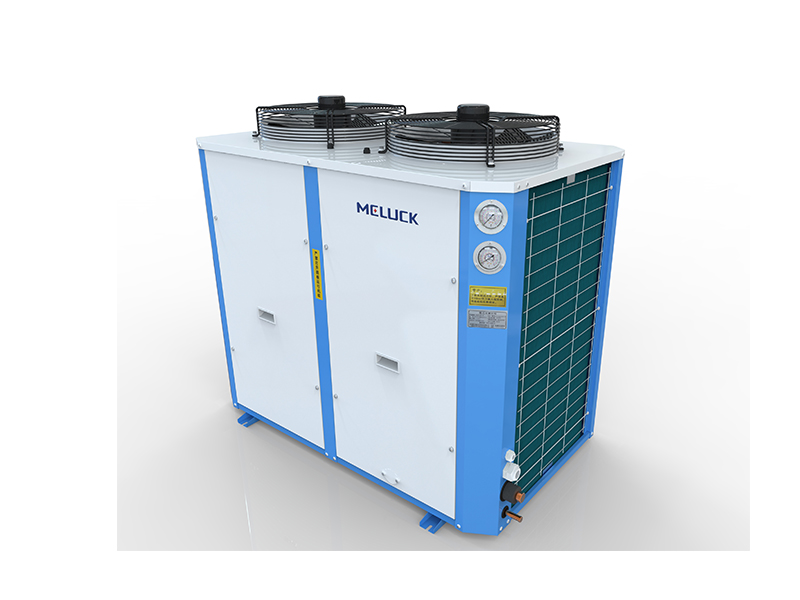
Send your room dimensions, stored product volume, target temperature, and site ambient to meluck@meluckcooling.com. A load calculation will match the condensing unit, evaporator, and panel thickness to your operation so the room holds 2°C to 4°C without short-cycling or excessive defrost.
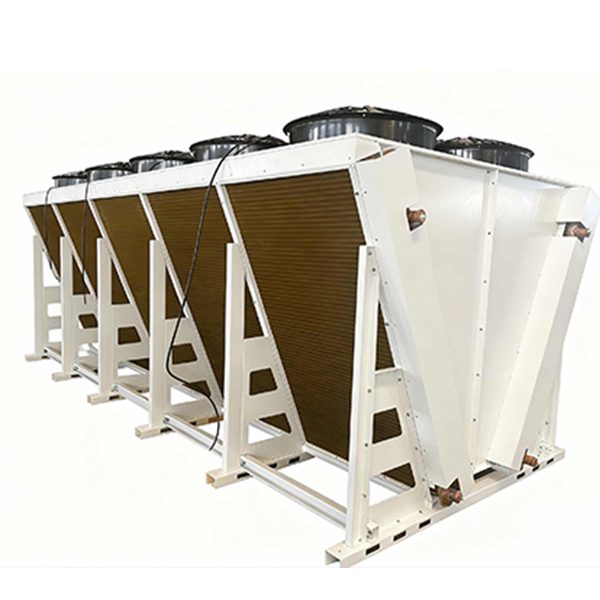
High-ambient climates change condensing unit capacity and pressure control. <Selecting a Condensing Unit for Tropical Climates> covers the design factors for hot regions.
Energy Efficiency Without Sacrificing Food Safety
Energy cost is a major part of chiller room ownership, but food safety cannot be traded away. The goal is to hold the correct temperature with the minimum electricity use.
Use the right panel type and thickness. A properly insulated room reduces compressor run time. Choose door switches, LED lighting, and a control setpoint with enough deadband to prevent short-cycling. Defrost should be just long enough to clear coil frost, because excessive defrost adds heat back into the room.
A stable control system also protects product. Temperature alarms should alert staff to a failed condensing unit, a stuck door, or a blocked coil before product enters the danger zone. Probe placement matters: sensors should measure the warmest return-air points and one or more product-simulated positions.
Installation, Commissioning, and Temperature Mapping
Before a beverage or dairy chiller room goes into service, run temperature mapping under load. Place sensors at multiple heights, near doors, and in the return air path. Confirm that every monitored point stays within the target band over a full operating cycle [4].
Check the following before sign-off:
- Panel joints are sealed and door gaskets close fully.
- Condensate drains slope correctly and do not leak.
- Condensing units have proper clearance and airflow.
- Evaporator fans run at the intended speed and direction.
- Controls and alarms respond correctly to a simulated high-temperature event.
Temperature mapping records are useful for HACCP audits and for resolving future temperature complaints. Keep the mapping report with the refrigeration startup log.
A chiller room purchase is also a financial decision. <Cold Storage Project ROI: A Practical Financial Evaluation> covers how to compare capital cost, energy, and product loss savings.
Get a Chiller Room Specification for Your Beverage or Dairy Operation
Tell us the room size, product types, storage temperature, and available power supply. MELUCK provides a complete chiller room proposal including insulation panels, condensing units, evaporators, controls, and commissioning support.
Email: meluck@meluckcooling.com
Phone: +8617369893087
Frequently Asked Questions
What temperature should a beverage chiller room be?
Most beverage chiller rooms operate between 2°C and 5°C. Dairy products are usually kept at 2°C to 4°C. A stable setpoint matters more than the exact number, so choose equipment that can hold the full room within a narrow band during door openings and loading.
Can I store dairy products and beverages together?
Yes, but the room should be designed for the most sensitive product. If milk, yogurt, and juice share a chiller room, hold the space at 2°C to 4°C and use air distribution that prevents warm dead zones. Keep raw dairy, strong-smelling products, or items with different humidity requirements in separate zones or wrapped containers.
How do I size a condensing unit for a dairy chiller room?
The condensing unit must match the calculated heat load, not just the room volume. The load includes product pull-down, door openings, lighting, people, and the site ambient. A refrigeration engineer can use the room dimensions, product type, and daily turnover to select the correct capacity and compressor brand.
Why is temperature mapping necessary before the room is used?
Temperature mapping shows whether the room actually holds the required temperature under load, not just at the thermostat location. It identifies warm spots near doors, airflow blockages, and sensor errors before product is stored.
References
[1] U.S. Food and Drug Administration, "Food Code 2022," Food and Drug Administration. [Online]. Available: https://www.fda.gov/food/fda-food-code/food-code-2022
[2] U.S. Food and Drug Administration, "Grade 'A' Pasteurized Milk Ordinance, 2019 Revision." [Online]. Available: https://www.fda.gov/food/milk-guidance-documents-regulatory-information/grade-pasteurized-milk-ordinance-pmo
[3] ASHRAE, "2018 ASHRAE Handbook: Refrigeration," American Society of Heating, Refrigerating and Air-Conditioning Engineers, 2018.
[4] European Commission, "Regulation (EC) No 853/2004 laying down specific hygiene rules for food of animal origin." EUR-Lex. [Online]. Available: https://eur-lex.europa.eu/legal-content/EN/TXT/?uri=CELEX%3A02004R0853-20240101
If you're interested, check out these related articles:
Condensing Unit Noise Reduction for Cold Room Applications
Chiller Room Solutions -10C~10C
With over 15 years of experience as a MELUCK refrigeration engineer, I specialize in the design of cold storage, chillers, ice makers, and cold chain energy-saving systems, providing technical support to distributors and engineering companies worldwide.

meluck