
Chiller Room for Fresh Produce: A Design Guide for Fruit and Vegetable Export Farmers
Fresh fruit and vegetable exporters do not lose product because a cold room is too cold. They lose product when field heat stays trapped in the produce, when humidity falls out of range, or when a room sized for storage is forced to act as a pre-cooling tunnel. A chiller room for fresh produce normally holds product between 0°C and 8°C, slows respiration, reduces water loss, and gives the packhouse a controlled staging point before grading, packing, or container loading [1]. For export farmers, this room is the first physical quality gate after harvest.
The Role of a Fresh Produce Chiller Room in Export Cold Chains
A fresh produce chiller room is not a freezer. It removes sensible heat and maintains a stable low-temperature environment without freezing the crop. Most mixed produce rooms are designed around 0°C to 8°C, with relative humidity between 85% and 95%, depending on the crop. The refrigeration system needs enough sensible capacity to handle product load, air infiltration, fan heat, and lighting, while the evaporator coil must operate with a low temperature difference to preserve humidity.
For export farmers, the chiller room also protects the time window between harvest and shipment. If produce waits in ambient heat, respiration continues, ethylene accumulates, and texture, weight, and appearance decline. By holding the product at the correct setpoint, the room extends shelf life, reduces rejection at destination, and makes loading schedules more flexible. This is not a storage bonus. It is a market access requirement.
Storage Conditions and Pre-Cooling Priorities
Temperature, Humidity, and Airflow
Temperature is only one part of the storage equation. Relative humidity controls weight loss, while air speed determines whether the product surface dries or sweats. Leafy crops need high humidity and low airflow to avoid wilting. Fruit with thicker skins can tolerate slightly lower humidity and higher air circulation. The table below gives starting ranges for common export crops handled in a chiller room. Exact setpoints should follow the buyer specification and the cultivar protocol for each shipment.
| Crop | Recommended temperature | Relative humidity | Notes |
|---|---|---|---|
| Leafy greens | 0°C to 2°C | 95% to 98% | High humidity, low air speed |
| Broccoli | 0°C to 2°C | 95% to 100% | Fast pre-cooling after harvest |
| Citrus | 4°C to 8°C | 85% to 90% | Washing and grading before storage |
| Avocado (Hass) | 5°C to 7°C | 90% to 95% | Chilling-sensitive at lower temperatures |
| Capsicum | 7°C to 10°C | 90% to 95% | Avoid condensation on fruit |
| Green beans | 5°C to 7°C | 90% to 95% | Quick cooling after picking |
These ranges are not universal. Codex guidance for packaging and transport of fresh produce [2] emphasizes that temperature, humidity, and ventilation must be matched to product type, maturity, and forecast journey time. A room that is safe for oranges may be too cold for some avocado varieties or too warm for tender leafy crops.

Pre-Cooling Before the Room Does the Heavy Lifting
A chiller room is a holding system, not a rapid pre-cooling tunnel. Field heat can be 15°C to 30°C above the required storage setpoint, and if a full day's harvest is loaded into a small room, the room can struggle to pull temperature down fast enough. The USDA commercial storage handbook [3] identifies several pre-cooling approaches before storage:
- Room cooling: air circulated in packed containers, slower but workable for produce with lower respiration.
- Forced-air cooling: high air pressure pulls cold air through crates, reducing cooling time to a few hours.
- Hydro-cooling: chilled water cools produce quickly but is suitable only for water-tolerant crops.
- Hydro-vacuum cooling: used for leafy or high surface area crops, faster but more capital intensive.
For most export farms, forced-air cooling is the most practical pre-cooling step before the chiller room takes over. It removes most of the field heat, reduces the load on the room evaporator, and shortens the time the product spends at dangerous intermediate temperatures. After pre-cooling, the chiller room maintains the setpoint and buffers the packhouse against interruptions. In one avocado cold storage project in Peru, a 17 m by 12 m by 3.1 m room held Hass avocados at 10°C with two Bitzer 20HP condensing units and two ceiling-mounted evaporators. The pre-cooling and storage sequence helped reduce rejection and spoilage from roughly 15% to below 4%.
Sizing, Refrigeration Capacity, and Enclosure Design
Load Estimation and Pull-Down
Sizing starts with three numbers: room volume, daily product intake, and target holding temperature. The refrigeration load includes transmission through panels, infiltration through doors, product field heat removal, respiration heat, fan heat, and occasional defrost. A room intended for fresh produce usually needs a medium-temperature refrigeration circuit, while frozen storage uses a low-temperature unit. For a produce room, a stable 0°C to 8°C band with good humidity control matters more than extreme cold.
The condensing unit selection follows the calculated load, not the room size alone. For a small to medium packhouse, a Bitzer 3HP reciprocating compressor condensing unit can handle moderate cooling requirements. Larger rooms that receive hot product quickly may need 20HP, 25HP, or larger units depending on pull-down time and ambient temperature. The evaporator should be selected for the sensible load and the desired relative humidity. A chiller room with a properly matched air cooler evaporator can hold temperature within a tight band while keeping coil surfaces above freezing for as long as possible.
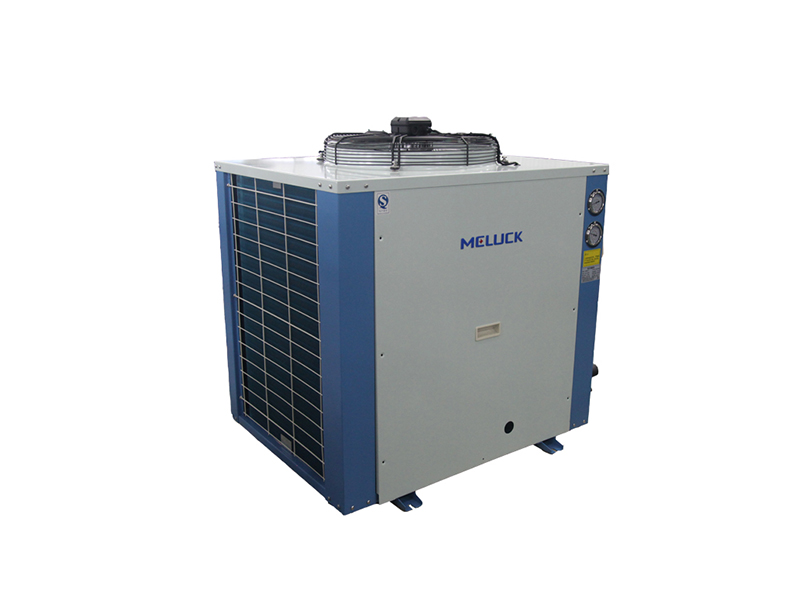
Post-harvest losses in fruit and vegetable supply chains can be substantial when cooling is delayed [4]. Refrigeration handbooks typically separate transmission, infiltration, product, respiration, and internal loads, then combine them with a safety margin [5]. The Myanmar tomato room project used Bitzer refrigeration and a custom room temperature between 8°C and 12°C. The system reduced spoilage and gave the grower better control over sales timing, which is a practical example of capacity matched to a crop rather than a generic room.
For produce rooms in hot climates, compressor selection and airflow need to be matched to harvest volume rather than the room alone. <Cold Room Project in India: Fruit Cold Chain Design Choices> covers how fruit cold chain design choices change with ambient conditions and export windows.
If you are sizing a room for a specific crop, send the room dimensions, daily harvest volume, and target temperature to meluck@meluckcooling.com. A technical review can clarify condensing unit and evaporator selection before you commit to a quotation.
Enclosure, Insulation, and Doors
The room envelope has a direct effect on running cost and temperature stability. PIR cold room panels provide good thermal insulation with fire-rating advantages, while PUR cold room panels are common for prefabricated cold rooms with a camlock quick-install system. For fresh produce rooms, panel thickness is usually selected to balance insulation value, floor space, and budget. A manual sliding door reduces the opening width during loading and helps limit warm air entry.
Air distribution is equally important. Crates should be stacked so that cold air from the evaporator can return across the product, not short-circuit back to the coil. A 100 mm to 150 mm gap from walls, an air gap under pallets, and visible stacking lanes improve temperature uniformity. The room should not be treated as a sealed box with a cold fan.

Export Compliance and Audit Documentation
Export buyers increasingly require more than a temperature reading on the door. They look for a clean, dry room, calibrated sensors, defrost and alarm logs, and a clear link between incoming produce and its time-temperature history. A fresh produce chiller room for export should include:
- Calibrated temperature and humidity sensors with automatic recording.
- High and low alarm thresholds connected to a phone or control panel.
- Cleanable surfaces and drainage that allow wet washing without pooling.
- A door discipline rule for loading and unloading.
- A traceable log showing pre-cooling time, room setpoint, and air temperature during storage.
Citrus exporters balancing washing, degreening, and storage temperature find that small setpoint changes affect stem-end shelf life and packout. <Cold Storage Room for Citrus Fruits: From Design to Export> covers orange and lemon chiller room design from post-harvest to export.
Import regulations often differ between destination markets, and a cold room that works for domestic trade may not meet buyer audit requirements. <Import Cold Chain Compliance: Cold Room Standards for Exporters> covers how to match room design and records to destination-country standards.
Commissioning and Handover Checklist
Before the room enters service, run these checks:
- Inspect panel joints, floor corners, and door gaskets for air leaks.
- Confirm that the evaporator fans and defrost cycle operate without excessive temperature swing.
- Perform a temperature mapping with empty and loaded conditions at three vertical levels.
- Verify sensor accuracy against an independent thermometer.
- Test the alarm path and ensure someone is assigned to respond.
- Document setpoints, refrigerant charge, compressor oil level, and control settings.
- Train operators on loading patterns, door discipline, and daily log keeping.
A room that passes these checks is ready to protect export quality. Commissioning is not a final signature. It is the point where the design becomes repeatable.
Discuss Your Chiller Room Project
If you are planning a fresh produce cold room for export and need a design matched to your crop, volume, and destination standards, send the following to meluck@meluckcooling.com or call +8617369893087: room dimensions, daily harvest volume, target temperature, and the main crop you handle. Shanghai Meluck Refrigeration Equipment Co., Ltd can support chiller room design, insulation panels, Bitzer condensing units, evaporators, doors, installation, commissioning, and after-sales service.
FAQ
What temperature should a fresh produce chiller room be?
Most fresh produce rooms run between 0°C and 8°C, but the setpoint depends on the crop. Leafy greens and broccoli stay near 0°C to 2°C, while citrus and some chilling-sensitive crops may need 4°C to 8°C or slightly higher. Work from the buyer specification and cultivar protocol.
How fast should a chiller room remove field heat?
A storage room is not a pre-cooling tunnel. Forced-air pre-cooling can bring many crops down within a few hours, while a room alone may need much longer and create uneven cooling. Use pre-cooling first, then let the chiller room maintain the setpoint.
Can one room store mixed fruits and vegetables?
It is possible if the crops share compatible temperature and humidity ranges. However, ethylene-producing crops can affect sensitive products, and humidity needs may conflict. Separate rooms or zones are safer for large export volumes.
What insulation thickness is suitable for a chiller room?
The correct thickness depends on ambient temperature, desired running cost, and panel type. PIR and PUR panels are commonly used for produce rooms. A reputable supplier calculates the required thickness from the room heat load rather than quoting a one-size-fits-all number.
How do I meet export buyer temperature requirements?
Build the room around the buyer specification, install calibrated and recording sensors, keep pre-cooling and storage logs, and train operators on door discipline. Many buyers check the full temperature record, not just the final reading at loading.
References
[1] ISO 7558:1988, Fruits and vegetables: guide to storage conditions and transport, International Organization for Standardization, Geneva, 1988.
[2] Codex Alimentarius, CAC/RCP 44-1995, Recommended international code of practice for packaging and transport of fresh fruits and vegetables, FAO/WHO, Rome, 1995.
[3] USDA Agricultural Research Service, Agriculture Handbook 66: The commercial storage of fruits, vegetables, and florist and nursery stocks, U.S. Department of Agriculture, Washington, DC, 2016.
[4] Food and Agriculture Organization of the United Nations, Prevention of post-harvest losses: fruits, vegetables and root crops, FAO Training Series 17/2, Rome, 1989.
[5] ASHRAE, 2018 ASHRAE handbook: refrigeration, American Society of Heating, Refrigerating and Air-Conditioning Engineers, Atlanta, 2018.
If you're interested, check out these related articles:
Ecuador Multi-Temperature Cold Storage Project
Cold Room Solutions for Supermarket Chains: Zoned Design
With over 15 years of experience as a MELUCK refrigeration engineer, I specialize in the design of cold storage, chillers, ice makers, and cold chain energy-saving systems, providing technical support to distributors and engineering companies worldwide.

meluck