
IQF Quick Freezer for Cheese and Dairy Processing: Key Specs
For cheese processors, individual quick freezing (IQF) is not simply about extending shelf life. It is about locking in texture, moisture, and product identity. An IQF quick freezer for cheese and dairy products freezes each piece separately, stopping cheddar cubes, mozzarella sticks, or cheese shreds from clumping together and preserving their shape and mouthfeel. Selecting the right equipment means understanding how freezing rate, airflow, and production capacity interact with the specific cheese type. As a refrigeration engineer who has worked on cold chain systems for food processors around the world, I can tell you that the difference between a successful IQF line and one that degrades product quality comes down to the technical details of freezer selection and integration, not just brand name.
How Does IQF Freezing Work for Cheese?
IQF, or individual quick freezing, rapidly freezes single pieces of cheese in a cold airstream so they remain separate and free-flowing. A tunnel IQF freezer conveys cheese cubes, sticks, or shreds on a perforated belt while high-velocity cold air passes through the product zone, typically at -30 °C to -40 °C. The fast freezing rate forms small ice crystals inside the cheese matrix, which protects cellular structure and minimizes moisture migration. This is critical for cheese because slower freezing would allow large ice crystals to rupture the protein network, leading to texture degradation and purge loss after thawing. Fluidized bed IQF freezers take this further by suspending smaller pieces in an upward airflow, creating a boiling-like motion that freezes individual particles without belt contact. For processed cheese products, which often contain emulsifiers and varying moisture levels, the freezing method must be matched to the product's size, density, and water activity to preserve functionality.
Why Is IQF Critical for Processed Cheese Quality?
Processed cheese products face unique challenges during freezing. Mozzarella sticks, cheese cubes, and shredded blends contain moisture and fat emulsions that are sensitive to temperature changes. A conventional slow freezer would cause sticking, surface damage, and purge loss when the cheese is thawed. IQF prevents these problems by freezing each piece independently, so the product maintains its shape, weight, and sensory quality. For dairy exporters and food manufacturers, this translates into higher yields, fewer rejected shipments, and satisfied end-users. In one of our cold chain projects—though for a different product—rapid temperature pull-down reduced quality defects from around 15 % to below 4 %. We see a similar pattern whenever fast freezing is applied to high-moisture foods. Cheese is no exception: faster freezing yields better texture and longer usable life.
How Do You Select an IQF Tunnel Freezer for Cheese Processing?
Choosing the right IQF tunnel freezer starts with three parameters: product type, required throughput, and temperature setpoint. For cheese, capacity is usually measured in kilograms per hour. A small factory might need 300 kg/h, while a high-volume processor may require multiple lines. Consider the physical dimensions of the product. Cheese sticks need more belt time than small shreds, so dwell time and belt speed become critical. Tunnel length and airflow velocity must be tailored to the product's freezing characteristics.
Below is a comparison of two common IQF freezer types used for cheese and dairy processing.
| Feature | IQF Tunnel Freezer (e.g., IQF-300KGS) | Fluidized Quick-Freezer |
|---|---|---|
| Freezing method | Perforated belt with high-velocity cold air | Upward airflow suspends particles |
| Ideal for | Shreds, sticks, cubes, irregular pieces | Small, uniform particles (e.g., grated cheese) |
| Throughput range | Up to 300 kg/h (scalable) | Higher volumes for granular products |
| Product handling | Gentle, minimal mechanical stress | Fluidization may cause abrasion in soft products |
| Typical application | Cheese cubes, mozzarella sticks | Fine shreds, diced cheese |
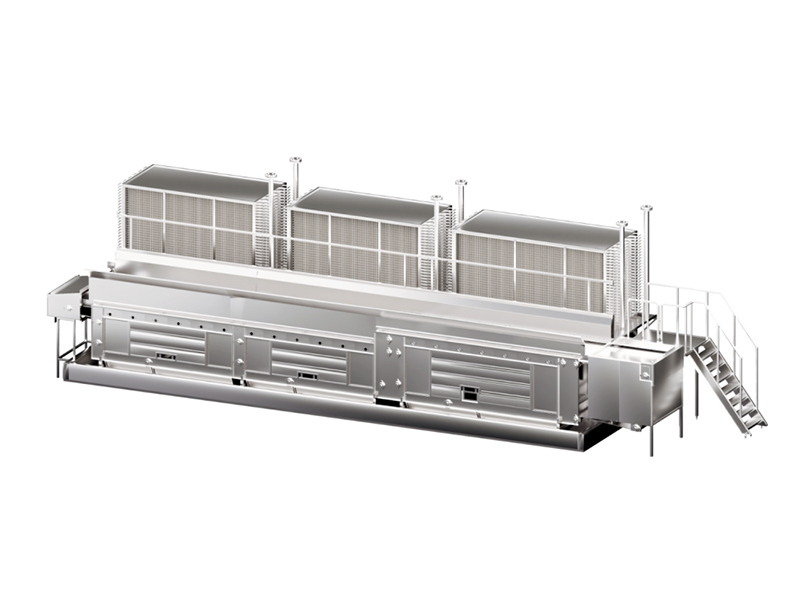
For processed cheese lines, a tunnel IQF freezer with adjustable belt speed and dual-temperature zones is often the best match because it provides the necessary control over dwell time and freezing intensity without risking product clumping.
If your production involves multiple cheese shapes and sizes, reaching out to determine the correct belt configuration and airflow design can prevent costly mistakes. You can send your product specifications to meluck@meluckcooling.com, and we’ll help you evaluate the right freezer parameters before you finalize your BOM.
How Do You Integrate an IQF Freezer into Your Dairy Processing Line?
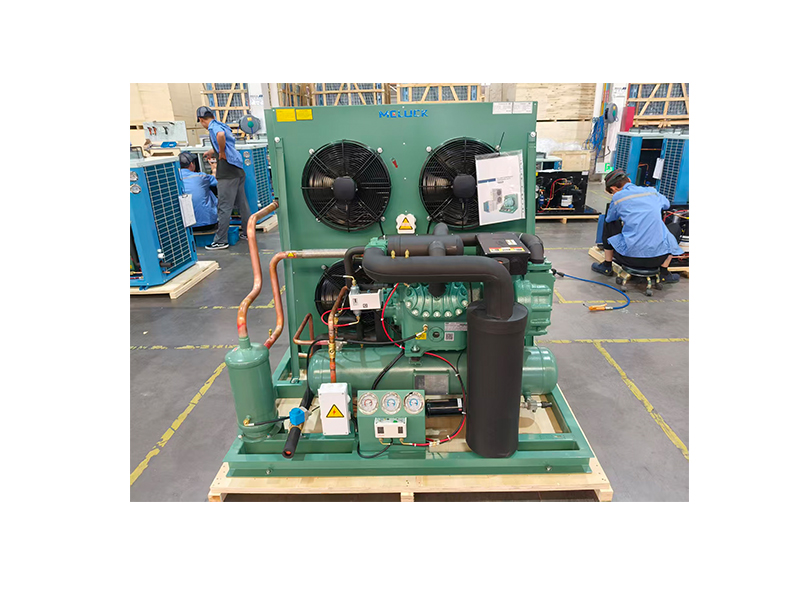
Integration should be viewed as part of the overall cold chain, not an isolated machine. The IQF freezer sits immediately after the forming or shredding station. Upstream, the cheese must be at a consistent temperature (typically 2–4 °C) to avoid a large heat load. Downstream, the frozen cheese drops directly into a cold storage room or packing area maintained at below -18 °C. The transfer between stations must be short and, ideally, enclosed to minimize heat infiltration. The condensing unit supplying the IQF freezer needs enough capacity for the peak load during startup pull-down. We often specify two-stage Bitzer semi-hermetic condensing units for tunnel freezers that operate at -35 °C or lower, because single-stage compression becomes inefficient and unreliable at those evaporating temperatures. A properly selected system also handles defrost cycles without affecting line speed.
What Are the Energy and Maintenance Requirements for IQF Freezers?
Energy consumption in an IQF tunnel freezer is driven by three factors: refrigeration compressor efficiency, insulation quality, and defrost frequency. Using a two-stage compressor with economizer can reduce annual electricity costs by 15–20 % compared to a standard single-stage unit at the same deep-freeze temperature. For maintenance, daily checks include belt alignment, airflow uniformity, and refrigerant charge verification. Frost accumulation on evaporator coils reduces heat transfer efficiency and must be managed with scheduled hot gas or electric defrost cycles. Food-grade lubricants and stainless steel construction on all food-contact surfaces simplify cleaning and meet HACCP requirements. In my experience, a well-maintained tunnel IQF freezer can run trouble-free for years with only periodic belt replacement and compressor oil changes.
How to Calculate IQF Freezer Capacity and ROI
Capacity calculation starts with the daily production volume. Determine how many kilograms of cheese you need to freeze per hour. Account for packaging and shift patterns. For example, if you produce 2,000 kg of cheese cubes per 8-hour shift, you need at least 250 kg/h throughput, with some buffer for startup and defrost time. Then calculate the heat load: the product's sensible heat above freezing, latent heat of fusion, and sensible heat below freezing. This determines the required refrigeration capacity and influences compressor selection. ROI comes from reduced product loss, improved export compliance, and labor savings. I have seen processors recover the additional cost of an IQF system over a conventional freezer within two to three years, purely through yield improvement and lower rejection rates.
Next Steps for Your IQF Cheese Processing Project
Getting the IQF freezer right is one of the most impactful investments a cheese processor can make. The wrong equipment leads to clumping, texture damage, and compromised export quality. The right one preserves product integrity and opens new markets. We have delivered integrated IQF freezing solutions for food processors across multiple continents, and we understand that each dairy product brings its own set of requirements. If you are planning a cheese IQF line, share your production capacity, cheese type, and desired throughput requirements with us. We will recommend a tunnel freezer configuration that matches your site conditions and budget. Reach out at meluck@meluckcooling.com or call +8617369893087.
Common Questions About IQF Cheese Freezing
Does IQF freezing damage cheese texture?
Not when done correctly. The rapid temperature drop forms tiny ice crystals that do not rupture the protein matrix, so the cheese retains its original texture after thawing. Damage occurs only when freezing is too slow or storage temperatures fluctuate. We have validated this principle repeatedly in projects where fast-freeze technology preserved delicate food structures, from french fries to avocado pulp.
What capacity IQF freezer do I need for cheese processing?
It depends on your daily throughput and number of shifts. For a small-to-medium processor, a 300 kg/h tunnel freezer is often sufficient, but if you run multiple lines or 24/7 production, larger or parallel units may be needed. Calculate your peak hourly output and add 20 % buffer for defrost cycles and production surges. Our engineers can help you size the system if you send your target production numbers.
Can I use a blast freezer instead of an IQF for cheese?
A blast freezer freezes cheese in bulk and causes pieces to freeze together, which then requires mechanical separation and often damages product integrity. IQF freezes each piece separately, preserving shape and free-flow characteristics. For cheese cubes, sticks, and shreds intended for retail or food service, IQF is the standard. Blast freezing is better suited for large blocks or raw material that will be further processed.
How much energy does an IQF tunnel freezer consume?
Energy consumption varies with freezing temperature, compressor type, and insulation. A typical 300 kg/h tunnel IQF freezer running at -35 °C with a two-stage Bitzer condensing unit might draw 60–80 kW. Using high-efficiency compressors and proper panel insulation can reduce this significantly. Annual electricity cost depends on local rates and operational hours, but our designs aim to return the investment through lower operational expenses within a few years.
How do I maintain food safety with IQF cheese freezing?
Follow HACCP principles: monitor air temperature continuously, record product core temperatures at regular intervals, and enforce cleaning schedules. Use stainless steel food-contact surfaces and food-grade lubricants. The system must be designed for easy access around the belt and evaporator for cleaning and inspection. If your program involves export to strict regulatory markets, it is worth confirming compliance documentation with your equipment supplier. Share your requirements and we’ll confirm available compliance documentation.
If you're interested, check out these related articles:
Blast Freezer Room Solutions -40C~-60C - Meluck
Ecuador Multi-Temperature Cold Storage Project - Meluck
Peru Avocado Pre-Cooling Cold Storage - Meluck
Processing Room Solutions for Food Plants - Meluck
Egypt French Fries Cold Storage Project - Meluck
With over 15 years of experience as a MELUCK refrigeration engineer, I specialize in the design of cold storage, chillers, ice makers, and cold chain energy-saving systems, providing technical support to distributors and engineering companies worldwide.

meluck