
Cold Room Manufacturer China: Quality and Cost Comparison
Sourcing a cold room from China can be the highest-value decision in a food processing or distribution project, but only when the comparison moves beyond the first quote. Chinese manufacturers now range from panel assemblers to full refrigeration system builders, and the gap between those groups shows up in energy use, food safety documentation, and service life. The right question is not whether a Chinese cold room is cheap. The right question is whether the supplier can prove the quality behind the price.
What Chinese Cold Room Manufacturing Actually Offers
China has one of the most developed component chains for refrigeration hardware and insulated panels. For buyers, that scale brings three practical advantages: a deep supplier network, fast production capacity, and the ability to configure a room around a specific temperature zone instead of forcing your product into an off-the-shelf box. A cold room built around a clear specification can be delivered as a kit for local assembly or as a supervised turnkey installation.
Chinese cold store design requirements in GB 50072-2010 define envelope, load, and safety boundaries that reputable manufacturers use as a baseline [1].
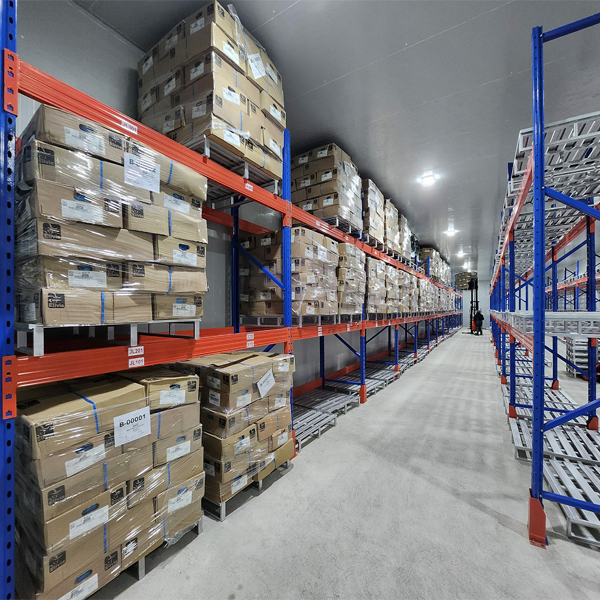
Scale is not a quality guarantee by itself. The same factory that produces high-density PU or PIR panels for export may also sell budget panels with lower foam density if the buyer only asks for the lowest price. This is why the first comparison point is the bill of materials, not the invoice total.
Quality: Look at the System, Not the Factory Location
A cold room is not a single product. It is an insulated envelope, a refrigeration load calculation, a condensing unit, an evaporator, a control system, and a door that must work together under daily use. When buyers compare factories, the most useful evidence is not the factory video; it is the component list and the design assumptions behind it. Ask whether the compressor is a known semi-hermetic or scroll model from Bitzer, Copeland, or an equivalent supplier, and whether the panel is PIR or high-density PU with the correct thickness for the room temperature.
Compressor and refrigerant selections are also safety decisions. EN 378-1 uses room volume, refrigerant charge, and occupied space to set charge limits and ventilation requirements, so a low-price quote that skips this calculation may create a compliance problem later [2].
For a freezer holding seafood or meat for export, the difference between -18°C storage and -25°C storage changes compressor horsepower, evaporator fin spacing, and panel thickness. A reliable supplier calculates the refrigeration load from room volume, product load, infiltration, and ambient temperature, then selects a compressor with enough reserve capacity for hot-season operation.
Cold room failures in mission-critical facilities rarely follow from one component; they follow from weak system design. <Refrigeration System Reliability for Critical Cold Rooms> covers redundancy, maintenance access, and failure prevention for cold rooms that cannot afford temperature drift.

Panel choice is equally important. PIR panels generally provide better fire resistance and lower thermal conductivity at the same thickness, while PU panels remain a proven option for many chiller and freezer rooms when density and cam-lock quality are specified. A bid should state foam density, steel thickness, and connection type, not just the words “sandwich panel.”
Panel selection changes fire compliance and long-term insulation performance in commercial buildings. <Cold Room Panel Fire Rating: PIR vs PU Commercial Compliance> covers when PIR is worth the premium and when PU is still suitable.

In a multi-room seafood facility in Manta, Ecuador, the bill of materials matched each zone to its load: -35°C blast freezing for rapid chilling, -18°C frozen storage, 5°C to 10°C processing, and a 10-ton/day flake ice plant. The result was a closed-loop cold chain rather than a set of separate cold rooms.
Cost: Purchase Price vs Lifecycle Cost
A low purchase price can hide a higher total cost of ownership. Cold room economics should compare equipment cost, installation, energy consumption, maintenance, and product loss over at least five to seven years. A room that runs with an undersized evaporator or a poorly sealed panel will cost more in electricity and lost product than the initial saving. ASHRAE refrigeration load guidance shows why: infiltration from a poorly sealed door or under-insulated panel becomes a continuous heat load that the compressor must remove day after day [3].
Purchase price is only the first line on a cold room project budget. <Cold Storage Project ROI: A Practical Financial Evaluation> covers the practical financial evaluation that separates workable projects from capital traps.
| Cost factor | Low-quote route | Engineered route |
|---|---|---|
| Panel | Unspecified PU density or thin steel | PIR or high-density PU with stated thickness and connection |
| Compressor | No-name or rebuilt unit | Bitzer, Copeland, or equivalent with full model code |
| Load calculation | Quick square-meter estimate | Room volume, product load, infiltration, ambient |
| Controls | Basic thermostat | Temperature alarm, defrost logic, optional remote monitoring |
| Commissioning | Start only | Start, pull-down test, door seal check, training |
| After-sales | Limited | Documented spare parts list and service response |
When comparing quotes, ask for the same scope. One supplier may quote a freezer room with panels, door, and refrigeration system; another may exclude piping, electrical work, commissioning, or freight. A complete quotation should show room dimensions, temperature requirements, compressor model, evaporator model, panel specification, control functions, and installation scope.
If you are comparing proposals, send the room dimensions, storage temperature, product type, and daily throughput to meluck@meluckcooling.com or call +8617369893087 for a technical review. A specification-based quotation should list compressor model, panel thickness, evaporator type, control functions, and commissioning scope line by line.
How to Compare Chinese Cold Room Manufacturers
Price alone is a weak filter. A better filter is documentable capability. Request the following before signing: panel material certificates, compressor original-source confirmation, load calculation summary, reference cases for your product type, and the after-sales response structure. A manufacturer with a large production base and wide export coverage is useful, but only if the operational details support it.
- Refrigeration load summary with room dimensions and ambient conditions
- Panel specification: foam type, density, steel thickness, and connection system
- Compressor and evaporator model codes, not just brand names
- Defrost and alarm control functions
- Installation, commissioning, and training scope
- Warranty period and spare parts availability
Ask for ISO 22000-oriented documentation if the room will hold food for export. ISO 22000 requires organizations to document temperature monitoring, corrective action, and withdrawal decisions for food safety [4].
Door type and seals are often overlooked. A manual sliding door with poor alignment or missing anti-sweat heater may be the largest single infiltration source in a freezer room. Specify the door opening dimensions, seal type, and whether the room requires a floor ramp or sectional door for forklift traffic.

Get a Technical Quotation for Your Cold Room Project
A reliable Chinese cold room manufacturer should be able to move from inquiry to a clear technical proposal quickly. Send the storage temperature, room size, product type, daily throughput, power supply, and site country to meluck@meluckcooling.com or call +8617369893087. MELUCK provides design review, component selection, installation support, and after-sales service for cold room, freezer, blast freezer, and chiller projects in more than 70 countries.
Frequently Asked Questions
Are Chinese cold rooms lower quality than European or North American equipment?
Not automatically. Quality depends on specification, component brand, panel material, and load calculation. Many Chinese factories export the same Bitzer, Copeland, PIR, and stainless steel components used in projects globally. Low quality appears when the buyer selects on price alone and ignores the bill of materials.
How much can a buyer save by sourcing from China?
Savings vary by product, specification, and freight destination. The largest savings typically come from panel production and complete room packaging, but the final delivered cost must include freight, local assembly, import duties, and commissioning. A like-for-like technical comparison usually shows a meaningful gap; a quote that is dramatically lower may not be like for like.
What should I include in a request for quotation?
Include storage temperature, room dimensions, product type, daily throughput or loading schedule, ambient temperature range, power supply voltage and frequency, door type, insulation preference, control features, and delivery location. This allows the manufacturer to calculate the refrigeration load and specify the correct compressor, evaporator, and panel.
How do I verify a cold room supplier before signing?
Request original compressor certification, panel foam density and fire rating, reference cases for the same product type, warranty terms, spare parts list, and commissioning checklist. A video call with the engineering or after-sales team can reveal more than a polished brochure.
What is the difference between a chiller room and a freezer room?
A chiller room typically holds product between 0°C and +8°C, while a freezer room holds -18°C to -25°C. Freezer rooms require thicker insulation, low-temperature compressor selection, and defrost controls. Blast freezers pull product down rapidly at -30°C to -40°C or lower.
References
- GB 50072-2010, Code for Design of Cold Store, Ministry of Housing and Urban-Rural Development, China, 2010.
- EN 378-1:2016, Refrigerating systems and heat pumps - Safety and environmental requirements, European Committee for Standardization, 2016.
- ASHRAE Handbook-Refrigeration, Chapter 24: Refrigerated-Facility Loads, American Society of Heating, Refrigerating and Air-Conditioning Engineers, 2018.
- ISO 22000:2018, Food safety management systems - Requirements for any organization in the food chain, International Organization for Standardization, 2018.
If you're interested, check out these related articles:
Banana Ripening Room vs Cold Storage for Importers
Blast Freezer Room Solutions -40C~-60C
Cold Room Project in Nigeria: 60Hz Equipment for Hot Climate
With over 15 years of experience as a MELUCK refrigeration engineer, I specialize in the design of cold storage, chillers, ice makers, and cold chain energy-saving systems, providing technical support to distributors and engineering companies worldwide.

meluck