
Cold Room Project in Nigeria: 60Hz Equipment for Hot Climate
Cold room projects in Nigeria fail most often when the refrigeration package is specified for a 50Hz market or a mild climate. I have seen this pattern across coastal West Africa: compressors run hot, heat rejection falls short, and panels sweat at the joints. For a cold room project in Nigeria, equipment selection starts with two facts. Many sites run on 60Hz generator sets or imported 60Hz equipment, and ambient temperatures regularly exceed 38°C. The right build uses 60Hz condensing units, oversized condensers, and insulation matched to the wet season.
60Hz Ready Equipment for Cold Room Projects in Nigeria
A cold room project in Nigeria has to handle two conditions that European and North Asian catalogues rarely address together. The first is 60Hz operation. The public grid is nominally 50Hz, but many industrial estates, processing plants, and off-grid sites run on 60Hz generating sets or imported 60Hz equipment. If you put a 50Hz compressor on a 60Hz supply, the motor runs roughly 20 percent faster, the amp draw rises, and the windings run hotter. If you put a 60Hz compressor on a 50Hz supply, you lose capacity. The second condition is ambient heat. Condensing units sized for 32°C will not reject enough heat at 40°C or higher, and the room will struggle to reach setpoint. In Lagos and Port Harcourt, I have seen this show up as high discharge pressure alarms and shortened compressor life.
Condensing Unit Selection for Nigeria's High Ambient Heat
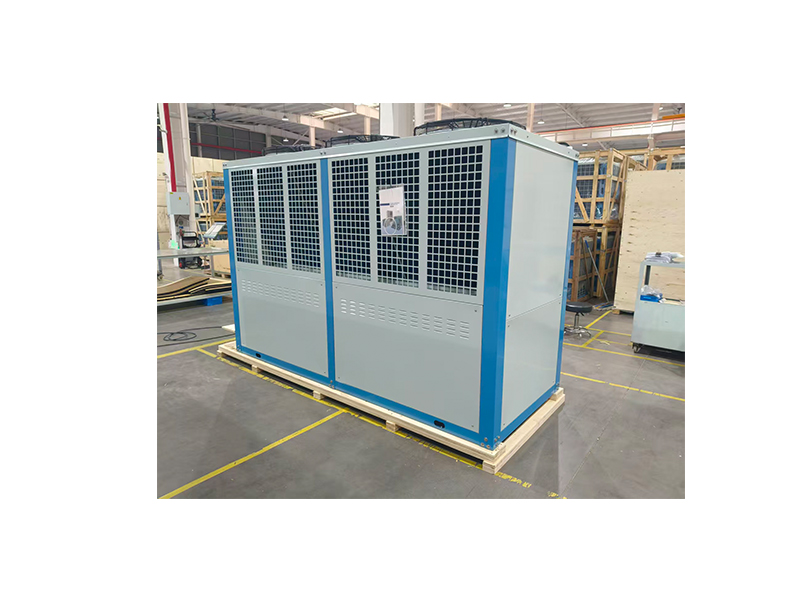
The condensing unit is the part that fails first when ambient temperature is underestimated. For a freezer room in Nigeria, we usually specify Bitzer semi-hermetic reciprocating units with an air-cooled condenser selected for at least 43°C ambient. For blast freezer and IQF applications, a Bitzer two stage condensing unit is the safer choice because it holds capacity at evaporation temperatures down to -50°C.
| Application | Condensing unit | Typical setpoint | Why it fits |
|---|---|---|---|
| Freezer room | Bitzer 4HP to 25HP reciprocating | -18°C to -25°C | Low temperature capacity without oversizing |
| Large cold store | Bitzer 30HP to 50HP reciprocating | -20°C or higher | High capacity for large rooms |
| Blast freezer or IQF | Bitzer two stage 16HP to 20HP | down to -50°C | Holds capacity at deep freeze |
| Chiller or processing room | Bitzer 20HP to 25HP medium temperature | 0°C to 10°C | Stable fresh room operation |
For coastal sites, the condenser needs extra corrosion protection because salt spray shortens fin life. In Manta, Ecuador, a similar hot humid coastal environment, we installed Bitzer systems for a multi-temperature seafood project and the equipment runs continuously without derating. The same logic applies in Lagos or Warri: specify tropicalized fin material, keep the condenser clear of discharge air recirculation, and oversize the fan by at least one step.
Cold Room Panel Insulation for Hot Climate Performance
Panel choice determines how hard the condensing unit has to work. In a hot humid climate, I prefer PIR panels over standard PUR for freezer rooms. PIR has better thermal stability and fire resistance, and its lower thermal conductivity delivers the same R value with a thinner panel. But the real failure point is not the panel core, it is the joint. Moist air entering through a poorly sealed camlock joint condenses inside the panel and ice forms behind the liner. Over time that ice pushes the liner off.
For chiller rooms at 0°C to 8°C, 100mm PUR or PIR is usually sufficient. For freezer rooms at -18°C to -25°C, I would not go below 150mm in Nigeria. Floor panels need to carry traffic and block ground heat, so we use reinforced camlock panels for site-assembled freezers. The wet season matters more than the dry season heat because moisture ingress is what kills panel performance.

Power Supply Planning for a Cold Room Project in Nigeria
Power planning should start with the actual supply on site, not the nameplate of the building. A cold room project in Nigeria often runs on a generator set or a mixed supply, so the refrigeration package must be matched to the frequency, voltage tolerance, and starting current available.
Generator Frequency and Voltage Stability
Voltage on a nominal 230V phase can swing between 170V and 260V in many Nigerian supply zones. A condensing unit with a wide input tolerance and phase protection survives that better than a unit specified for a stable European grid. Confirm the generator frequency under full load, not at idle, because frequency can drop when the compressor starts.
Sizing the Electrical Supply for Startup Load
Compressors draw six to eight times the running current at startup. If the generator is sized for running load only, it will trip when the compressor starts. We size the generator at 1.8 to 2.2 times the total running load for a single compressor start, or add a soft starter for large semi-hermetic units.
If your site runs on a generator set or has a mixed frequency supply, confirm the starting current and frequency tolerance of the condensing unit before finalizing the equipment list. Send your site voltage and frequency data to meluck@meluckcooling.com, and we will check the compressor match.

Equipment Package Confirmation Before Purchase
Most mistakes I see on Nigerian cold room projects are not product failures. They are specification mismatches discovered after installation: the panel is too thin, the condenser is too small, the generator cannot start the compressor, or the evaporator airflow does not reach the far corner. These failures are avoidable before payment. The fastest way to close the gap is to submit four details together: site location and extreme ambient, actual supply frequency and voltage, required room temperature, and expected daily product load. MELUCK engineers will confirm the matching condensing unit, panel thickness, evaporator model, and startup current requirement. Send those details to meluck@meluckcooling.com or call +8617369893087. This is a technical check, not a sales follow-up.

Common Questions About Cold Room Projects in Nigeria
Does Nigeria use 50Hz or 60Hz power for cold room projects?
The utility grid in Nigeria is nominally 50Hz, but that does not mean every cold room runs on 50Hz. Many industrial sites, process plants, and off-grid installations use 60Hz generating sets or imported 60Hz equipment. If the site supply is 60Hz, the compressor, fan motors, and controls must all be rated for 60Hz. If a 50Hz compressor is run on 60Hz, it spins faster, draws more current, and fails early. Before ordering, verify the actual frequency at the compressor terminals under full load, not just the utility label.
What cold room panel thickness do I need in a hot humid climate?
Use at least 100mm PIR or 120mm PUR for a chiller room, and 150mm for a freezer room in Nigeria's hot humid climate. The thickness is not only about the dry season heat. Humidity and rainfall drive moisture into panel joints, and once condensation freezes inside a panel, the insulation value drops and the liner can separate. PIR panels give better fire resistance and thermal stability than standard PUR, and a well-sealed slip-joint or camlock joint matters more than an extra 10mm of foam.
What happens if the site has frequent power outages?
It depends on whether the room is on the public grid, a dedicated generator, or a mixed supply. On a public grid, the system needs phase-loss protection, voltage monitoring, and a restart delay to protect the compressor from rapid cycling. On a generator, the set must be sized for compressor starting current, not just running load. For a mixed supply, the control panel should transfer cleanly and prevent simultaneous starts. In every case, the alarm system should alert the operator before product temperature moves more than a few degrees.
Can a cold room project be delivered as a turnkey package in Nigeria?
In West African projects we have supported, turnkey delivery usually includes site survey, panel production, refrigeration design, installation, commissioning, and operator training. This is the faster route when local installation labor is uncertain. A turnkey cold room project in Nigeria should include a written commissioning report, temperature pull-down test results, and two days of operator training as standard. If the supplier cannot confirm those items in writing, expect to manage the project yourself. Send your room dimensions and site voltage to meluck@meluckcooling.com, and we will confirm which turnkey scope fits.
If you're interested, check out these related articles:
Peru Avocado Pre-Cooling Cold Storage - Meluck
Processing Room Solutions for Food Plants - Meluck
With over 15 years of experience as a MELUCK refrigeration engineer, I specialize in the design of cold storage, chillers, ice makers, and cold chain energy-saving systems, providing technical support to distributors and engineering companies worldwide.

meluck