
Bitzer Condensing Unit Guide for Industrial Cold Storage
A Bitzer condensing unit is a matched assembly built around a Bitzer compressor, and it became the reference choice in industrial cold storage for practical reasons rather than marketing ones. The compressor can be opened and serviced in place, the platform runs from a 3HP chiller room unit to a screw package built for -40°C work, and service information and spare parts exist in most export markets. Those advantages only appear when the unit is selected for the temperatures it will actually see. The same 20HP label can hold a room at -18°C in one plant and fall short in another, because delivered capacity follows evaporating and condensing temperature, not the horsepower number.
What Actually Comes in a Bitzer Condensing Unit
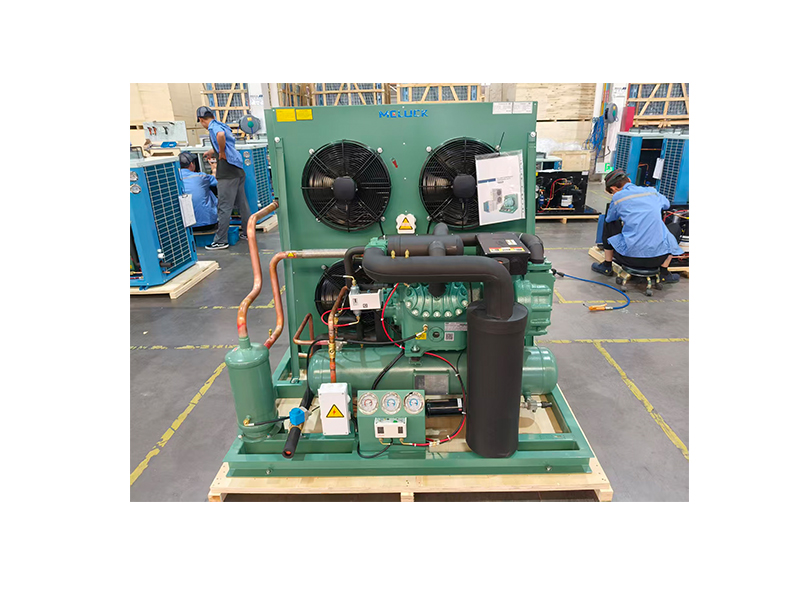
A condensing unit is not a compressor on its own. It is a frame assembly that combines the compressor, the condenser, the liquid receiver, the high and low pressure controls, the filter drier and sight glass, and an electrical panel or controller. On low-temperature versions the accessory set also includes an oil separator and a suction accumulator, because oil return and liquid floodback behave differently below -20°C than they do in a chiller room.
The compressor type inside the frame decides how the unit behaves over its service life. Bitzer semi-hermetic reciprocating compressors use a bolted cast iron body, so valve plates, pistons, bearings and shaft seals can be replaced with the body still on the frame. Sealed scroll and hermetic compressors cannot be opened in the field, so a mechanical failure means replacing the whole compressor. For a plant in a market where a replacement compressor takes weeks to arrive, that difference is usually worth more than the price gap between the two designs.
The horsepower figure on the quotation is a compressor class, not a cooling capacity. A 20HP compressor selected for a chiller room and a 20HP compressor selected for a freezer room can carry different applied ratings, different accessory sets and different control settings. Before comparing two offers, confirm the compressor model, the capacity at your design evaporating and condensing temperatures, the refrigerant the capacity is based on, the condenser type, and whether the low-temperature accessories are included or priced separately. A freezer unit is not a medium-temperature unit with the setpoint turned down.
Why Bitzer Platforms Suit Industrial Cold Storage
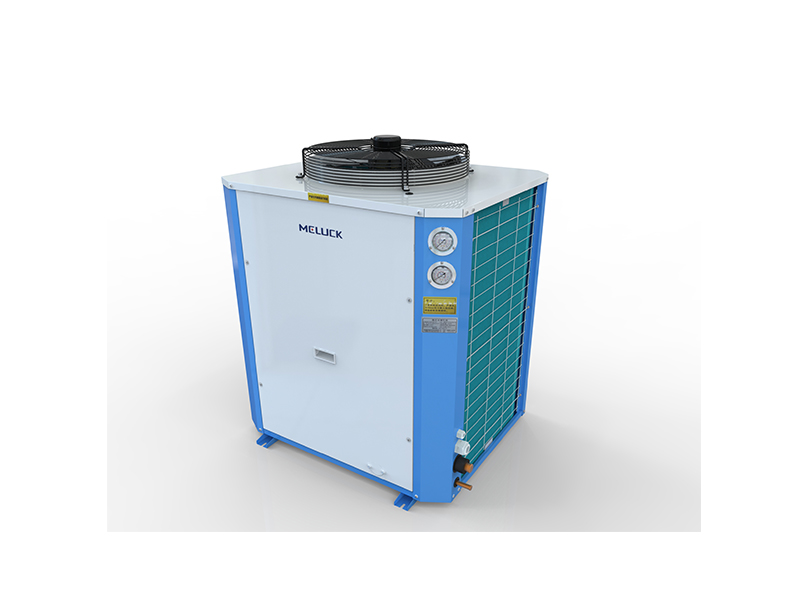
The first reason is continuity of range. The medium-temperature reciprocating ladder runs from 3HP through 5HP, 7HP, 9HP, 12HP, 15HP, 20HP, 25HP, 30HP and 40HP up to 50HP, while dedicated low-temperature versions cover the 18HP to 34HP band. A plant that starts with one chiller room and adds freezer capacity three years later stays inside the same service vocabulary, the same spare parts family and often the same technician training.
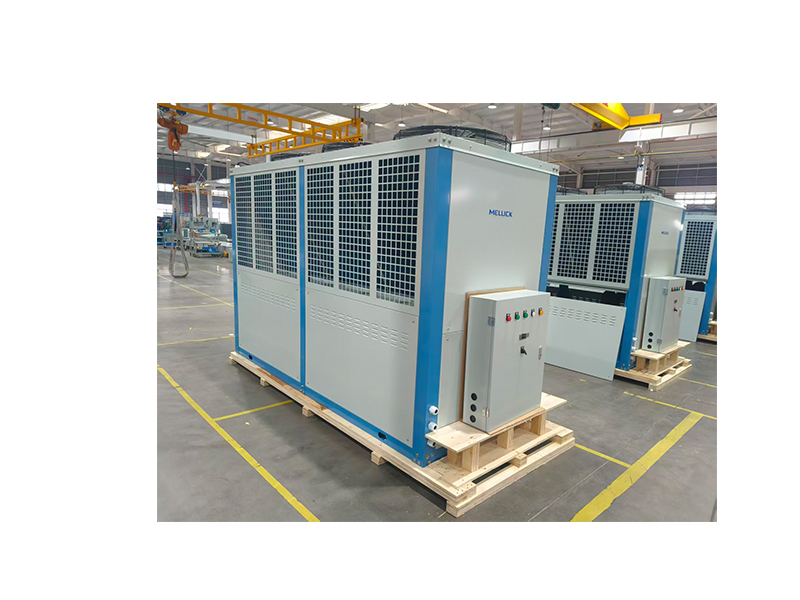
The second reason is repairability under real operating conditions. Condensing units in export projects sit behind a fence in a hot yard, not in a climate-controlled machine room. When a valve plate fails, a semi-hermetic unit can be brought back with a gasket set and a few hours of technician time. A sealed compressor in the same position becomes a shipping and customs problem before it becomes a repair.
The third reason appears at the cold end of the range. At -35°C and below, a single-stage compressor works against a high pressure ratio, discharge temperature climbs, and oil life shortens. Two-stage semi-hermetic units split that compression across two cylinder sets so each stage carries a moderate ratio. The catalog two-stage 16HP and 20HP units reach evaporation temperatures down to about -50°C, which is the working territory of blast freezers, IQF lines and tuna or seafood plants.
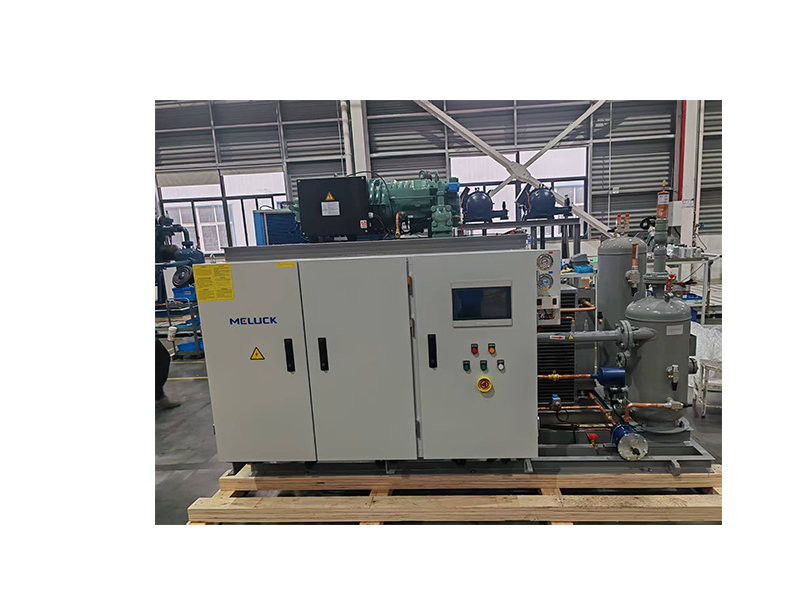
Above the reciprocating range, semi-hermetic screw compressors cover large low-temperature duty from -25°C to -40°C with continuous compression, fewer wear parts and a PLC touchscreen controller that can be extended with remote monitoring. Reciprocating and screw platforms are not competitors so much as neighbours on the same capacity curve, and the choice between them is a matter of load size and run hours rather than brand preference.
The limit is worth stating plainly. The platform sets the ceiling of what a unit can do, not the result inside the room. Insulation, door traffic, product entering warm, defrost frequency and summer ambient decide whether a correctly rated unit holds temperature, and no compressor brand rescues a room that was designed without those numbers.
Matching Unit Capacity to Room Temperature and Load
Capacity is quoted at a pair of temperatures, and both have to come from your project. The evaporating temperature sits below room air by a margin chosen for the product and the evaporator. A storage room uses a moderate difference, while a blast freezer uses a much larger one to drive heat out of the product quickly. The condensing temperature follows the ambient at the condenser. Capacity falls as ambient rises, which is why a unit rated at a mild design ambient looks generous on paper and thin in a Gulf or African summer.
| Capacity band | Platform | Typical duty |
|---|---|---|
| 3HP to 7HP | Semi-hermetic reciprocating, medium temperature | Small chiller rooms, preparation areas, back rooms |
| 9HP to 15HP | Semi-hermetic reciprocating, medium temperature | Medium chiller and freezer rooms, processing halls |
| 18HP to 25HP | Low-temperature reciprocating versions | Freezer rooms, meat and seafood holding |
| 30HP to 50HP | Semi-hermetic reciprocating, medium temperature | Large rooms, distribution and warehouse storage |
| 16HP to 20HP | Two-stage semi-hermetic | Blast freezers and IQF lines down to about -50°C evaporating |
| Screw CSH and HSN | Semi-hermetic screw | Large low-temperature capacity from -25°C to -40°C |
Two further variables move the number after the unit is chosen. Refrigerant matters, because a capacity table built for R404A does not transfer unchanged to R448A or R449A, and a unit charged with a different refrigerant must be re-rated rather than assumed. Supply frequency matters as well, since motor speed scales with frequency and a unit built for one market's power supply does not deliver its rated duty on another.
The practical check is short. Ask for capacity at your design evaporating temperature and your maximum summer ambient, ask whether the figure includes pull-down after a defrost or a warm load, and ask which refrigerant the table assumes. A supplier who answers all three is quoting a selection. A supplier who answers with a horsepower number is quoting a catalog page.
Where Parallel and Screw Systems Replace Single Units
A single condensing unit per room is the simplest arrangement and stays the right answer for most small and mid-sized plants. It stops being the right answer when three conditions appear together: several rooms with different loads, a plant that runs near full load only a few hours a day, and a product loss that would be serious if one compressor stopped.
A parallel system places three or four Bitzer piston compressors on a common rack with a PLC controller. Capacity is added and removed in steps as the load moves, which suits a plant whose demand swings between a quiet night and a busy morning. If one compressor fails, the rack keeps the rooms at temperature on reduced capacity while the repair is arranged. The costs are real: more piping, more controls, a larger footprint and a technician who understands a rack rather than a single unit. A plant with one room and no maintenance team gains little from that complexity.
Screw compressor units take over at the other end. When the low-temperature load is large and continuous, a single screw package with a PLC controller and optional remote monitoring replaces several reciprocating units and simplifies the machine room. Below that capacity, a screw package is usually more expensive to buy and harder to justify than a reciprocating unit of the same duty.
The trade-off is consistent across all three arrangements. Fewer and larger compressors lower first cost and raise the consequence of a single failure. More and smaller compressors raise first cost and lower the consequence. Redundancy is a decision about product value, not about compressor quality.
Splitting a plant into separate temperature zones changes the unit count before it changes the total capacity. <Cold Room Zoning for Meat Packaging: Condensing Unit Guide> covers how zoning and condensing unit selection connect in meat packaging plants.
Specifying a Unit That Will Hold Its Rating
Most selection errors are made in the request, not in the equipment. The table below lists the fields that decide whether the unit you receive matches the room you built.
| RFQ field | What to request | Why it matters |
|---|---|---|
| Room and product | Room dimensions, product type, incoming product temperature, daily throughput | Sets the load and whether a single-stage unit is viable |
| Capacity basis | Capacity at stated evaporating and condensing temperatures, pull-down included | A nominal horsepower can hide a shortfall during pull-down |
| Refrigerant | R404A, R448A, R449A or other, with the capacity table used | Capacity tables differ by refrigerant and cannot be mixed |
| Ambient | Maximum summer ambient at the condenser position | High ambient raises condensing temperature and cuts capacity |
| Power supply | Voltage, phase and frequency, 50Hz or 60Hz | A unit rated for one frequency does not deliver its duty on another |
| Evaporator and controls | Evaporator model, temperature difference, defrost method, controller and alarm functions | Unit and coil are selected together, not separately |
A vague line in a purchase order is worth replacing before it becomes a dispute. Reject a request written as "Bitzer 20HP condensing unit, low temperature, R404A" and replace it with the compressor model and serial, the capacity at your design evaporating and condensing temperatures, the refrigerant and charge basis, the design ambient, the supply frequency, the matched evaporator and the controller functions. The second version can be checked by two suppliers on the same basis. The first cannot be checked by anyone.
Original parts deserve their own check. Ask for a photograph of the compressor nameplate and the serial number, confirm that the compressor model on the unit matches the model on the quotation, and verify the serial with the compressor manufacturer or an authorised distributor. A rebuilt or grey-market compressor inside a new frame will run, and it will also fail outside any warranty conversation you can win later.
Certification questions usually start with the compressor and end with the unit model, because a certified component does not automatically certify the assembly. <Bitzer CRAA Certified Condensing Units: China Market Guide> covers how CRAA certification applies to Bitzer condensing units in the China market.
Field Records from Three Industrial Projects
Sizing logic is easier to trust when it comes with the rooms it was applied to. MELUCK has delivered multi-zone Bitzer installations across South America and North Africa, and the records below show how capacity was allocated by zone rather than by total plant size.
| Project | Room and temperature | Bitzer unit | What the record shows |
|---|---|---|---|
| Manta, Ecuador | Blast freezer at -35°C, three rooms of 7 x 5 x 4 m | 40HP per room with dedicated blast evaporators | Freezing treated as its own stage before storage |
| Manta, Ecuador | Frozen storage at -18°C, 14 x 12 x 6 m | 30HP | Holding duty after the product is already frozen |
| Cairo, Egypt | Blast freezer at -35°C, 7 x 9 x 4 m | 125HP | High-capacity freezing where the condenser works against hot ambient |
| Cairo, Egypt | Finished goods storage at -20°C, two rooms of 15 x 16 x 9.6 m | 75HP per room with ceiling air coolers | Large-volume holding with uniform air distribution |
| Peru | Avocado pre-cooling at +10°C, 17 x 12 x 3.1 m | Two 20HP air-cooled units with two ceiling evaporators | Medium-temperature control held at plus or minus 0.5°C |
| Manta, Ecuador | Processing room at 5°C to 10°C, 20 x 20 x 4 m | 25HP | A working zone kept above freezing for sorting and packing |
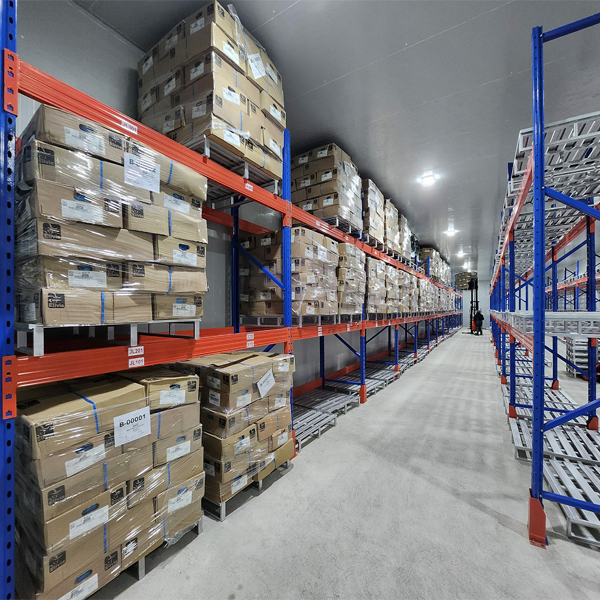
These records prove something narrow, and the boundary matters. They show that capacity allocation followed the function of each zone, with freezing, holding, processing and ice storage separated rather than combined. They do not show that a 75HP unit suits any room of 15 x 16 x 9.6 m, because the actual load came from product type, throughput, insulation, ambient and door openings that are specific to those plants. The reported outcomes, spoilage in the Peruvian avocado project falling from about 15 percent to below 4 percent and defects in the Egyptian line held below 2 percent, belong to those operations and their handling practice. They are not a property of the compressor brand alone.
Installation and Ambient Conditions That Decide Real Performance
A correctly rated unit installed badly performs like an undersized one. Six checks cover most of the gap between the catalog and the room.
- Condenser air path. Confirm the clearance on the coil face and above the fan, and check that hot discharge air cannot recirculate back into the coil. Two units placed fan to fan will fight each other.
- Ambient design value. Size the condenser for the hottest week of the year at the site, not the annual average. This is the single most common cause of a freezer room that holds temperature in winter and drifts in August.
- Supply frequency. Confirm the unit, motors and controller match the site's 50Hz or 60Hz supply before shipment, not after arrival.
- Refrigerant and charge. Charge by weight against the unit's data plate, and set superheat at the evaporator rather than adjusting the expansion valve by feel.
- Oil return and defrost. On low-temperature units, confirm the suction line layout, trap positions and defrost termination settings, since oil logging in the evaporator and incomplete defrost both show up as capacity loss weeks later.
- Commissioning record. Log suction and discharge pressures, superheat, subcooling, room pull-down over 24 hours, defrost cycles and alarm tests. That log is what a warranty discussion is built on.
If one of these checks fails, the fix belongs before the room is loaded, not after the first rejected shipment.
Send Your Room Data for a Matched Selection
The fastest route to a unit that holds temperature is to send the room data first and let the selection follow. Send the room dimensions, the product and its incoming temperature, the daily throughput, the target room temperature, the maximum summer ambient at the condenser position, the power supply voltage and frequency, and any refrigerant requirement from the destination market. With those fields, the reply can name a compressor model, a capacity at your design temperatures, a matched evaporator and a controller instead of a bare horsepower number.
Shanghai Meluck Refrigeration Equipment Co., Ltd builds these packages with original Bitzer compressors and supplies the cold room panels, air coolers, doors and ice equipment around them. Email meluck@meluckcooling.com or call and WhatsApp +8617369893087 with your room schedule. One boundary is worth keeping in view: the unit is selected against the data you provide, so incomplete room information produces a conservative estimate rather than a guaranteed match.
FAQ
Is a Bitzer condensing unit better than a Copeland scroll unit?
Neither is better in general, and the decision follows the duty. For small and medium chiller rooms where the compressor runs in a comfortable range and a replacement is easy to source, a sealed Copeland scroll unit is cheaper and simpler. For low-temperature rooms, remote sites and plants where a mechanical repair must be possible without replacing the compressor, the semi-hermetic Bitzer platform is the more practical choice. Compare service access and temperature range before comparing price.
How do I size a condensing unit for a freezer room?
Volume alone cannot size a unit. You need the product type, the temperature it enters at, the daily tonnage, the insulation specification, the door traffic and the maximum ambient at the condenser. Those inputs produce a load, and the load is then matched to a capacity quoted at your design evaporating and condensing temperatures. A supplier who offers a horsepower figure from room volume alone has skipped the calculation.
How can I confirm a unit really contains an original Bitzer compressor?
Ask for a photograph of the compressor nameplate and serial number, and confirm the compressor model matches the model on the quotation. Then verify the serial with the compressor manufacturer or an authorised distributor. A factory test record for the assembled unit supports the check but does not replace it. Keep the nameplate photograph with the project file, because it is the document that settles most warranty questions.
Can a Bitzer condensing unit reach -40°C?
It depends on the platform rather than the brand. Single-stage reciprocating units are limited at the cold end and are usually not the right choice below about -30°C evaporating. Two-stage semi-hermetic units reach around -50°C evaporating and are the standard answer for blast freezers and IQF lines. Screw compressor units cover the -25°C to -40°C band at large capacity. Confirm whether the figure refers to room air or evaporating temperature, since the two are not the same.
What maintenance does a Bitzer condensing unit need?
Clean the condenser coil on a schedule matched to the site's dust and insect load, check oil level through the sight glass, and verify superheat and subcooling at each service visit. Inspect electrical terminals for tightness, test the high and low pressure cutouts and the alarm, and confirm defrost termination still works. Keep filter driers, contactors, gaskets and a valve plate set on site, because those are the parts that turn a shutdown into an afternoon.
If you're interested, check out these related articles:
Cold Room for Green Coffee Export: Temp & Humidity Control
IQF Quick Freezer for Berries: Sizing Capacity for Your Line
Cold Room for Food Service: Compact Energy Efficient Options
With over 15 years of experience as a MELUCK refrigeration engineer, I specialize in the design of cold storage, chillers, ice makers, and cold chain energy-saving systems, providing technical support to distributors and engineering companies worldwide.

meluck