
Bitzer Condensing Units for Freezer Rooms: 4HP to 50HP
A Bitzer condensing unit for a freezer room is chosen from the duty at the design evaporating temperature, and the horsepower figure is the result of that decision rather than the starting point. Two units carrying the same 25HP label can hold a -18°C store of very different size once evaporating temperature, ambient, refrigerant and product load change. Getting the selection right means working through four questions in order: what temperature the room must hold, what the load actually is, which compressor series matches that duty, and only then what nominal horsepower the unit carries.
Why the Horsepower Number Cannot Size a Freezer Room
A horsepower rating is a motor rating. On a Bitzer condensing unit it describes the nominal drive power of the compressor at declared rating conditions. It tells you how much mechanical work the compressor is built to handle, not how many kilowatts of cooling the unit will deliver in your room, and not which temperature range the compressor is approved for.
The pressure ratio explains the gap. A freezer compressor working between -30°C evaporating and +45°C condensing pushes against a far larger pressure difference than the same compressor at -10°C evaporating. Mass flow through the cylinders falls, volumetric efficiency falls, and the cooling delivered per unit of shaft power falls with them. The motor stays the same size because the compressor must still be driven at its worst operating point, but the useful cooling at freezer temperatures can be a small fraction of the medium-temperature figure for the same model.
That is why a 25HP unit is not a specification. It is one number inside a specification that also contains evaporating temperature, condensing temperature, refrigerant, compressor model and the declared application range of the complete unit. Project records show the effect faster than a datasheet can.
| Project record | Conditions when it was built | What it legitimately shows | What it does not prove |
|---|---|---|---|
| Seafood plant, Manta, Ecuador: three blast rooms of 7 × 5 × 4 m at -35°C, one Bitzer 40HP system per room | Coastal hot climate, rapid freezing of freshly landed seafood | A 40HP low-temperature system can serve a compact -35°C blast room fitted with dedicated blast evaporators | That any 140 m³ room at -35°C needs 40HP; product intake and pull-down time set the duty |
| French fries plant, Cairo, Egypt: blast freezer of 7 × 9 × 4 m at -35°C on a Bitzer 125HP system | Continuous line feeding warm, freshly cut product | Throughput and product entering above 0°C can push blast duty far beyond what room volume suggests | That 125HP is the correct figure for a roughly 250 m³ blast room somewhere else |
| Same Ecuador plant: frozen store of 14 × 12 × 6 m at -18°C on a Bitzer 30HP system | Storage only, product already frozen on arrival | Storage duty per cubic metre is far lower than blast duty | That 30HP covers a -18°C room of that size receiving warm product |
| Avocado pre-cooling room, Peru: 17 × 12 × 3.1 m at +10°C on two Bitzer 20HP units | Field heat removal after harvest in a hot climate | A room held above 0°C can still need more installed power than a freezer store of similar size | That a chiller room always needs more power than a freezer room |
These are records of completed projects, not selection rules. Each row shows what a design team sized for a particular product, climate and throughput. None of it transfers to another room without recalculating the load.
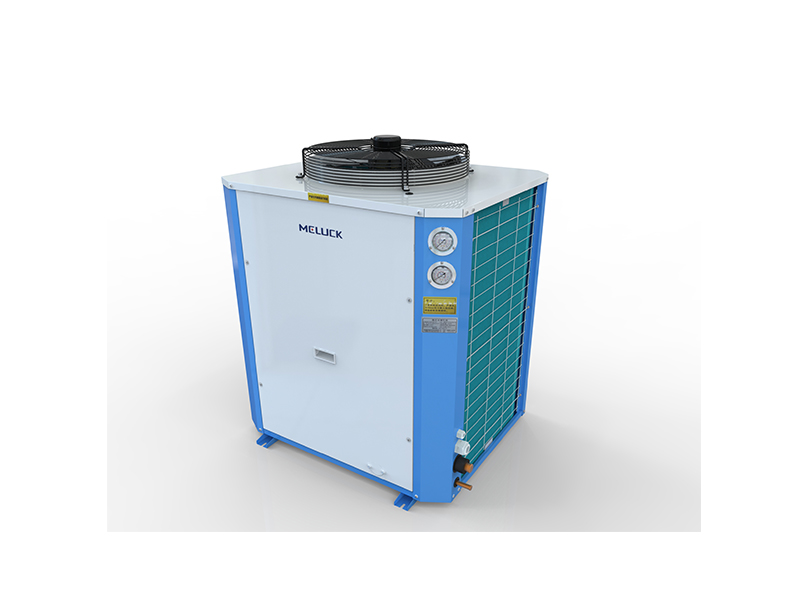
Temperature Band Comes Before Horsepower
The room temperature is a product decision: -18°C for general frozen goods, -25°C for ice cream and some seafood, -35°C for blast freezing, -45°C or lower for tuna and special processes. The compressor never sees the room temperature. It sees the evaporating temperature, which sits below the room temperature by the design temperature difference.
For freezer rooms that difference is commonly 8 to 10 K, so a -25°C room runs an evaporating temperature in the region of -33 to -35°C. The choice of difference is a real trade-off. A wider difference allows a smaller evaporator and faster pull-down, but it lowers suction pressure, raises power per kilowatt of cooling, dries the air around the product and lengthens defrost. A narrower difference needs a larger evaporator and more capital, and returns better humidity, lower running cost and shorter defrost cycles. There is no universal correct value; it follows from what the product can tolerate and what the owner pays for electricity.
| Room temperature | Typical design evaporating temperature | Compressor configuration | Where it fits |
|---|---|---|---|
| +2 to +10°C | -5 to 0°C | Single-stage medium-temperature | Produce, meat, dairy, chilled processing |
| -18°C | -25 to -28°C | Single-stage low-temperature | General frozen storage and distribution |
| -25°C | -32 to -35°C | Single-stage low-temperature, two-stage where the envelope demands it | Ice cream, some seafood, premium frozen products |
| -35°C | -40 to -45°C | Two-stage, or a large low-temperature single-stage with high displacement | Blast freezing and rapid pull-down |
| -45°C and below | -50°C or lower | Two-stage or screw | Tuna, specialised deep freeze, process freezing |
The evaporating temperatures above reflect common design practice. They must be confirmed against the selected compressor's published capacity data for the actual refrigerant, because the same model has different approved envelopes depending on what it is charged with.
From Room Load to Nominal Horsepower
A load calculation answers one question: how many kilowatts must be removed at the design evaporating temperature to hold the room, and to pull it down within the time the business needs.
- Fix the product and the holding temperature. This sets the evaporating temperature band.
- Calculate the transmission load through panels, floor and ceiling using the panel U-value, the surface area and the temperature difference across it.
- Add the product load. For freezing this includes sensible heat above freezing, the latent heat of fusion, and sensible heat below freezing. Product entering warm is usually the largest single item in a blast freezer.
- Add infiltration from door openings and air changes, internal loads from fans, lights, defrost heaters, people and trucks, and a pull-down allowance for the first chilling of a warm room.
- Read the compressor capacity table at the design evaporating and condensing temperatures for the chosen refrigerant, and select the model whose capacity covers the total with a sensible margin.
Condensing temperature belongs in step 5 because it moves with the weather. A unit rated at 40°C condensing loses capacity and gains power consumption at 48°C ambient, and in tropical or Middle Eastern sites the design condensing temperature can sit well above the European catalogue point. Correcting for that before comparing models avoids the common mistake of buying a unit that meets the load on paper and fails in August.
A condensing unit sized on a 32°C ambient catalogue point will not deliver the same capacity inside a 45°C plant room. <Selecting a Condensing Unit for Tropical Climates> covers how ambient temperature and condenser selection change the required compressor size.
| Nominal HP band | Bitzer compressor models we build freezer units around | Where the band usually fits |
|---|---|---|
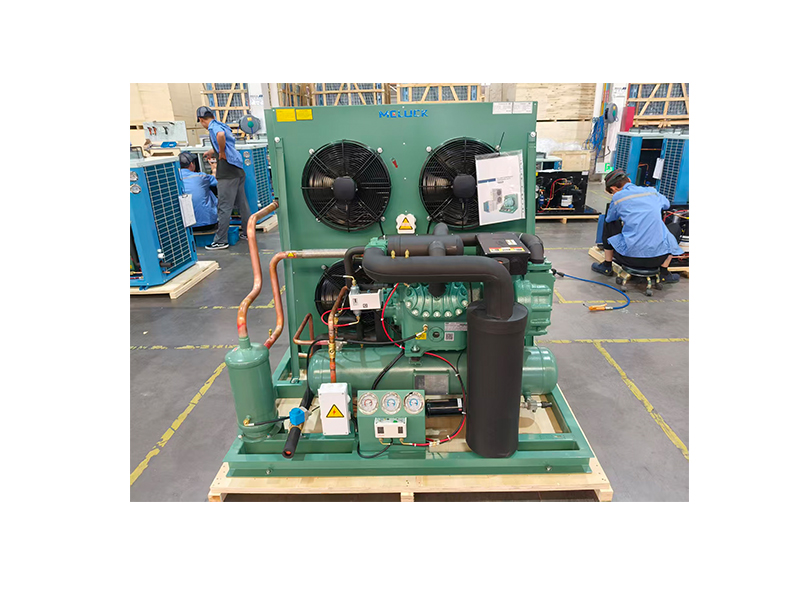
| 4HP to 7HP | 4EES-4Y, 4DES-5Y, 4DES-6Y, 4VES-7Y | Small walk-in freezers, reach-ins, small blast cabinets |
| 9HP to 12HP | 4VES-10Y, 4PE-12Y | Medium freezer rooms, small processing rooms |
| 15HP to 20HP | 4PE-15Y, 4HE-18Y, 4NE-20Y | Medium to large freezer stores |
| 23HP to 34HP | 4GE-23Y, 6GE-34Y | Large freezer stores and light blast duty |
| Two-stage 16HP to 20HP | Semi-hermetic two-stage units, evaporating to about -50°C | Blast freezing, IQF, deep freeze below -35°C |
| Screw and parallel racks from 25HP upward | CSH and HSN screw units, three and four compressor parallel racks | Large deep-freeze stores, multi-room plants, IQF lines |
One caution on reading that table. The same compressor model can appear in both a medium-temperature build and a freezer build, because the model code identifies the compressor while the unit's declared application range identifies the duty. The horsepower label never settles the question on its own; the model code and the declared range have to agree.
Bitzer 4HP to 7HP Units for Small Freezer Rooms
This band covers walk-in freezers behind shops and restaurants, small bakery freezer rooms, display storage and compact blast cabinets. The compressors are small enough that electrical supply, condenser position and noise usually matter as much as capacity.
Two practical constraints show up at this size. First, the reserve is thin: a 4HP or 5HP unit matched tightly to a well-insulated room has little left for a hot kitchen, a door left open during deliveries, or a product load that arrives warmer than planned. Second, defrost dominates the duty cycle in small rooms, because a short, frequent door-opening pattern brings in far more moisture per cubic metre than a large store does.
A storage room with steady duty can run on surprisingly little power. In our Ecuador seafood project, a 280 m³ ice storage room held at -10°C ran on a single Bitzer 7HP unit, because the room held already-frozen ice with low traffic and good insulation. That same 7HP unit would be badly undersized for a -25°C room of identical volume receiving warm product. Use the record as orientation, not as a rule.
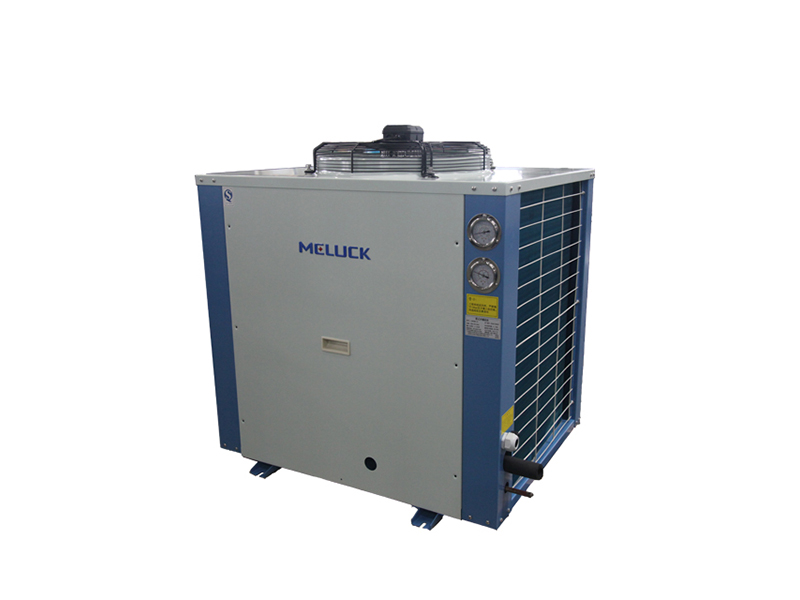
Bitzer 9HP to 15HP Units for Medium Freezer Rooms
This is where most commercial freezer rooms land. A 9HP 4VES-10Y, a 12HP 4PE-12Y or a 15HP 4PE-15Y covers storage rooms, small processing areas and regional distribution, and the selection questions shift from "will it hold the temperature" to "how does it behave at part load".
The main decision in this band is one larger unit against two smaller ones. Two 7HP units instead of one 15HP unit give redundancy, let you run one machine at low load in quiet periods, and reduce the starting current drawn at any moment. They also double the footprint, the piping, the controls and the number of electrical circuits, and they add another oil management point to maintain. When a room is loaded gradually through the day, the pair usually wins. When the room runs near full load continuously, the single unit is simpler and often cheaper to install.
This band is also where the two-stage option first becomes worth pricing. If the room runs at -35°C rather than -18°C, a two-stage 16HP unit can deliver duty that a single-stage unit of higher horsepower struggles to reach efficiently, because the two-stage machine splits the pressure ratio instead of fighting it.
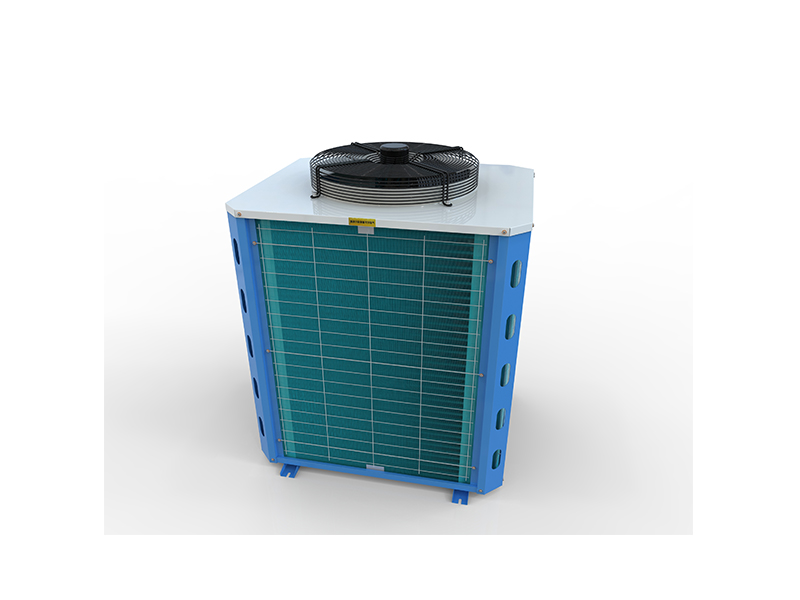
Bitzer 18HP to 34HP Units for Large Freezer Rooms
Large freezer stores and distribution centres need this band, and the engineering attention moves to air distribution, defrost water removal and serviceability. In the Ecuador plant, a 1,008 m³ frozen store at -18°C ran on a Bitzer 30HP system, a typical match for a storage-only room where product arrives already frozen and the duty is steady.
Once a room passes a few hundred cubic metres, a single evaporator stops being sufficient. Multiple air coolers on one condensing unit distribute air evenly and shorten defrost recovery, but they also require balanced refrigerant distribution, correctly sized suction headers and an oil return path that works at low load. The compressor may be right and the room still underperform because the evaporator circuit was an afterthought.
The 34HP 6GE-34Y sits at the top of the single-compressor freezer range in our catalogue. Above it, the decision changes shape rather than simply scaling up.
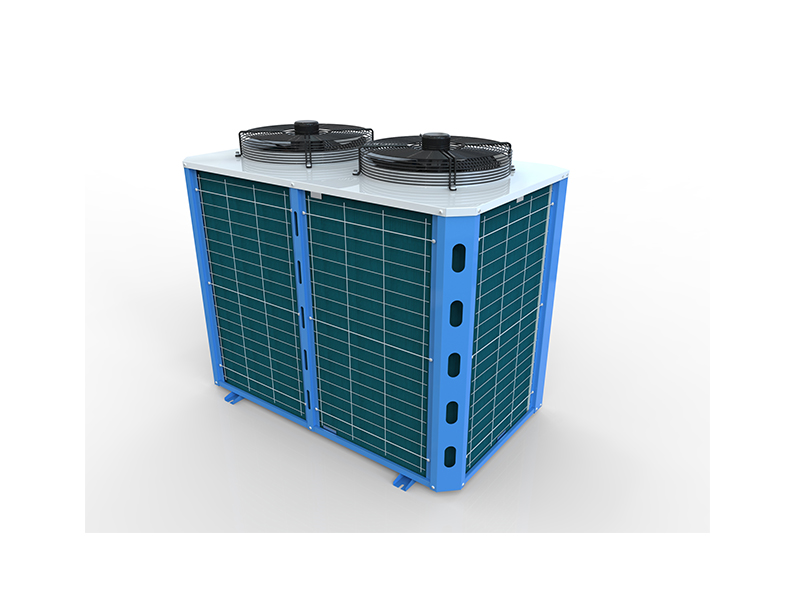
Two-Stage and Screw Units for Ultra-Low Temperature
Below about -30°C evaporating, a single-stage compressor works against a pressure ratio that pushes discharge temperature up, reduces volumetric efficiency and cuts the cooling returned per unit of power. Two-stage compression splits that ratio across two cylinders sets, with interstage cooling keeping discharge temperature inside safe limits. Semi-hermetic two-stage units reach evaporating temperatures around -50°C and are the standard choice for blast freezing, IQF lines and deep freeze rooms below -35°C.
At larger capacities the screw compressor takes over. CSH and HSN units handle high low-temperature loads with fewer moving parts, continuous capacity modulation and PLC control, and they can be tied into remote monitoring so that a plant manager sees a drifting suction pressure before product is lost.
Parallel racks are the third option, and often the practical one. Three or four Bitzer piston compressors piped in parallel give stepwise capacity control, built-in standby and easier service, because one compressor can be isolated while the room keeps running.
There is a trap in this part of the market. In our own range, the single-compressor freezer units stop at 34HP; the 30HP, 40HP and 50HP reciprocating condensing units are built for medium-temperature duty. A buyer who assumes the largest horsepower number must be the coldest option ends up with a chiller-rated machine in a freezer room, and no amount of extra horsepower fixes a compressor that is outside its approved envelope.
Deep freeze storage at -25°C to -40°C is where compressor architecture matters more than nominal power. <Bitzer Screw Compressor Condensing Units for Deep Freeze Storage> covers how screw units are specified for large low-temperature stores.
What Else Changes the Horsepower Decision
Ambient and condenser condition. The condenser rejects heat at a temperature above ambient, so a restricted plant room or a dirty coil raises condensing temperature exactly as a hot day does. Clearance around the unit is not a comfort detail; it is part of the capacity calculation.
Refrigerant. R404A carried most freezer rooms for two decades and has a high global warming potential, which places it inside the HFC phase-down agreed under the Kigali Amendment [1]. European rules tightened quotas and service restrictions further through the revised F-gas regulation [2]. R448A and R449A are common replacements, but they are not drop-in equivalents at every condition: capacity tables, oil, elastomers and expansion valve settings all have to be checked, and a unit approved on one refrigerant may not be approved on another.
Evaporator and defrost. A freezer room uses a different air cooler from a chiller room, and a blast freezer uses a different one again. Electric defrost suits many small and medium freezer rooms; hot gas defrost reduces energy use in larger systems but needs piping and control logic to support it.
Power supply. Voltage, phase and frequency decide which compressor builds are available and which motor protection is fitted. A 60Hz site cannot simply run a 50Hz unit at the same capacity figure.
Controls and redundancy. A temperature alarm protects product; a remote monitoring link protects the business. On a critical room, the cheapest horsepower decision is often the one that includes a standby compressor or a split system.
| What to send | Why it changes the selection |
|---|---|
| Room temperature and the product going in | Sets the evaporating temperature band and the compressor series |
| Daily throughput and product entry temperature | Drives product load and pull-down; warm product entry can raise the duty substantially |
| Room dimensions, panel type and thickness, door traffic | Drives transmission and infiltration load |
| Design condensing temperature or local summer ambient | A condensing temperature 10 K higher cuts capacity and raises power draw |
| Refrigerant, voltage, phase and frequency | Determines the approved compressor build, the correct capacity table and motor protection |
| Evaporator type, defrost method and control preference | Changes the matched system, defrost energy and part-load behaviour |
A vague request produces a vague quote. Reject this one: "Price for one 25HP Bitzer freezer unit." Replace it with a filled template: freezer room [length × width × height] holding [temperature], [panel type and thickness], product [type and daily tonnage] entering at [temperature], [door openings per day], summer ambient [temperature], [voltage, phase, frequency], refrigerant [type], [defrost method]. With those fields, capacity can be read from the table at the right point instead of guessed from a label.
Send Your Room Data for a Matched Selection
A freezer room selection is only as good as the data behind it. Send the room temperature, the product and daily throughput, the room dimensions and panel build, the summer ambient, the refrigerant and the electrical supply, and the unit can be matched to the duty rather than picked from a horsepower label. Our engineers will confirm the evaporating and condensing points, read the Bitzer capacity data at those points and return a model with a capacity figure for your conditions.
Shanghai Meluck Refrigeration Equipment Co., Ltd
Email: meluck@meluckcooling.com
Phone and WhatsApp: +86 173 6989 3087
FAQ
Is a bigger Bitzer unit always better for a freezer room?
No. Oversizing causes short cycling, wider temperature swings, poorer humidity control in the room and longer defrost cycles, while the compressor runs inefficiently at part load. It also raises starting current and refrigerant charge. Match the capacity to the calculated duty with a sensible margin, and when part-load behaviour matters, prefer a parallel rack or two smaller units over one oversized machine.
Can a 30HP or 50HP unit be used in a -25°C freezer room?
The horsepower number does not decide the temperature range. The compressor model and the declared application range of the complete unit do. A machine built around a medium-temperature compressor will exceed its approved envelope at freezer evaporating temperatures, and its capacity there is far below what the label suggests. Ask for the capacity table at your own evaporating and condensing points, and confirm which refrigerants the unit is approved for.
How do I size a Bitzer condensing unit for a -18°C freezer room?
Calculate the total load from transmission, product, infiltration, internal gains and pull-down. Fix the evaporating temperature roughly 8 to 10 K below room temperature, fix the condensing temperature from the local summer ambient, and read the compressor capacity table at those two points for your refrigerant. Choose the model that covers the load, then confirm evaporator match, defrost method and power supply.
When is a two-stage unit worth the extra cost?
Two-stage compression earns its cost when the pressure ratio of a single stage pushes discharge temperature and efficiency loss beyond what the application tolerates, which usually starts around -35°C evaporating. At -40 to -50°C it is often the only practical reciprocating option. Below -30°C evaporating, compare both configurations on their published capacity tables before deciding, because the crossover point moves with load and refrigerant.
References
[1] Kigali Amendment to the Montreal Protocol on Substances that Deplete the Ozone Layer, United Nations, 2016.
[2] Regulation (EU) 2024/573 of the European Parliament and of the Council on fluorinated greenhouse gases, Official Journal of the European Union, 2024.
If you're interested, check out these related articles:
Cold Storage for Nuts & Dried Fruits: Prevent Rancidity & Mold
Cold Room Equipment Warranties: A Buyer’s Guide to Guarantees
Cold Room for Bakery Distribution: Chiller and Freezer Zones
Seafood Supermarket Cold Room: Design and Equipment Guide
With over 15 years of experience as a MELUCK refrigeration engineer, I specialize in the design of cold storage, chillers, ice makers, and cold chain energy-saving systems, providing technical support to distributors and engineering companies worldwide.

meluck