
Bitzer 2-Stage Condensing Unit for Blast Freezers: When It Pays
A Bitzer 2-stage condensing unit earns its cost on a blast freezer only when the duty point falls outside what a single-stage compressor can hold comfortably through the year: a low evaporating temperature, a high condensing pressure from a hot plant room, or both at once. Plenty of blast freezers running at -35°C are still built with single-stage Bitzer reciprocating units and freeze product properly. The choice turns on the evaporating temperature and the pressure ratio the compressor must survive on the hottest day, not the number printed on the room thermostat. Everything else follows from that duty point.
What two-stage compression changes in a blast freezer
A single-stage compressor lifts refrigerant from evaporating pressure to condensing pressure in one sweep. As the evaporating temperature drops, that sweep has to cover a wider ratio between two absolute pressures, and the gas leaving the discharge valve gets hotter. A two-stage unit splits the lift. The first stage discharges into an intermediate pressure, where the gas is cooled, and the second stage finishes the compression to condensing pressure.
The gains follow from that reduced lift per stage. Discharge temperature stays in a range the oil can tolerate, volumetric efficiency holds up at low evaporating temperatures, and the compressor can be applied where a single-stage model would sit outside its published envelope. During pull-down of warm product, when suction pressure is at its highest, interstage cooling keeps discharge temperature away from the region where oil degrades and valves carbonise.
What two-stage does not do is create capacity. On a room held at -18°C to -25°C for storage, the added cost buys almost nothing. It also does not compensate for an undersized evaporator, a condenser starved of airflow, or a door that stands open for twenty minutes every shift.
Where the single-stage envelope ends
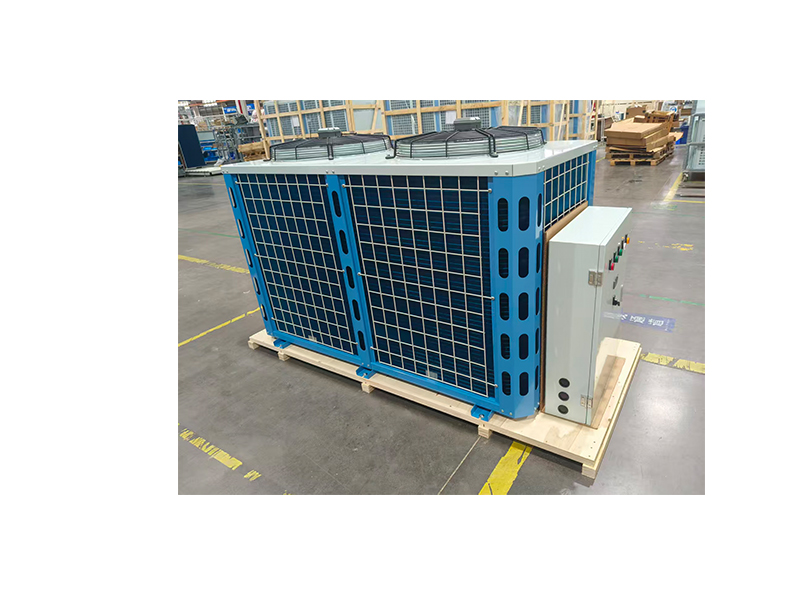
The cut-off is not a universal temperature. Every Bitzer compressor model carries a published application envelope, and the honest check is to plot the real duty point on it: the lowest evaporating temperature the room will see against the highest condensing temperature the plant will see, with the refrigerant that will actually be charged, keeping discharge temperature and oil behaviour inside the limit.
Project records show how much a single-stage unit can carry in a hot climate. In Manta, Ecuador, the blast freezing section of a seafood plant uses three rooms at -35°C, each served by a Bitzer 40HP compressor and a dedicated blast freezing air cooler. A french fries factory in Cairo runs a single -35°C blast freezer on a 125HP Bitzer system alongside its frozen storage. Both sites sit in high-ambient locations and both freeze at -35°C.
The boundary moves when the product demands a colder room. Holding a room at -40°C or below pushes the evaporating temperature towards -45°C, the ratio per stage grows, and the single-stage options narrow to large displacement machines working near their limits. That is the point where a two-stage unit becomes the engineering answer rather than a preference.
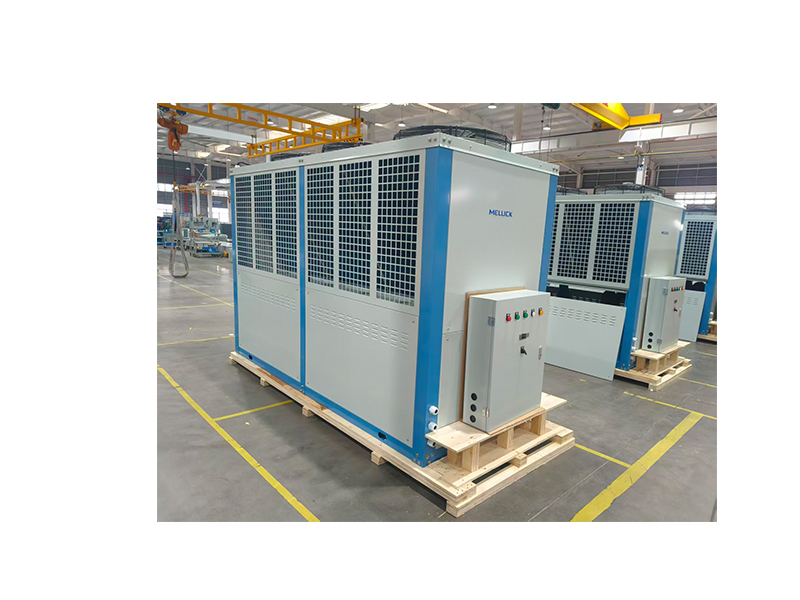
Storage is a separate question. A freezer room holding finished goods between -18°C and -25°C runs at a modest ratio and does not need a second stage, which is why so many distribution warehouses are built around single-stage reciprocating condensing units.
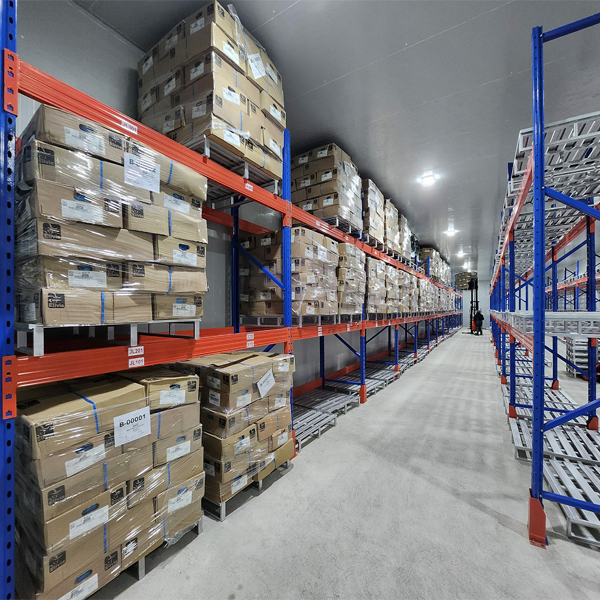
Blast freezer duty points that justify a two-stage Bitzer unit
Ultra-low freezing below -45°C
Seafood for raw consumption and premium tuna work is where two-stage units are specified most often. The MELUCK range pairs Bitzer two-stage semi-hermetic compressors in 16HP and 20HP condensing units, applied down to -50°C evaporating temperature, which covers rooms held around -45°C and the colder end of tuna processing. A room held at -60°C needs an evaporating temperature well below -50°C, so that duty is normally built as a cascade system instead.
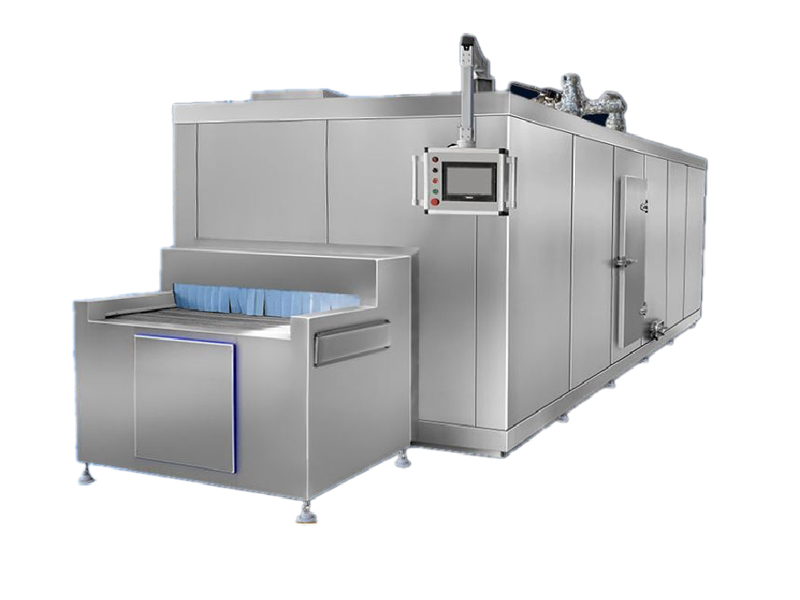
Tuna loining rooms combine a very low room temperature with a working environment that has to stay hygienic through long shifts. <Cold Room for Tuna Loining and Processing at -60°C Deep Freeze> covers the equipment side of a -60°C tuna loining room.
Low evaporating temperature with high ambient
A condenser working in 42°C to 48°C summer air raises condensing pressure at exactly the moment the evaporator runs at its lowest pressure. The two effects multiply the pressure ratio and the discharge temperature together, and the compressor feels both. Two-stage compression reduces the lift each stage handles, but it does not excuse a condenser that is too small or a plant room with no airflow. Correct the heat rejection first, then decide whether the compressor still needs a second stage.
Ambient design temperature is one of the first inputs in any condensing unit selection, and it moves the required capacity more than most buyers expect. <Selecting a Condensing Unit for Tropical Climates> covers condensing unit selection for hot-climate sites.
Repeated warm loading and heavy throughput
A blast freezer that takes a warm batch every two hours spends much of its day pulling down rather than holding. Each pull-down lifts suction pressure, and the compressor has to move a large mass flow while the room is still warm. A two-stage unit handles that cycle with lower discharge temperature, and its step control keeps one stage working efficiently when the load falls away at the end of the cycle.
What two-stage compression costs you
The second stage is a second machine, and it appears in the quotation: a higher compressor price, an interstage receiver or flash intercooler, more piping, an extra control layer, and a larger footprint in the plant room. It also raises the maintenance bar. Interstage pressure, oil level, and superheat settings have to be understood by whoever services the plant, and a two-stage unit commissioned without that knowledge tends to lose its efficiency advantage within a season.
Compare the alternatives honestly before committing. A larger single-stage compressor with liquid injection may cover a marginal case at lower capital cost. Running the room at -40°C instead of -45°C may keep the duty inside the single-stage envelope, if the product tolerates it. At large capacities, screw compressors become competitive on footprint and part-load behaviour.
Beyond a certain capacity, the choice stops being about stages and starts being about compressor type. <Bitzer Screw Compressor Condensing Units for Deep Freeze Storage> covers screw compressor condensing units for deep freeze storage.
Specifying a two-stage unit for an RFQ
Weak enquiries describe the room and leave the machine to the supplier, which is how two projects with identical room dimensions end up with different capacities. Put the duty point, the refrigerant, and the ambient on the enquiry, and ask for the model's application envelope at that duty.
| RFQ field | What to request | Why it matters |
|---|---|---|
| Duty point | Capacity in kW at stated evaporating and condensing temperatures, not at room temperature | A quote sized on room temperature alone falls short once summer ambient arrives |
| Refrigerant | R404A, R448A, R449A, R507A or another refrigerant, named before selection | Capacity tables and interstage pressures change with the refrigerant, and mixed data misstates capacity |
| Ambient and condenser | Maximum summer ambient at the condenser position, plant room ventilation, condenser model | Undersized heat rejection raises condensing pressure until the high pressure switch trips in the hottest week |
| Compressor model | Exact Bitzer model number with its published envelope for the duty point | Two models with the same nominal horsepower have different approved limits |
| Interstage and controls | Interstage receiver or flash intercooler scheme, controller model, discharge temperature and oil pressure protection | Weak interstage cooling surfaces later as high discharge temperature and oil breakdown |
| Documentation | Selection sheet, wiring diagram, test record, refrigerant charge, commissioning report | Without records, both warranty claims and fault finding stall |
A weak enquiry line and a usable one look like this.
Reject: "One Bitzer two-stage condensing unit required for a -40°C blast freezer, please quote."
Replace with: "Bitzer two-stage condensing unit, R449A, 96 kW at -45°C evaporating and +45°C condensing, ambient design 46°C, interstage receiver with flash gas handling, discharge temperature protection, selection sheet and envelope chart required with the quotation."
The second version can be checked against a selection sheet before anyone signs.
Commissioning checks that decide whether the unit delivers
- Pressure test the complete circuit, including the interstage section, and record holding time and result.
- Evacuate to the specified vacuum and charge by weighed amount, noting the charge on the unit label.
- Set evaporator superheat for the low-temperature range and confirm it during pull-down and again under steady load.
- Check oil level in the sight glass during pull-down and under load, and confirm oil return from the evaporator.
- Run a full pull-down from ambient with the room empty, then a loaded test with warm product.
- Repeat the loaded test at the hottest part of the day, or at the design ambient, and confirm condensing pressure stays inside the envelope.
- Verify every protection device: high discharge temperature, oil pressure, high pressure, phase sequence, and the alarm path to whoever is on call.
- Hand over the commissioning report and train operators on what normal discharge temperature and oil level look like.
Steps 5 and 6 are the ones commonly skipped when a project is behind schedule, and they are the only points where the unit proves it can do the job in that plant rather than on paper.
What project records can and cannot prove
| Record | Method context | Responsible use | Do not infer |
|---|---|---|---|
| Three -35°C blast rooms in Manta, Ecuador, each on a Bitzer 40HP compressor | Company project record, coastal high humidity, single-stage equipment | Shows single-stage units covering -35°C blast duty in a hot, humid climate | Do not infer that -35°C duty never needs a second stage, or that the same horsepower reaches -45°C evaporation |
| -35°C blast freezer on a 125HP Bitzer system, Cairo, Egypt | Company project record, hot climate, 24/7 french fries line | Shows how ambient and throughput drive capacity on a single-stage blast freezer | Do not infer that adding horsepower substitutes for a second stage at lower evaporating temperature |
| Bitzer two-stage 16HP and 20HP condensing units applied down to -50°C evaporation | Company product data | Indicates the range where two-stage equipment is offered for blast freezing and IQF duty | Do not infer a capacity at a specific duty point without the selection sheet for that model |
| Packaging area held at 5°C to 10°C inside the same Cairo line | Company project record, multi-zone plant | Shows that zone design, not only compressor choice, protects product quality | Do not infer that compressor architecture alone produced the reported quality result |
These records describe specific plants built by our own teams. They support statements about what is achievable in comparable conditions, not a rule that one compressor suits every blast freezer of the same size.
Tell us the duty point before the model is fixed
Send the room temperature, the product and batch weight, the required freezing time, the refrigerant you intend to charge, the maximum ambient at the condenser position, the power supply, and the site country. With those fields the compressor stage, model, and condenser can be checked against the envelope in one pass instead of three.
MELUCK supplies Bitzer two-stage semi-hermetic condensing units in 16HP and 20HP, together with the air coolers, panels, and doors that complete the room. Email meluck@meluckcooling.com or call +8617369893087 with the duty point and we will return a selection for the blast freezer.
FAQ
Can a two-stage unit be used for a -18°C freezer room?
It can run, but it is a poor use of money. A storage room at -18°C to -25°C sits at a modest pressure ratio that single-stage reciprocating units handle comfortably, so the second stage adds capital, controls, and service complexity without a matching gain. Two-stage equipment belongs where the evaporating temperature has to go well below the range a single-stage model is approved for.
What is the difference between a two-stage unit and a booster system?
A two-stage condensing unit houses both compression stages in one package, sharing a frame and control panel, with an intermediate pressure between them. A booster system splits the duty between separate low-stage and high-stage machines, which is common in large industrial plants where the two stages sit in different locations. Both reduce the lift per stage, but piping, controls, and service access differ.
How low can a Bitzer two-stage condensing unit go?
Our 16HP and 20HP two-stage semi-hermetic condensing units are applied down to -50°C evaporating temperature. The real limit for a given project depends on the refrigerant and on the condensing temperature the site will see in summer, so the selection sheet for the exact model decides it. Rooms held at -60°C fall outside that range and are normally built as cascade systems.
Which refrigerant should I specify for a deep blast freezer?
Name the refrigerant on the enquiry rather than leaving it to the supplier. R404A remains in service in many plants, alternatives with a lower global warming potential such as R448A and R449A are increasingly specified, and R507A still appears in low-temperature work. Each behaves differently at the interstage, and the selection must be made for the refrigerant actually charged rather than a substitute.
If you're interested, check out these related articles:
Garlic Cold Storage Room: Humidity and Temperature Control
Remote Control Condensing Units: Smarter Cold Room Management
With over 15 years of experience as a MELUCK refrigeration engineer, I specialize in the design of cold storage, chillers, ice makers, and cold chain energy-saving systems, providing technical support to distributors and engineering companies worldwide.

meluck