
Air Cooler for Freezer Room: DD Series High-Delta-T Evaporator Selection Guide
Selecting the right air cooler is one of the most practical decisions in a freezer room project. In low-temperature storage, the evaporator does more than cool air; it controls frost formation, air distribution, and the run time of the compressor. For most freezer rooms operating between -18°C and -25°C, a DD series high-delta-T evaporator is the standard starting point because it is designed for frozen storage, not for fresh produce, dairy, or meat chilling [1].
If you are working on a freezer room specification now, send the room dimensions, product type, and target storage temperature to meluck@meluckcooling.com for a preliminary selection review.
What a DD Series High-Delta-T Air Cooler Does
In refrigeration terminology, delta T refers to the temperature difference between the refrigerant evaporation temperature and the room air temperature. A freezer room needs a different delta T than a chiller room. Chiller rooms often use a smaller delta T because they hold moist products near 0°C to +8°C. Freezer rooms require a larger delta T, typically 7 K to 10 K, because the objective is rapid heat removal while maintaining frozen storage conditions.
A DD series unit cooler is built around that larger temperature difference. Its coil circuiting, fin spacing, and fan selection are configured for low air temperature, frost build-up, and long defrost cycles. The housing is usually designed for ceiling mounting, with internal condensate drainage and heating elements for defrosting.
The DL, DD, and DJ naming convention is a practical way to separate evaporator families. DL units suit chiller rooms, DD units suit freezer rooms, and DJ units suit blast freezers or rooms running below -30°C. Choosing a DL unit cooler for a freezer room is a common error because the coil does not have the right fin spacing or defrost arrangement for frozen storage.

Selection Parameters for Freezer Room Air Coolers
To select a DD series air cooler, you need more than room volume. The basic heat load formula remains Q = U × A × TD, where U is the overall heat transfer coefficient, A is the coil surface area, and TD is the design temperature difference [2]. However, the actual selection also depends on product load, door openings, lighting, fan motors, and infiltration.
| Parameter | What to confirm for a freezer room |
|---|---|
| Room internal dimensions | Length, width, and ceiling height, not only floor area |
| Storage temperature | Usually -18°C, -20°C, or -25°C |
| Design delta T | Typically 7 K to 10 K for DD series selections |
| Product entry temperature | Frozen entry or ambient entry during pull-down |
| Daily throughput | Product mass entering per day and required pulldown time |
| Fin spacing | Wide spacing for frost tolerance, generally 6 to 8 mm in freezer rooms |
| Defrost method | Electric or hot gas, with drain line heating for cold environments |
| Air throw | Distance from coil to far wall, with enough throw to avoid dead zones |
A freezer room that stores already-frozen products uses a smaller refrigeration load than one that pulls down warm products every day. If the room receives pallets of product at -5°C for storage at -20°C, the load is modest. If the same room receives pallets at +5°C, the load increases sharply and the evaporator capacity must be corrected for the increased heat removal rate.
For a detailed selection, send the room dimensions, product type, daily throughput, and target temperature to meluck@meluckcooling.com. A calculated load avoids both the cost of an oversized unit and the temperature instability of an undersized one.
Matching the DD Air Cooler to the Condensing Unit
An air cooler never works alone. Its capacity changes with the evaporating temperature, which is set by the condensing unit and compressor. A DD unit cooler rated at a -25°C evaporating temperature will deliver different capacity at a -30°C evaporating temperature. On the condensing unit side, the compressor must match the same design condition.
For freezer rooms, the practical sequence is to first establish the required evaporation temperature, then select the air cooler at that condition, and then select the condensing unit that delivers the required cooling capacity under the site ambient temperature. A mismatch in either direction creates problems. If the condensing unit is too small, the room cannot reach setpoint. If the air cooler is too small, the compressor may short-cycle or operate with a larger delta T than intended.
The product library at MELUCK includes Bitzer reciprocating condensing units from 3 HP up to 50 HP and specialized freezer condensing units for low-temperature operation. The DD series air cooler is normally paired with a low-temperature condensing unit, not a medium-temperature chiller unit.
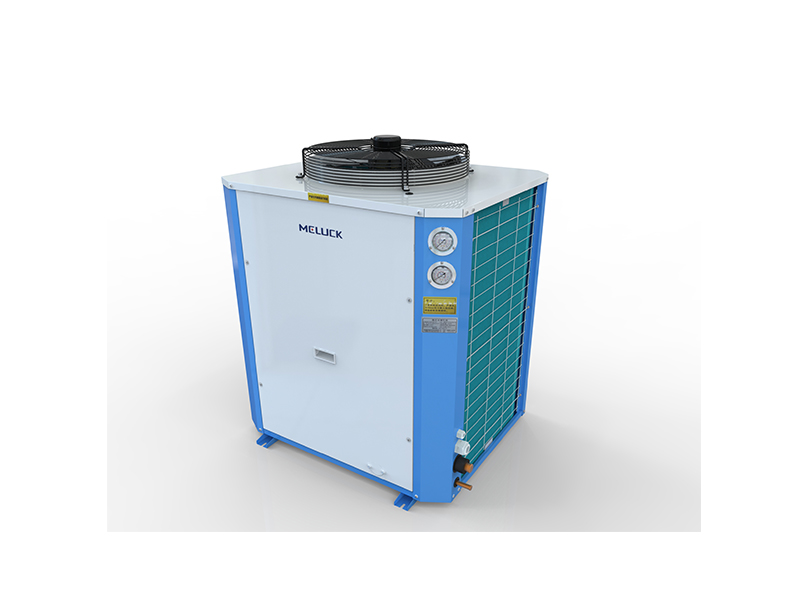
Freezer rooms that combine deep-freeze storage with high-delta-T evaporators need a matched compressor during summer pull-down conditions. <Bitzer 2-Stage Compressor for Ultra-Low Temp Cold Rooms> covers compressor specifications for ultra-low-temperature cold rooms.
Airflow, Placement, and Defrost Management
Airflow is the part of freezer room design that gets underestimated. A DD series air cooler can be sized correctly and still perform poorly if the air pattern is wrong. The unit should be positioned so that cold air travels across the product zone and returns to the coil without short-circuiting near the ceiling or along the walls.
Leave enough clearance between the evaporator and the ceiling, usually the distance specified in the installation drawing. Leave enough distance between the air outlet and the far wall so that the air throw covers the room length. Do not place tall racks directly under the air inlet, because that blocks return air and creates uneven temperature bands.
Defrost management matters as much as the coil itself. Freezer room evaporators accumulate frost, and the defrost system must remove it without allowing the room temperature to swing too far. Electric defrost is common for smaller rooms. Hot gas defrost is more efficient for larger industrial rooms, but it requires additional control and piping. In both cases, the drain line must be heated and routed correctly so that melted frost cannot refreeze before leaving the room.
Air movement should be checked as carefully as temperature. <Onion Cold Storage Ventilation: Preventing Spoilage> covers ventilation design for storage rooms where uneven airflow causes product loss.
Energy Efficiency and Operating Cost
A larger delta T reduces the required coil surface area, but it lowers the evaporating temperature and increases compressor power. A smaller delta T reduces compressor energy but requires more coil surface and more fan power. For a freezer room, the practical operating point is not the cheapest coil or the largest coil; it is the combination that keeps the room stable with the lowest total electricity cost per year.
Fan motors run continuously in many freezer rooms, so their power consumption adds up. A DD series unit cooler with efficient fan motors and a well-balanced coil can reduce the total operating cost even if the first cost is slightly higher. Defrost energy is another factor. A coil with wide fin spacing may need fewer defrost cycles because frost builds more slowly.
When comparing air coolers, ask for the capacity at the same evaporating temperature, the same room air temperature, and the same refrigerant. Comparing two coils at different rating conditions gives misleading results. The selection should also include the fan motor power, because an air cooler with many small fans can consume more energy than expected over a 10-year operating period.
Common Freezer Room Air Cooler Mistakes
The most frequent mistake is choosing a chiller room coil for a freezer room because it looks similar. The second most frequent mistake is selecting a unit based on floor area alone, without checking height, product load, and door openings. The third mistake is placing the air cooler too close to a door, where outside air enters and freezes as frost on the coil.
Other mistakes include undersizing the defrost heater, ignoring drain line heating, and selecting a condensing unit without confirming the actual ambient temperature at the site. In hot climates, a condensing unit that performs well at 35°C may not perform well at 45°C, which directly changes the evaporator capacity and room performance.
For smaller freezer rooms, a compact DD unit can still deliver stable temperature if the coil is matched to the room. For larger freezer rooms with frequent door traffic, a more powerful unit with wide fin spacing and hot gas defrost may be the better choice despite the higher initial cost.
The DD series selection changes for small walk-in freezer rooms compared with larger process rooms. <Cold Room for Butcher Shops: Chiller and Freezer Specs> covers freezer and chiller specifications for compact commercial applications.
Get a DD Series Freezer Room Air Cooler Recommendation
Selecting a freezer room air cooler is not about picking the biggest model. It is about matching capacity, airflow, fin spacing, defrost, and condensing unit behavior to the actual storage conditions. A short technical review before ordering can prevent expensive field modifications after installation.
Email meluck@meluckcooling.com or call +8617369893087 with your freezer room dimensions, storage temperature, product load, and site ambient temperature. MELUCK engineers can confirm the DD series model, fin spacing, defrost method, and condensing unit match before you place an order.
Frequently Asked Questions
What is the difference between DL, DD, and DJ air coolers?
DL series units are designed for chiller rooms, DD series units for freezer rooms, and DJ series units for blast freezers or low-temperature rooms below -30°C. The main differences are coil circuiting, fin spacing, housing airflow, and defrost design.
How do I know which DD series air cooler capacity I need?
You need the room dimensions, storage temperature, product entry temperature, daily throughput, and design ambient temperature. The selection is based on the calculated refrigeration load at the required evaporating temperature, not on floor area alone [2].
What delta T should I use for a freezer room air cooler?
Most freezer room selections use a delta T of 7 K to 10 K between the room air and the evaporating refrigerant. The exact value depends on product moisture, desired temperature stability, and the refrigeration system design.
Can I use a DL air cooler in a freezer room?
No. A DL air cooler does not have the correct fin spacing, coil circuiting, or defrost arrangement for frozen storage. It will frost quickly and may not maintain the target temperature during real operating conditions.
How often should a DD series air cooler be defrosted?
The defrost schedule depends on door openings, product moisture, and room temperature. Electric defrost units often defrost two to four times per day, while hot gas defrost can be scheduled based on coil frost sensors or differential pressure across the coil.
References
[1] EN 328:2014, Air coolers for refrigeration. Test methods. European Committee for Standardization.
[2] ASHRAE Handbook, Refrigeration. American Society of Heating, Refrigerating and Air-Conditioning Engineers, 2022.
[3] ISO 5149-1:2014, Refrigerating systems and heat pumps. Safety and environmental requirements. Part 1: Definitions, classification and selection criteria. International Organization for Standardization.
If you're interested, check out these related articles:
Cold Storage Projects in Ghana for Food and Agriculture
Shrimp and Fish Cold Storage Solutions in Bangladesh
Cold Room for Butcher Shops: Chiller and Freezer Specs
Indonesia Seafood Cold Storage: Reliable Cold Room Design
Cold Room Project Kenya: High Ambient Equipment Selection
With over 15 years of experience as a MELUCK refrigeration engineer, I specialize in the design of cold storage, chillers, ice makers, and cold chain energy-saving systems, providing technical support to distributors and engineering companies worldwide.

meluck