
Insulation Panel Requirements for Blast Freezer Rooms at -40°C
Cold room panels for a blast freezer at -40°C are not a thicker version of a -18°C freezer wall. The temperature difference across the envelope roughly doubles, the vapour pressure difference across it rises by more than two orders of magnitude, and the room is asked to swing from deep freeze to defrost heat several times a day. Thickness matters, but thickness alone will not hold the room. Joint design, the vapour seal, the floor build-up and the way the evaporator is hung decide whether the room still pulls down in year three.
Why -40°C Breaks Assumptions Borrowed From Freezer Room Panels
A -18°C storage room in a 35°C plant works across a 53 K difference. A -40°C blast freezer in the same plant works across 75 K. For the same insulation build, that is about 42% more heat flow through every square metre of wall, and it lands in a room whose refrigeration capacity was sized around a large product load rather than around envelope losses.
The panel itself is a declared industrial product, and the declaration route runs through EN 14509 [1], which covers factory-made double-skin metal-faced panels and the data that has to accompany them. That matters here because a blast freezer needs a comparable datasheet, not a description.
The larger change is not the extra watts. It is what cycling does to the assembly. A blast freezer runs a freeze cycle, then a defrost that pushes hot gas through the coil, then a pull-down again. Skins and foam move at different rates, sealant at every joint is worked in tension and compression, and the vapour seal is asked to stay continuous through thousands of those cycles. An envelope that is airtight at commissioning can be a different envelope after two seasons.
Project records show how much refrigeration sits behind that envelope. Three -35°C blast rooms in Manta, Ecuador, each 7 m × 5 m × 4 m, run on 40HP systems; a french-fries plant in Cairo runs a 7 m × 9 m × 4 m room at -35°C on a 125 HP system, with packaging at 5°C to 10°C and finished storage at -20°C. In both plants the blast room is small relative to the site and carries a disproportionate share of connected power, which is why an insulation defect there costs more per square metre than anywhere else on the site.
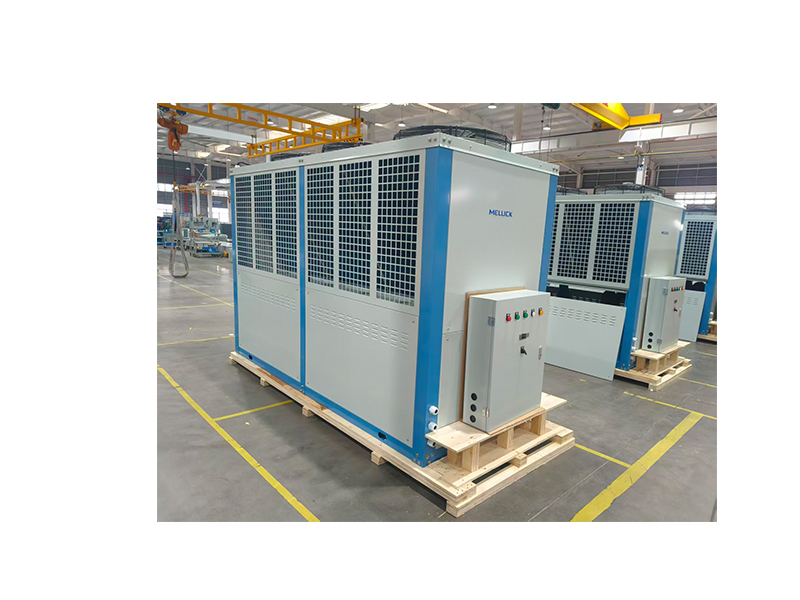
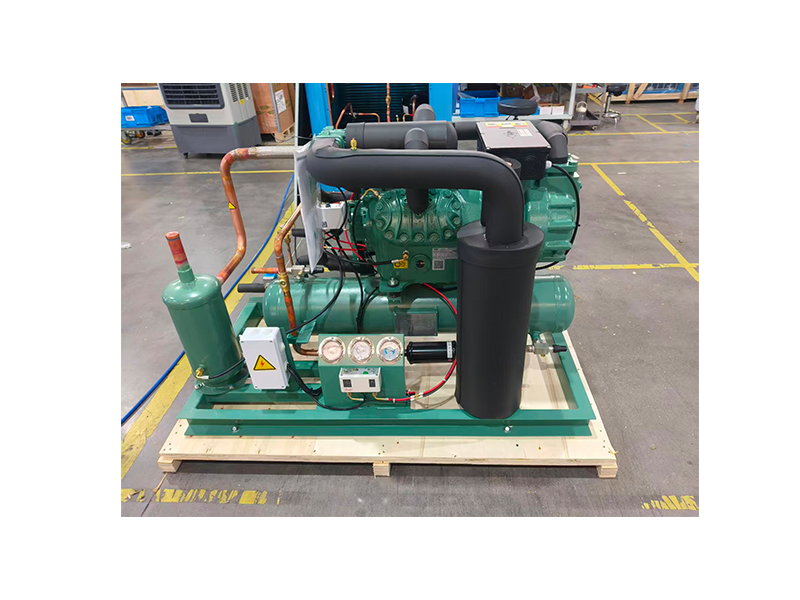
Room temperature is also not the refrigeration temperature. A room held at -40°C needs an evaporating temperature well below it to pull down after a defrost, which pushes a semi-hermetic reciprocating machine into two-stage territory, and two-stage units in the range are rated to evaporation temperatures around -50°C. Panel design and machine selection therefore have to be settled together rather than in sequence.
Blast freezing duty is set by product, load depth and cycle time, and no panel specification rescues a room whose freezing cycle was never defined. <Seafood Export Blast Freezer: IQF Standards and Rapid Freeze> covers how IQF standards and rapid freeze requirements shape room and equipment configuration.
Treat the blast freezer as a process vessel rather than a storage room and the order of questions changes: duty cycle first, envelope second, equipment third.
Sizing Panel Thickness From the Temperature Difference
The calculation is simple; the input is not. Thermal transmittance is declared conductivity divided by core thickness, U = λ / d, and steady-state heat flow through an area is Q = U × A × ΔT. Declared conductivity for a PU or PIR foam product comes from EN 13165 [2] and is quoted at a mean temperature, commonly around 10°C. A wall with a -40°C cold face does not sit at that mean, so the declared figure is a starting point rather than a prediction.
Using a declared λ_D of 0.023 W/(m·K) and a 200 m² wall at ΔT 75 K, the arithmetic shows both why thickness matters and where it stops paying:
| Nominal core | U value | Heat flow, 200 m² at ΔT 75 K |
|---|---|---|
| 100 mm | 0.23 W/(m²·K) | 3450 W |
| 120 mm | 0.19 W/(m²·K) | 2880 W |
| 150 mm | 0.15 W/(m²·K) | 2295 W |
| 180 mm | 0.13 W/(m²·K) | 1920 W |
| 200 mm | 0.12 W/(m²·K) | 1725 W |
| 250 mm | 0.09 W/(m²·K) | 1380 W |
Moving from 100 mm to 150 mm removes roughly 1150 W of continuous load. Moving from 200 mm to 250 mm removes roughly 345 W, adds 50 mm to every wall, and adds weight to the structure. That is the point where detailing starts to matter more than thickness: one unsealed cable penetration or one hanger bracket without a thermal break can return the saving. Thicker panels pay while the envelope is weak and stop paying once it is sound.
Two rules follow. Ask for the declared λ_D and the mean temperature it was declared at, and treat a brochure figure without a reference temperature as unusable. Then run the U-value through a component calculation that includes joints and fixings rather than the panel face alone, which is what ISO 6946 [3] covers.
The same logic separates blast freezer panels from freezer room panels. A -25°C to -18°C store usually carries a steady product load and fewer door cycles, so a lighter build often holds the duty, and the budget is better spent on the door and the floor.
A -18°C to -25°C freezer store is a different envelope problem from a blast freezer, and treating one as the other either overspends or underperforms. <Freezer Room Solutions -25C~-18C> covers how frozen storage rooms at those temperatures are configured.
Moisture Is the Real Failure Mode at Ultra-Low Temperature
Water vapour moves from high vapour pressure to low. At 35°C and 70% relative humidity, outside air carries roughly 3.9 kPa of vapour pressure. Saturation pressure over ice at -40°C is roughly 0.013 kPa. The ratio is around 300 to 1, and it acts across every joint, every fixing and every door frame in the envelope.
That ratio explains a failure pattern that looks like a manufacturing defect and usually is not. Cold air is dense and leaks in at the bottom of the room; warm moist air is drawn through the same path at the top, or through any gap in the warm-side seal. It reaches the cold skin, condenses, then freezes. Ice occupies more volume than the water it came from, so it lifts the metal skin off the foam, one cycle at a time. The panel does not fail because the foam was poor. It fails because a continuous vapour retarder on the warm side became discontinuous.
Four requirements follow:
- Keep the vapour retarder on the warm side and keep it continuous: a flexible sealant bead in every joint, a gasket in every cam-lock, and a sealed sleeve at every penetration. A tape-only joint is a temporary seal, not a vapour retarder.
- Specify sealant that stays elastic at the cold-face temperature. A standard construction sealant that turns brittle at -30°C cracks within the first season and opens the path it was meant to close.
- Screen the build-up for interstitial condensation with ISO 13788 [4], and read the result as a screening check. A steady-state calculation does not model door openings, defrost cycles or a damaged gasket.
- Never add a second vapour barrier on the cold side. Two barriers trap moisture between them, and in a -40°C room the trapped layer becomes ice.
Core Material and Fire Performance in a Blast Freezer
PUR and PIR are the two cores in normal use, and the difference matters more at -40°C than at -18°C. PIR has a more cross-linked structure, which gives better dimensional stability under thermal cycling and a better reaction-to-fire classification at the same nominal density. PUR is generally cheaper and, in good grades, slightly better on conductivity. In a room cycling between deep freeze and defrost heat, the stability argument usually carries more weight than the small conductivity advantage.
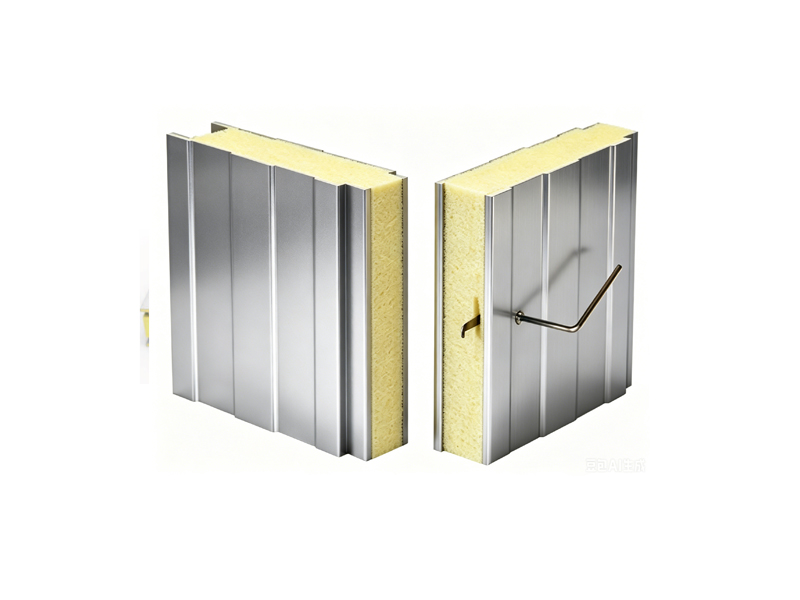
Fire performance is where specification language gets loose. Reaction-to-fire classes are assigned under EN 13501-1 [5], which ranks products from A1 to F with smoke and droplet sub-classes such as s1 and d0. A GB 8624 B1 marking is a different classification system and is not interchangeable with an EN 13501-1 class. When a supplier offers "B1 panels", ask which standard the class was issued under and for the test report reference. A blast freezer is not a high-fire-risk room while it runs, but the panels become fuel during construction hot work and after an electrical fault, and insurers increasingly ask for the classification rather than the marketing phrase.
Two further core properties deserve a line in the specification. Closed-cell content and water absorption determine how quickly performance degrades after a leak. Dimensional stability determines whether a 6 m panel stays flat through years of cycling. Neither is visible on a finished wall, and neither can be checked after installation.
Floors, Ceilings and Every Point That Breaks the Envelope
The floor is usually the most expensive mistake in a -40°C room. Heat flows down through the slab, the subsoil freezes, water in the soil expands, and the slab lifts. Nothing fails dramatically at first: a door stops closing properly, a panel base cracks, and a leak path opens at a junction nobody inspects after handover.
A floor at this temperature normally needs two things a standard freezer floor can sometimes skip. The first is load-bearing insulation with a declared compressive strength, and extruded polystyrene to EN 13164 [6] is the usual choice because it keeps its performance in damp ground. The second is a heat source under the slab, either an electric heater mat or a glycol loop taken from the plant, controlled from slab temperature sensors rather than from room air. Fix the sensor positions before the concrete is poured; retrofitting them means breaking the floor.
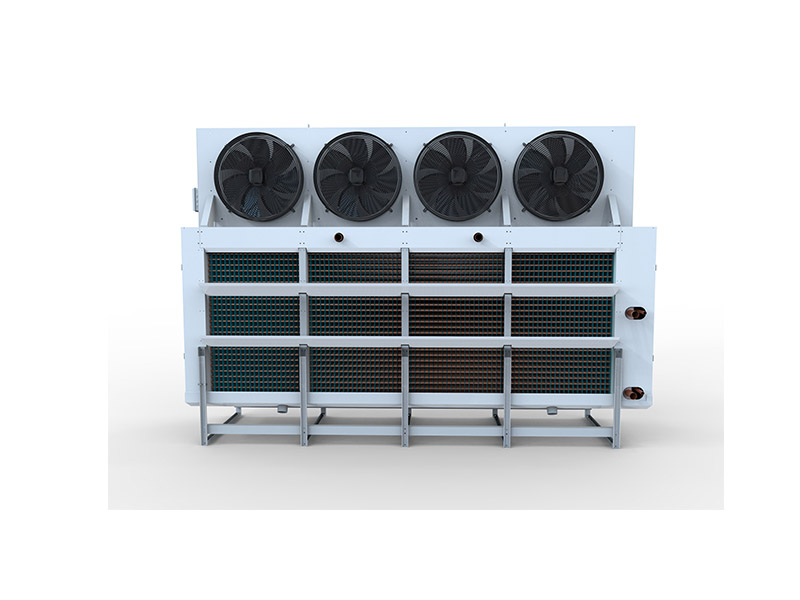
Above the floor, every penetration is a candidate vapour path. Evaporator hangers, drain lines, cable conduits, sensor wells and door frames all interrupt the envelope. A hanger that passes straight through the ceiling panel to structural steel makes a cold bridge, and the warm end of that bridge condenses inside the roof space where nobody looks. Use hangers with a thermal break, or carry the evaporator on an independent frame inside the room. Size the ceiling for evaporator mass plus ice plus a maintenance point load, and state that number in the panel schedule.
Doors need their own specification at this temperature. A standard door freezes to its frame, so the build needs a heated frame and threshold, a gasket rated for the duty, and a pressure equalisation valve so the door can be opened after a defrost. Surface requirements apply in the same room as well: cleanable, impermeable finishes under Regulation (EC) No 852/2004 [7], which makes a cracked panel skin a hygiene non-conformance and not only a thermal one.

Adjacent areas belong to the same envelope decision, because every door between a -40°C room and a processing space is a controlled leak. <Processing Room Solutions for Food Plants> covers processing room design and equipment for food plants.
Which Panel Document Proves What
Suppliers send a folder, and not every page carries the same weight. The table below sets out what each common record can support and what it cannot.
| Record | What it covers | What it can support | What it cannot support |
|---|---|---|---|
| EN 14509 [1] | Factory-made double-skin metal-faced panels: dimensions, tolerances, mechanical and thermal declaration | That the panel is a declared industrial product with a comparable datasheet | That a declared panel is suitable for -40°C service, or that its joint meets a project airtightness target |
| EN 13165 [2] | Declared thermal conductivity of factory-made PU and PIR foam products | Comparing declared λ_D between suppliers, provided the mean temperature is stated | That the declared value holds at a -40°C cold face |
| ISO 6946 [3] | Component thermal resistance and transmittance calculation | A U-value that includes surface films and defined layers | That as-built performance matches when joints, hangers and penetrations are unsealed |
| ISO 13788 [4] | Interstitial condensation and critical surface humidity screening | A check on whether a proposed build-up keeps the dew point out of the room | That a steady-state pass survives door openings, defrost cycles and a damaged gasket |
| EN 13501-1 [5] | Reaction-to-fire classification, classes A1 to F with smoke and droplet sub-classes | Comparing fire classes on a like-for-like basis | That a fire class substitutes for a continuous vapour seal, or that one class satisfies every insurer |
| EN 13164 [6] | Factory-made XPS products with declared compressive strength and conductivity | Specifying floor insulation for a loaded, damp, cold slab | That insulation alone prevents frost heave without a heat source |
The working discipline is to ask for the record that matches the claim and to reject a claim that arrives without one. A panel with a declared λ_D and a fire classification report is a specified product. A panel described as high density, B1 grade and suitable for -40°C in a quotation is a description, and it cannot be compared with another supplier's description.
What to Put in the Panel Enquiry
An enquiry that lists fields gets comparable quotes. An enquiry that lists a temperature and a room size gets drawings that cannot be compared. The fields below follow the decisions in the sections above.
| Enquiry field | What to state | Why it changes the answer |
|---|---|---|
| Design conditions | Room temperature, ambient design temperature and humidity, defrost strategy, door cycles per day | Thickness and the condensation check depend on both sides of the wall, not on room temperature alone |
| Core and thickness | Core type, declared λ_D with its mean temperature, nominal thickness, skin material and gauge | A λ declared at 10°C mean understates the flux through a -40°C wall |
| Fire classification | Class, the standard it was classified under, and the test report reference | A GB 8624 B1 marking and an EN 13501-1 class are different systems and cannot be compared directly |
| Joint and seal | Joint type, gasket specification, sealant type and low-temperature flexibility, cam-lock spacing basis | The joint is where vapour enters and where ice lenses start lifting the skin |
| Floor build-up | Insulation type and compressive strength, heater mat or glycol loop, slab thickness, sensor positions | Frost heave lifts the slab and cracks panel bases, and it cannot be corrected from above |
| Documentation | Panel schedule, dimensional drawings, hanger load data, warranty scope and exclusions | Missing hanger loads and warranty exclusions surface at commissioning, not at quotation |
A short contrast shows why the wording decides the outcome. An enquiry line reading "200 mm PU panel, B1 fire rating, cam-lock, suitable for blast freezer" cannot be compared, because two suppliers will interpret every term differently. A line reading "200 mm PIR core under an EN 14509 [1] declaration, declared λ_D stated with its mean temperature, reaction-to-fire class stated with the standard it was classified against plus the test report reference, cam-lock spacing based on the supplier's load calculation, sealant rated for the cold-face temperature, floor build-up with XPS and heater mat, panel schedule and hanger load data included" can be compared line by line.
Keeping panel and refrigeration scope with one supplier makes that comparison easier, because hanger loads, room load and unit selection come from the same calculation. MELUCK publishes PUR and PIR panel ranges with cam-lock and slip-joint connections alongside the matching two-stage condensing units and blast freezer evaporators, which is the practical reason the ceiling load and the panel thickness can be checked against each other before the order is cut.
Send the Room Data Before the Panels Are Cut
Panel orders are cut to a schedule, and a schedule built on the wrong design condition is expensive to change once the container is on the water. The floor build-up in particular cannot be corrected after the slab is poured. Send the design room temperature and the ambient design condition, the room dimensions and intended floor build-up, the defrost strategy, the expected door cycles per day, the products and daily throughput, and any local fire or insurance requirement. Those inputs are enough to calculate thickness, joint detail, floor insulation and hanger loads as one package rather than four separate guesses.
Email meluck@meluckcooling.com or call +8617369893087 with the room data, and MELUCK will return a panel schedule with the matching refrigeration selection for review.
FAQ
What panel thickness does a -40°C blast freezer need?
There is no single number, because thickness follows the design condition and the joint detail rather than room temperature alone. As a starting point, at a declared λ_D of 0.023 W/(m·K), 150 mm gives about 0.15 W/(m²·K) and 200 mm about 0.12 W/(m²·K). Most -40°C enquiries land between those two once ambient conditions and runtime are considered. Fix the declared λ_D with its mean temperature and the ambient design condition first; the calculation then decides, and a supplier who quotes a thickness before those inputs are fixed is guessing.
Can standard -18°C freezer panels be used in a blast freezer?
Rarely, and the limits that block it are not the ones buyers expect. A -18°C panel system is normally selected for steady storage, so the sealant, gasket and dimensional stability data may not cover cycling to -40°C with hot gas defrost. The panel may physically fit, but the vapour seal is what fails first. Check three documents before reusing panels: the sealant temperature rating, the core dimensional stability data, and the reaction-to-fire classification. If any is missing, the panel is unrated for the duty, and unrated is not a safe answer in a -40°C room.
Why does ice form at the panel joints?
Warm moist air is reaching a cold surface through a gap in the warm-side seal, not because the foam was wet from manufacture. The vapour pressure difference across a -40°C wall is large, so even a small break in continuity moves water steadily inward. It condenses on the cold skin, freezes, and expands enough to lift the skin from the foam over repeated cycles. The repair is to find and close the path: inspect joints and penetrations during a pull-down, reseal with a low-temperature flexible sealant, and confirm the gasket in every cam-lock is present and compressed.
Does a -40°C blast freezer floor need heating?
For a ground-bearing slab, usually yes. Heat flows down through the insulation, the subsoil freezes, water in the soil expands and the slab lifts. The first symptoms are a door that no longer closes and a crack at a panel base. A heater mat or a glycol loop controlled from slab temperature sensors prevents it, and a ventilated void is the alternative where the structure allows. Insulation alone does not solve frost heave. Decide the heat source before the slab detail is fixed, because adding sensors afterwards means breaking the floor.
References
[1] EN 14509:2013, "Self-supporting double skin metal faced insulating panels. Factory made products. Specifications," CEN, 2013.
[2] EN 13165:2012+A2:2016, "Thermal insulation products for buildings. Factory made rigid polyurethane foam (PU) products. Specification," CEN, 2016.
[3] ISO 6946:2017, "Building components and building elements. Thermal resistance and thermal transmittance. Calculation methods," ISO, 2017.
[4] ISO 13788:2012, "Hygrothermal performance of building components and building elements. Internal surface temperature to avoid critical surface humidity and interstitial condensation. Calculation methods," ISO, 2012.
[5] EN 13501-1:2018, "Fire classification of construction products and building elements. Part 1: Classification using data from reaction to fire tests," CEN, 2018.
[6] EN 13164:2012+A1:2015, "Thermal insulation products for buildings. Factory made extruded polystyrene (XPS) products. Specification," CEN, 2015.
[7] Regulation (EC) No 852/2004 of the European Parliament and of the Council of 29 April 2004 on the hygiene of foodstuffs, Official Journal of the European Union, 2004.
If you're interested, check out these related articles:
Blood Bank Cold Room: Ultra-Precise Temperature Control
Chiller Room Solutions -10C~10C
With over 15 years of experience as a MELUCK refrigeration engineer, I specialize in the design of cold storage, chillers, ice makers, and cold chain energy-saving systems, providing technical support to distributors and engineering companies worldwide.

meluck