
Copeland Scroll Condensing Unit Sizing for Chiller Rooms
A chiller room held at 0 °C to +8 °C usually misses temperature for reasons that were settled on the sizing sheet, long before commissioning. Sizing a Copeland scroll condensing unit for a chiller room means fixing three numbers in order: the room's real duty in kW, the evaporating temperature that duty requires, and the condensing temperature the site will actually produce. Horsepower then follows from those three inputs rather than replacing them. Reverse the order and a correctly rated unit can still fall short in the hottest week of the year, when ambient temperature and door traffic rise together.
What a Copeland scroll condensing unit does in a chiller room
A condensing unit carries the compressor, the air-cooled condenser, the receiver and the electrical controls. It rejects heat outdoors and supplies liquid refrigerant to an evaporator mounted inside the room. The chiller room holds product between 0 °C and +8 °C, so the coil runs a few degrees colder than the room and the compressor works across a moderate pressure ratio. That moderate ratio suits a scroll compressor: the scroll pair has few moving parts, runs with low vibration, and keeps its efficiency at evaporating temperatures around -5 °C to +5 °C, which is where most chiller room coils operate.
The application range matters when you read a quotation. Catalogue data for a medium-temperature Copeland scroll condensing unit covers roughly -5 °C to +15 °C, which includes chiller rooms, processing areas at 5 °C to 10 °C and fresh produce stores. It does not cover freezer rooms at -18 °C or blast freezing, where the pressure ratio and discharge temperature of a medium-temperature scroll become limiting.
Capacity is also shared with the evaporator. A unit rated at a given capacity at one evaporating temperature delivers that figure only when the coil, the airflow and the defrost cycle hold the evaporating temperature where the rating assumes. A coil that ices up, fans sized for a colder room, or doors left open through a shift all move the operating point, and the compressor follows the coil rather than the catalogue.

Evaporating and condensing temperature decide capacity, not horsepower
Two temperatures fix what a compressor can do, and neither appears in the horsepower label.
Evaporating temperature is the refrigerant temperature in the coil. It sits below room temperature by the coil's design difference, often 6 K to 8 K for chiller rooms. A room held at +2 °C with an 8 K difference runs an evaporating temperature near -6 °C. Lower that figure and the compressor must compress across a larger ratio, so mass flow and capacity fall while discharge temperature rises.
Condensing temperature is the refrigerant temperature in the condenser, above ambient by the condenser's approach, typically 10 K to 15 K for air-cooled units. A site designed for 38 °C ambient with a 12 K approach condenses near 50 °C. Push condensing temperature up and capacity falls again, because each kilogram of refrigerant now costs more compressor work.
The practical consequence is that a 5HP unit has no single capacity. The same frame appears at several capacities in one performance table, depending on the evaporating and condensing temperatures chosen for that table. Two suppliers quoting 5HP and the same kW figure may be reading from different points, and neither number necessarily describes your room in August.
| Input | Where it comes from | What it can support | What it cannot tell you |
|---|---|---|---|
| Nominal horsepower | Compressor model designation | Identity of the frame and a rough capacity band | That two units of equal horsepower deliver equal duty at your temperatures |
| Catalogue capacity | Manufacturer table at stated evaporating and condensing temperatures | Comparison at those exact conditions | That the same capacity holds at 45 °C ambient or on a different refrigerant |
| Room volume | Site survey | A first sanity check on load | That equal volumes need equal capacity, since product, door traffic and occupancy differ |
| Throughput estimate | Customer production plan | A first pass at product load | That a peak shipping day matches an average day |
| Sound data | Catalogue figure at a stated distance | Comparison at that distance | That the level holds at a boundary wall or a neighbouring property |
| Refrigerant on the nameplate | Unit documentation | What the compressor is approved for | That another refrigerant can be charged without written approval |
The habit worth building is to ask for the performance point, not the headline. Ask at which evaporating and condensing temperatures the capacity was measured, and whether those values match your site. A supplier who can answer quickly is working from a real table.
Ambient conditions change what a given horsepower can deliver, and coastal sites add humidity and salt to the same problem. <Selecting a Condensing Unit for Tropical Climates> covers how high ambient temperatures affect condensing unit selection.
Build the duty from six load components
Room duty in kW is the sum of six contributions, and each behaves differently across a working day. A single average figure hides the peaks that decide whether the room holds temperature at four in the afternoon.
- Transmission through panels, floor and ceiling. Driven by panel thickness, panel condition and the difference between room and surroundings. It runs all day at a nearly constant value.
- Product load. Heat removed from goods entering above room temperature, plus respiration heat for fresh produce. It arrives in batches, so it sets the peak rather than the average.
- Infiltration. Warm, humid air entering through doors, gaps and penetrations. Moisture matters as much as heat, because it ends up as frost on the coil.
- Internal loads. People, lights, forklift motors and machinery running inside the room.
- Defrost energy. Heat added to clear frost from the coil, which the compressor then removes again.
- Pull-down and margin. The reserve needed to bring a warm room down after loading, after a defrost or after a power interruption.
Written as one line:
Q_total = Q_transmission + Q_product + Q_infiltration + Q_internal + Q_defrost + Q_margin
As an arithmetic check, if transmission works out at 1.8 kW, product pull-down at 2.4 kW, infiltration at 0.6 kW, internal loads at 0.4 kW and defrost at 0.9 kW, the total is 6.1 kW. A margin of ten percent lifts that to about 6.7 kW. Those inputs illustrate the method and are not values for your room. The point is that 6.7 kW asks something different of a compressor than 4 kW does, even when the two rooms look identical in a photograph.
The margin deserves a decision rather than a default. Roughly 10 to 15 percent suits many chiller rooms; a room that receives warm product twice a day, or one that opens onto a hot loading bay, may need more. Whatever figure you choose, write it on the selection sheet so the next reviewer can see the assumption instead of guessing at it.
Door design moves the infiltration term more than any other single item. A well sealed sliding door with a quick closing action limits air exchange; an open doorway to a 35 °C packing hall does not. Record the door type and the openings per shift in the enquiry, because the difference between ten and sixty openings a day can move a selection by a frame size.

Capacity bands in the Copeland scroll range
The table below is a planning aid, not a rating. Use it to narrow the conversation, then confirm the choice against a performance table at your own temperatures.
| Room situation | Copeland scroll range in the catalogue | Typical use | Step up when |
|---|---|---|---|
| Single walk-in room, light traffic | 2HP to 7HP | Retail back room, small kitchen, deli supply | Door openings run into double figures per shift or product enters warm |
| Medium room with mixed pallets | 8HP to 15HP | Distribution intake, processing buffer | Design ambient exceeds 40 °C or a daily pull-down is required |
| Large single room | 20HP to 30HP | Supermarket back room, central store | Duty passes the top of the range or redundancy is required |
| Several rooms on one site | Multiple smaller units or a parallel arrangement | Multi-zone processing, market halls | One room's failure would stop the whole site |
The 2HP to 7HP band covers the small and medium rooms where a single scroll unit is the simplest answer: one compressor, one condenser, one control panel, and a footprint that fits beside a service corridor. MELUCK supplies Copeland scroll condensing units in a 2HP to 7HP range for this work and an 8HP to 30HP range for larger rooms, with matching evaporators and controls.
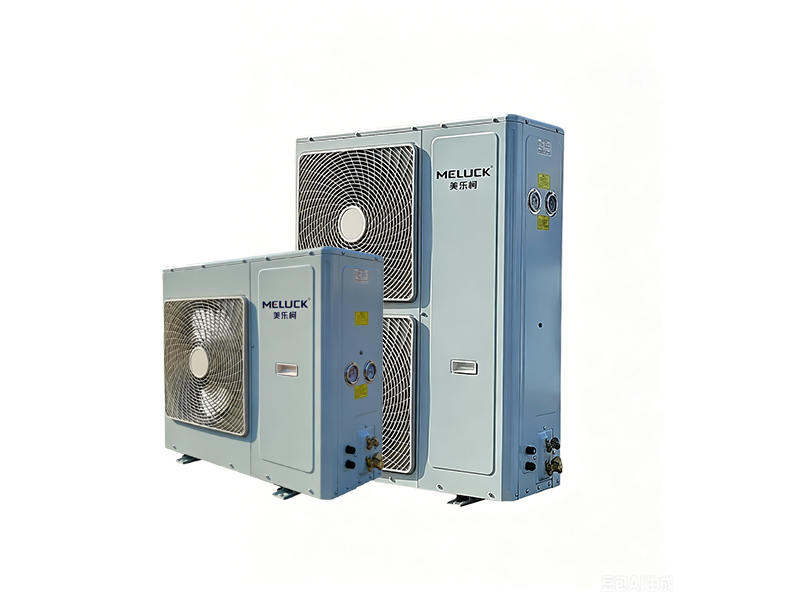
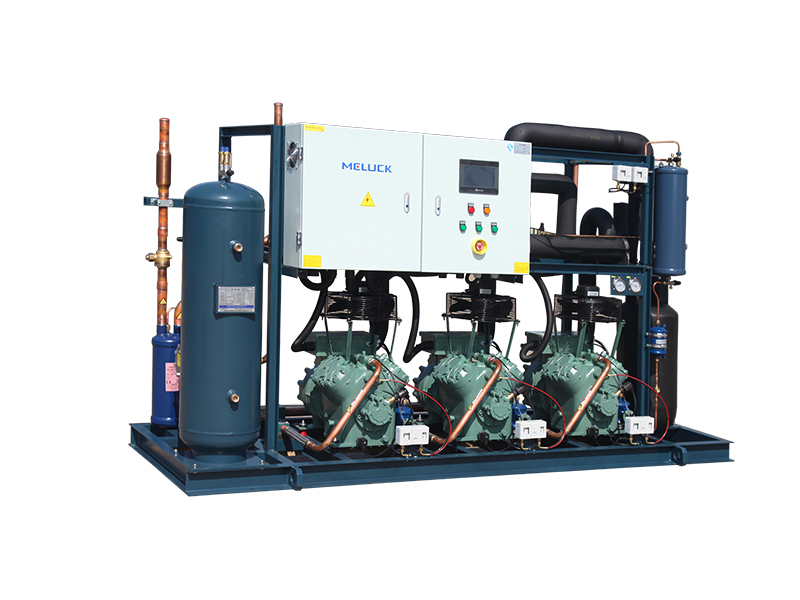
Above the single-unit comfort zone, the question changes from capacity to resilience. Two smaller units on a multi-room site let you service one while the other holds part load, and a parallel arrangement of three or four compressors modulates capacity as rooms open and close through the day. The trade is control complexity, a larger refrigerant charge and more joints to leak, so parallel equipment earns its place on sites with several rooms and uneven load, not on a single room with steady demand.
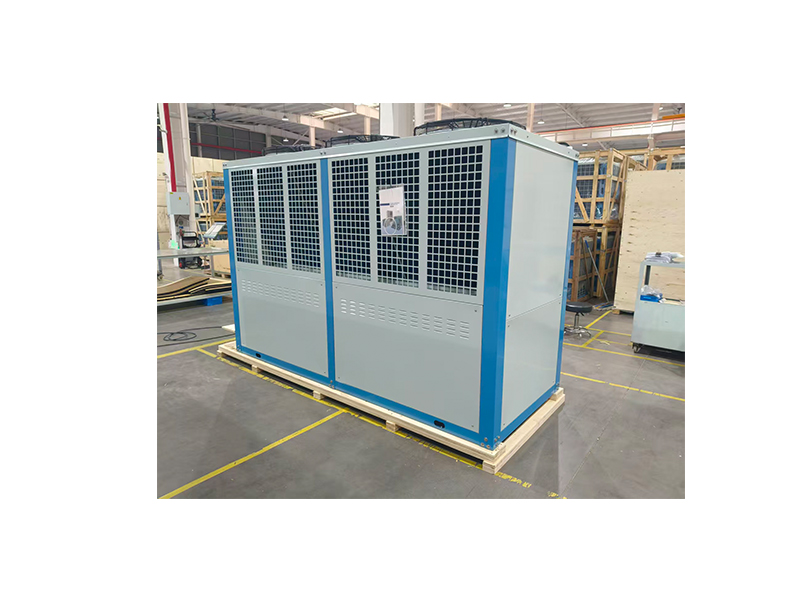
When duty passes the top of the scroll range, or when the site needs a compressor that can be rebuilt in place, a semi-hermetic reciprocating frame takes over. A 30HP or 50HP reciprocating condensing unit is a common answer for large chiller rooms and industrial cooling, at a higher first cost and with more serviceable parts. Both routes work; the decision turns on load profile, redundancy and the maintenance capability on site.
Matching the evaporator, defrost and controls
A condensing unit selection is only half a system. The coil decides the evaporating temperature the compressor will actually see, so the two should be chosen together.
For chiller rooms, a DL series air cooler is the usual starting point, matched to the room's duty at the same temperature difference used for the compressor. Face area and air throw matter as much as nominal capacity: a small coil pushed to high air velocity dries the product surface and widens the temperature spread across the room, while an oversized coil with long air throw gives more even conditions at the cost of space.
Defrost needs a decision early. A room running above about +2 °C with moderate traffic can often use off-cycle or air defrost, which adds little heat. A room close to 0 °C with frequent door openings will ice the coil, and electric defrost with termination on coil temperature and time is the safer choice. Either way the drain line, trap and slope belong in the drawing, because a blocked drain becomes a floor of ice and a compressor running continuously.
Controls finish the job. Electronic expansion valves hold superheat across a wider load range than a thermostatic valve and suit rooms where throughput varies, but they add commissioning work. A controller that logs room temperature, alarms on deviation and can be read remotely turns a nuisance fault into a same-day repair, and it is the cheapest reliability upgrade on most projects.
Refrigerant choice and compliance for new chiller rooms
Refrigerant selection is now a compliance decision as much as a technical one. R-404A remains in service on older equipment, while R-448A and R-449A have become the usual lower-GWP replacements in medium-temperature retail and processing rooms. R-410A appears where the compressor is approved for it. A scroll built for one refrigerant family cannot simply be recharged with another, because capacity, discharge temperature and lubricant all change.
Refrigerant classification and charge limits are set by standards such as ISO 5149 and, in Europe, EN 378 [1]. In the European Union, Regulation (EU) 2024/573 sets the HFC phasedown schedule that increasingly decides which refrigerant a new commercial system can be placed on the market with [2]. Lower flammability A2L refrigerants are classified under ASHRAE Standard 34, and their adoption changes both charge limits and the ventilation requirements for the plant room [3].
None of that alters the arithmetic of capacity, but it changes which compressor model is available to you and what the installation must include. Check the nameplate and the compressor's approved refrigerant list before comparing prices, and treat a refrigerant substitution as a new selection rather than a paperwork change.
Plant room ventilation and refrigerant choice are reviewed together, because charge limits and air changes interact. <Compressor Room Airflow for Cold Storage: Design Factors> covers the airflow design factors that keep a compressor room inside its operating limits.
What to verify before you approve the selection
Five checks catch most of the errors that survive a quotation review.
- Performance point. Capacity stated at your evaporating and condensing temperatures, not at laboratory conditions.
- Ambient at the real location. A unit under a roof, against a wall or inside a fence sees a higher inlet temperature than the weather record for the district.
- Electrical match. Voltage, phase and hertz confirmed against the site supply, since a motor wound for 60 Hz behaves differently on a 50 Hz supply.
- Receiver and charge. Liquid line length and receiver volume checked against the layout, especially when the condenser sits far from the room.
- Alarm route. Confirmed who receives the alarm and what they do at 2 a.m., because a controller without a response is only a recorder.
Airflow around the condenser decides whether the rated condensing temperature is reachable on site at all. <Condensing Unit Installation Clearance: Key Spacing Rules> covers the spacing rules that protect airflow and service access.
A selection can only be checked against real room data, so the enquiry should carry these fields:
| Field to send | Why it changes the selection | What goes wrong without it |
|---|---|---|
| Room dimensions, panel thickness, target temperature | Sets transmission load and coil temperature difference | Unit sized on volume alone, room drifts warm at peak |
| Product type, entering temperature, daily tonnage | Sets product and pull-down load | Capacity short during intake, product held above specification |
| Design ambient dry bulb and unit location | Sets condensing temperature | Unit rated at mild conditions, short of capacity in summer |
| Power supply, voltage, phase and hertz | Sets motor and control configuration | Wrong motor, delayed shipment, site rework |
| Refrigerant preference or constraint | Sets approved compressor model and charge limits | Unit charged with a refrigerant the compressor is not approved for |
| Door type, openings per shift, defrost method | Sets infiltration and defrost allowance | Icing, short cycling, unstable room temperature |
Match the unit to the room before ordering
Send the room dimensions and panel thickness, the product and its entering temperature, daily tonnage, target room temperature, design ambient, power supply in voltage, phase and hertz, refrigerant preference, and door type with openings per shift. Those fields decide more than a horsepower figure does, because they let the selection be checked against a real performance table instead of a catalogue headline.
MELUCK builds Copeland scroll condensing units from 2HP to 30HP with matching evaporators, panels and controls. Email meluck@meluckcooling.com or call +8617369893087 with the room data, and we will return a sized selection for your review.
FAQ
How many HP does a 100 m³ chiller room need?
Volume alone cannot answer that. Two rooms of the same size differ by product load, insulation, door traffic and design ambient, and those four items move the duty more than the cubic measurement does. A small room of that size with 100 mm panels and light traffic often falls in the 2HP to 7HP band, while the same volume receiving warm product twice a day lands higher. Fix the evaporating temperature, build the duty from the six components, then read the capacity from a performance table at your condensing temperature.
Can a Copeland scroll condensing unit hold a room at -18 °C?
Not the medium-temperature scroll units used for chiller rooms. Those are applied with evaporating temperatures around -5 °C to +5 °C. A room at -18 °C needs an evaporating temperature near -25 °C, which raises the pressure ratio, the discharge temperature and the demand on motor cooling. Low-temperature work is normally handled by semi-hermetic reciprocating or two-stage equipment. Check the compressor's approved envelope before assuming a scroll frame covers a frozen duty.
Which refrigerant should I specify for a new chiller room?
Start from the compressor's approved list, then apply local rules. R-448A and R-449A are common choices for new medium-temperature systems, R-404A mostly appears on existing equipment, and R-410A applies where the compressor is approved for it. Refrigerant choice changes capacity and discharge temperature, so the selection has to be recalculated rather than adjusted on paper. Confirm the nameplate and the approval document before you compare quotations.
What ambient temperature should I design for?
Use the design dry bulb for the hottest expected week at the unit's actual location, not the district average. A condenser under a roof, in a fenced enclosure or against a wall sees a higher inlet temperature than an open field. Once you have that figure, add the condenser approach to get the condensing temperature and read capacity at that point. Designing on a mild average is the most common reason a correctly sized unit looks undersized in its first summer.
References
[1] ISO 5149-1:2014, "Refrigerating systems and heat pumps," ISO, 2014.
[2] Regulation (EU) 2024/573 on fluorinated greenhouse gases, Official Journal of the European Union, 2024. [Online]. Available: https://eur-lex.europa.eu/eli/reg/2024/573/oj
[3] ASHRAE Standard 34-2022, "Designation and safety classification of refrigerants," ASHRAE, 2022.
If you're interested, check out these related articles:
Cold Storage Project ROI: A Practical Financial Evaluation
High-Capacity Condensing Unit Selection for Cold Storage
With over 15 years of experience as a MELUCK refrigeration engineer, I specialize in the design of cold storage, chillers, ice makers, and cold chain energy-saving systems, providing technical support to distributors and engineering companies worldwide.

meluck