
Cold Room for African Processing Zones: Sourcing and Setup
Setting up a cold room in an African food processing zone is not just a matter of buying a cooler and turning it on. Power stability, ambient heat loads, local skills for maintenance, and long lead times for spare parts shape every equipment decision. I've been involved in cold storage projects from Egypt to Ecuador, and the gap between what a catalog offers and what works on-site is often wide. However, when you match the fundamentals of refrigeration design to the realities of an African processing environment, the result is a system that delivers reliable, year-round temperature control at a cost that makes economic sense.
Matching Refrigeration Design to African Processing Zone Realities
Processing zones in Africa face conditions that standard commercial cold rooms are not built for. Ambient temperatures regularly exceed 35°C in the shade, and in coastal zones like Manta, Ecuador (a project we completed for a seafood exporter), humidity and salt-laden air rapidly corrode untreated metal components. Inland, at a French fries processing plant in Cairo, dust and heat combined to shorten condenser life until we specified heavy-duty finned coils and protective coatings.
For African food processing applications, a cold room must start with a condensing unit rated for high ambient operation. Bitzer semi-hermetic reciprocating compressors have proven themselves across our installations because their discharge gas temperature stays within safe limits even when the air entering the condenser is 45°C. The condenser itself needs a larger heat rejection surface than a temperate-climate unit of the same nominal capacity. We typically select air-cooled condensers with a design temperature difference of at least 12°C, and we specify a receiver sized to hold the full system charge so the unit can operate under high condensing pressure without tripping.

Panel insulation is the other half of the equation. In a 10°C processing room, the heat gain through walls and ceiling is the largest single thermal load after product respiration. For African conditions, we recommend PIR panels rather than standard PUR because the former's lower thermal conductivity (0.018-0.022 W/m·K versus 0.022-0.028 W/m·K for PUR) and better fire resistance (B1 rating) matter when the building may house multiple tenants. A 100 mm PIR panel is sufficient for a 0°C to 8°C chiller room; for a freezer operating at -20°C, we step up to 150 mm. The incremental cost is paid back in lower electricity consumption within 18 months in most African locations.
Core Refrigeration Equipment for a Processing Zone Cold Room
The equipment list for a processing zone cold room is straightforward, but matching each component to the specific zone's throughput and product type prevents oversizing and energy waste.
| Application | Recommended Condensing Unit | HP Range | Temperature Range |
|---|---|---|---|
| Small processing room (up to 100 m³) | Bitzer 4HP–7HP reciprocating (4DES-5Y, 4VES-7Y) | 4–7HP | -5°C to 5°C |
| Medium chiller processing (100-300 m³) | Bitzer 9HP–15HP reciprocating (4PE-12Y, 4PE-15Y) | 9–15HP | 0°C to 8°C |
| Large frozen storage (300+ m³) | Bitzer 20HP–50HP reciprocating (4NE-20Y, 6HE-44Y) or parallel units | 20–50HP | -18°C to -25°C |
| Blast freezer for quick freezing | Bitzer 2-stage 16HP or 20HP semi-hermetic | 16–20HP | -35°C to -50°C |
For medium-to-large frozen zones above 500 m³, parallel condensing units with three or four Bitzer piston compressors on a common frame offer capacity staging that reduces compressor cycling and energy spikes. We used this configuration on the Egyptian frozen storage rooms (each 15m x 16m x 9.6m) and the system maintained -20°C with 75HP per unit during the hottest months without short-cycling.
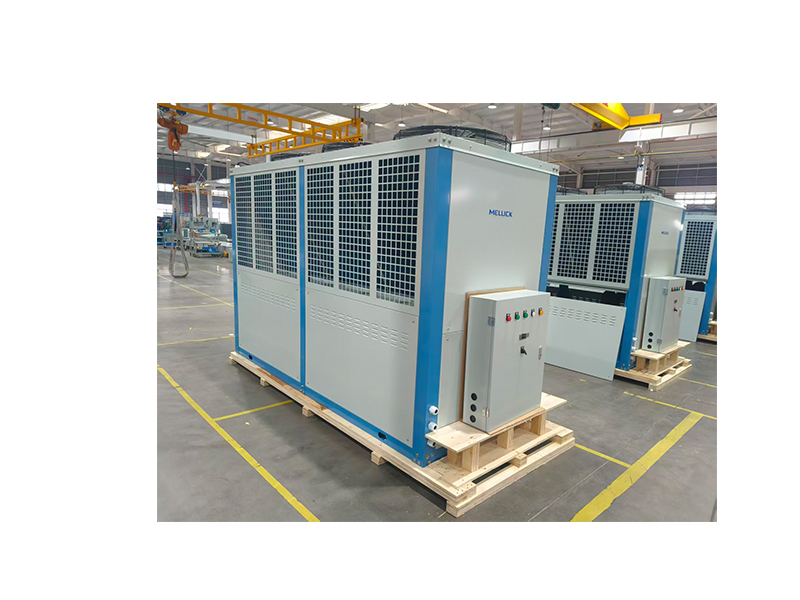
Evaporator selection follows the room's temperature band. For processing rooms maintained at 5°C to 10°C, DL series air coolers with an evaporating delta-T of 6-8K provide gentle dehydration that does not dry out product surfaces. Freezer rooms use DD series units with electric defrost, and blast freezers at -35°C or below require DJ series high-velocity coolers designed to handle rapid frost buildup. In the Ecuador seafood project, we paired 40HP Bitzer condensing units with dedicated blast-freezing air coolers that could pull the room from ambient to -35°C in under four hours with a full load of shrimp trays.
Sourcing Equipment for Africa: What to Look For Beyond the Spec Sheet
A condensing unit that performs perfectly in Shanghai can fail in Luanda if the supplier does not prepare for the logistics and support realities of African markets. I always advise buyers to evaluate three things beyond the technical data.
First, inspect the manufacturer's track record in the specific climate, not just the region. We have installed Bitzer-based systems in Cairo's 40°C summers, on Ecuador's coast, and in Myanmar's monsoon conditions. The compressors are the same, but the condenser sizing, refrigerant charge, and control logic differ. A supplier who only ships standard kits without adjusting for ambient design temperature is asking for trouble. Ask for a heat load calculation tailored to your site, not a generic chart.
Second, confirm that the supplier can provide commissioning support and operator training on-site. In our Myanmar tomato cold room project, the local staff had never operated a digital temperature controller. We spent two days walking them through setpoints, alarm thresholds, and daily log sheets. That training is the difference between a cold room that runs for a decade and one that fails in the first wet season because someone disabled the defrost cycle.

Third, evaluate spare parts availability. Compressor valve plates, contactor coils, fan motors, and door gaskets are consumables in any industrial cold room. A supplier who cannot air-freight a critical spare to an African capital within five days creates a risk that outweighs a small upfront cost saving. We keep a dedicated stock of Bitzer spare parts for our existing African installations, and we include a recommended spare parts list with every shipment so the on-site team can hold the essentials locally.
If your processing zone involves blast freezing below -35°C or multiple temperature zones, the compressor selection is not straightforward. It is worth confirming the exact heat load and capacity with an engineer before finalizing the order. Reach out at meluck@meluckcooling.com with your product types and throughput.
Installation and Setup: Getting It Right the First Time
A processing zone cold room is a semi-permanent structure. The slab preparation, drainage, and vapor sealing are as important as the refrigeration hardware.
Start with a level concrete floor that can bear the weight of loaded pallet jacks and forklifts if the room is drive-in. In a freezer, thermal expansion and contraction will crack an unreinforced slab within months. We require a minimum 150 mm reinforced concrete base with a vapor barrier underneath to prevent ground moisture from freezing and heaving the slab. Floor insulation (100 mm XPS or PIR) with a wearing slab on top is mandatory for rooms operating below freezing, or the ground will eventually become an ice block and lift the walls.
Panel assembly should use cam-lock or slip-joint connections rather than simple tongue-and-groove to maintain airtightness over years of thermal cycling. In the Egypt French fries plant, we used PIR panels with a concealed cam-lock system, and the 9.6-meter-high walls went up in three days with a small crew.

Electrical supply in African processing zones often fluctuates. We always recommend a phase monitor, undervoltage relay, and a correctly sized voltage stabilizer ahead of the compressor control panel. A short power glitch that momentarily reverses a three-phase scroll compressor can cause mechanical damage before the thermal overload trips. For remote sites, a generator with an automatic transfer switch is the only safe option, and the refrigeration system must include a delay timer to prevent the compressor from restarting immediately against high head pressure after a power outage.
Cost and ROI: What to Expect for Your Processing Zone Cold Room
Cold room costs are driven by four factors: insulation thickness and panel type, compressor size and brand, installation complexity, and import duties. For a typical 200 m³ processing room maintaining 5°C, a complete system including panels, Bitzer condensing unit, evaporator, door, and electrical controls will range between USD 25,000 and USD 45,000 ex-works, depending on PIR vs PUR panels and compressor horsepower. A -20°C freezer of similar size with floor insulation and a larger condensing unit will be 40% to 60% higher due to the additional insulation and heavier compressor. Shipping and on-site installation add another 15% to 25% depending on distance and local labor costs.
The payback, however, is measured in product preservation. In our avocado cold room project in Peru, the packer was losing roughly 15% of harvested fruit to spoilage before installing a 10°C pre-cooling room. The cold room brought losses below 4% within the first season. Even with conservative market prices, that recovery paid for the entire installation in less than eight months. For a processing zone handling higher-value items like frozen fish fillets or prepared foods, a single export shipment rejected for temperature abuse can cost more than the cold room itself.
For a ballpark estimate tailored to your processing requirements, send your floor plan and temperature specifications to meluck@meluckcooling.com or call +8617369893087. We will prepare a preliminary equipment layout and budget.
Common Questions About Processing Zone Cold Room Sourcing
How do I choose between PIR and PUR panels for a processing zone?
PIR panels offer a higher fire rating (B1) and about 10% better thermal insulation than PUR of the same thickness. If the cold room is inside a shared processing building or will be inspected by international food safety auditors, PIR is the safer choice. PUR remains acceptable for standalone small chiller rooms where cost is the primary constraint and there is no fire code requirement for insulated wall panels.
Can a processing zone cold room operate on a 60Hz power supply?
Yes, but you must specify 60Hz when ordering compressors and fan motors. Many African countries use 50Hz (Egypt, Kenya, Ghana, Ethiopia), but Nigeria and some West African nations run on 60Hz. We stock Bitzer and Copeland condensing units in both 50Hz and 60Hz configurations specifically to avoid the delivery delays that come with factory-order voltage changes. The unit's cooling capacity shifts slightly at 60Hz, so we recalculate the heat rejection to match the actual site frequency during the design phase.
How long does it take from order to a running cold room?
For a standard 100-300 m³ processing room, panel production and refrigeration unit assembly take four to five weeks. Ocean freight to major African ports adds two to four weeks depending on destination. On-site assembly, piping, vacuuming, charging, and commissioning typically require one to two weeks with a competent local crew and remote guidance. A turnkey project with our supervisor on-site extends the installation time by perhaps a day but reduces the likelihood of commissioning errors that surface months later.
Do I need a separate processing room and a storage cold room?
It depends on your throughput. If product moves continuously from processing to chilling without accumulating, a single room can serve both functions. However, if processing staff enter and exit frequently and the room door remains open for extended periods, the heat and moisture infiltration will cause temperature swings and frost buildup that affect stored product quality. In the Egyptian French fries plant, we separated the 5°C to 10°C packaging area from the -20°C finished goods storage with an insulated wall and high-speed strip curtains, which kept the evaporator defrost cycles to a predictable twice per day. If your production volume justifies it, the additional investment in separate zones almost always repays itself in reduced energy and better product consistency.
Share your project timeline and we can confirm equipment availability and shipping schedule to your port. Contact David Zhang at meluck@meluckcooling.com or +8617369893087.
If you're interested, check out these related articles:
Chiller Room Solutions -10C~10C - Meluck
Processing Room Solutions for Food Plants - Meluck
With over 15 years of experience as a MELUCK refrigeration engineer, I specialize in the design of cold storage, chillers, ice makers, and cold chain energy-saving systems, providing technical support to distributors and engineering companies worldwide.

meluck