
Bitzer Condensing Units at -55°C for Ultra-Low Cold Storage
A Bitzer condensing unit for -55°C is not one product category, and the number alone does not define the machine. It can describe the air temperature held inside a cold room, the evaporating temperature the compressor must sustain, or the core temperature a processor needs at the centre of a tuna loin. Each reading leads to a different selection. Two-stage semi-hermetic reciprocating packages cover most of the evaporating range where ultra-low freezing happens. Holding an entire room at -55°C is a harder duty, because the coil has to run several kelvin below the room, which pushes the decision toward cascade or screw compound compression rather than a larger reciprocating unit.
What -55°C Refers To in a Bitzer Condensing Unit Spec
An enquiry that states only -55°C leaves the supplier guessing, and a quotation built on the wrong reading is expensive to correct later. Three references matter: room air temperature, evaporating temperature, and product core temperature. They are related but not interchangeable, and a package sized for one will not deliver the other.
Room air is the hardest of the three. A cooling coil absorbs heat only when its surface is colder than the air passing over it, so a room held at -55°C needs an evaporating temperature below that value. In a well-designed freezer the difference is small, often in the range of five to ten kelvin; it widens when coil surface is limited or the load is heavy. When a quotation offers a unit whose minimum evaporating temperature is -50°C for a room that must sit at -55°C, the margin has already been spent before the door opens.
| Reference the buyer may mean | What it describes | What it changes in the selection |
|---|---|---|
| Room air at -55°C | Temperature held inside the store | Coil must run below the room, so the compressor needs an evaporating rating colder than -55°C |
| Evaporating at -55°C | Boiling temperature of refrigerant in the cooler | Defines compressor duty, available capacity and discharge temperature |
| Product core at -55°C | Centre temperature after freezing | A time-based blast duty, not a storage specification |
| Door and defrost recovery | Load after each opening or defrost cycle | Spare capacity and coil surface needed to recover without drift |
The practical rule for an enquiry is to write all three values, plus the design ambient, before asking for a price. Suppliers who receive one number will assume the reading that suits their standard package.
Why Single-Stage Compression Stops Short of -55°C
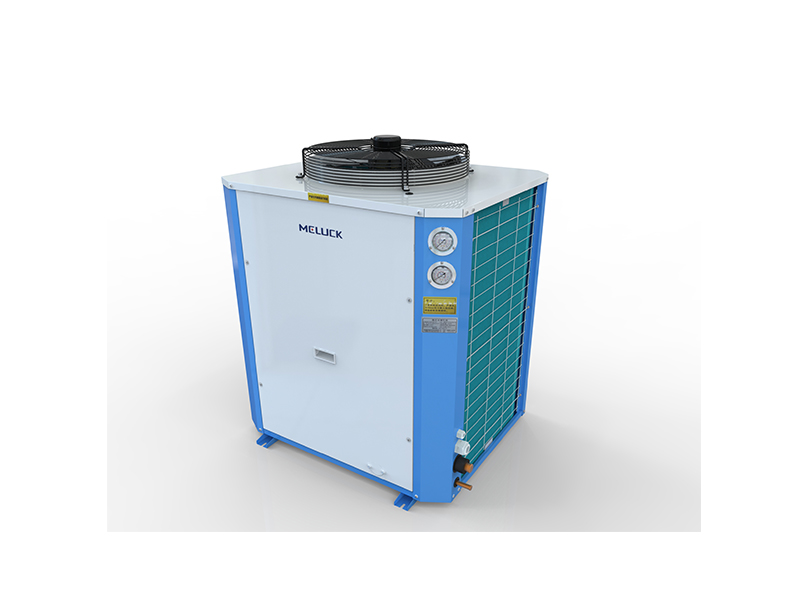
As evaporating temperature falls, saturated suction pressure falls with it, reaching sub-atmospheric levels at the deep end of the range. The compressor then works across a much larger pressure ratio. Volumetric efficiency drops, discharge temperature climbs, and each horsepower moves noticeably less heat than it would in a chiller duty. Low-temperature single-stage reciprocating units in the Meluck range cover freezer rooms from -18°C to -30°C, which is where most frozen storage belongs.
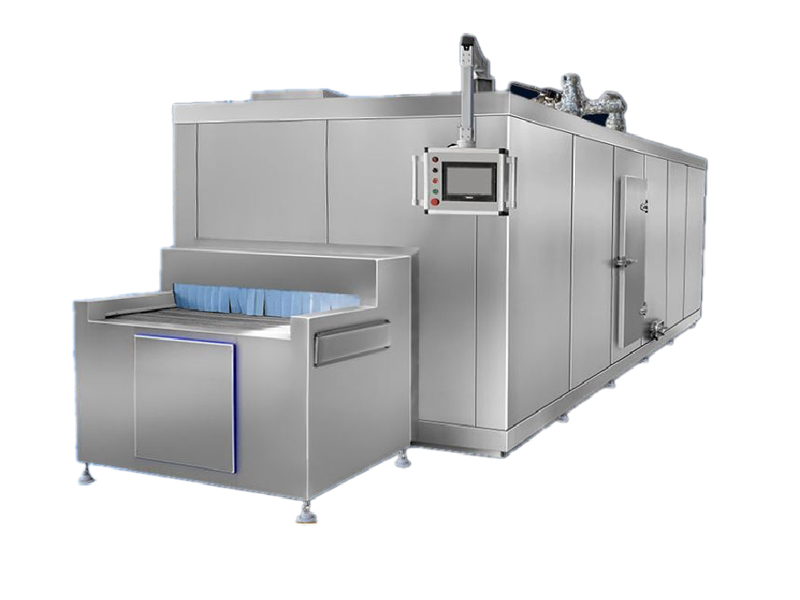
Two-stage compression splits that ratio between two cylinders or two machines, with intercooling between the stages to control discharge temperature. A two-stage semi-hermetic package can hold evaporating temperatures down to roughly -50°C, which covers blast freezing and the colder holding rooms in seafood and premium meat plants. Capacity still falls as the duty point gets colder, so selection has to be made from a capacity table at the actual evaporating and condensing temperatures rather than from horsepower.
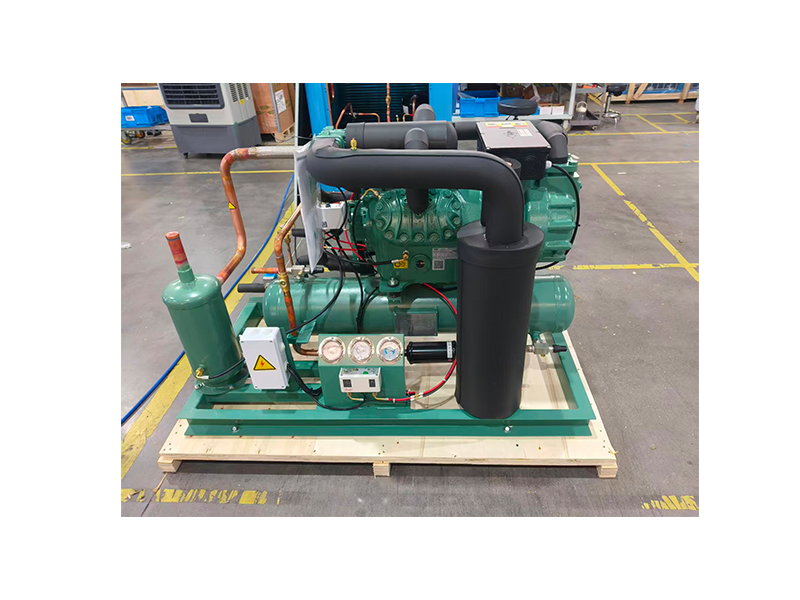
Below that, the arithmetic changes again. A room held at -55°C requires a coil near -60°C to -63°C, which sits outside the normal envelope of a two-stage reciprocating package. Cascade systems handle it by pairing two refrigerant circuits, the low stage using a low-boiling refrigerant that can operate at very low suction pressure. The trade is real: higher first cost, more controls, two circuits to service, and technicians who understand both. For a genuine -55°C store the alternative is usually a screw compound unit with an economizer, not a bigger piston machine.
Where -55°C Capacity Is Genuinely Needed
Cold capacity at this level is worth paying for only where the product value or the technical requirement justifies it. The pattern across the trade is consistent: the colder the store, the more valuable or the more temperature-sensitive the goods inside it.
| Application | What the low temperature protects | Duty type |
|---|---|---|
| Sashimi and premium tuna | Colour, texture, drip loss after thaw | Blast freezing, then holding at -55°C or colder |
| High-value seafood loins | Cell structure in slow-frozen cuts | Blast freezing before transfer to -25°C storage |
| Meat for raw consumption | Texture and purge loss | Blast freezing at the coldest available coil |
| Ice cream and frozen desserts | Crystal size and shape retention | Hardening tunnel |
| Laboratory and pharmaceutical samples | Stability of temperature-sensitive material | Holding with tight control and alarm |
Two distinctions save money here. First, blast freezing is a time duty; a -55°C evaporating coil shortens the pull-down and protects texture, but the room does not need to be held at that temperature between batches. Second, standard frozen storage from -18°C to -25°C covers most seafood, meat and prepared food, and a colder store adds power, defrost load and equipment complexity without improving anything the buyer can measure.
Bitzer Options for Ultra-Low Temperature Duty
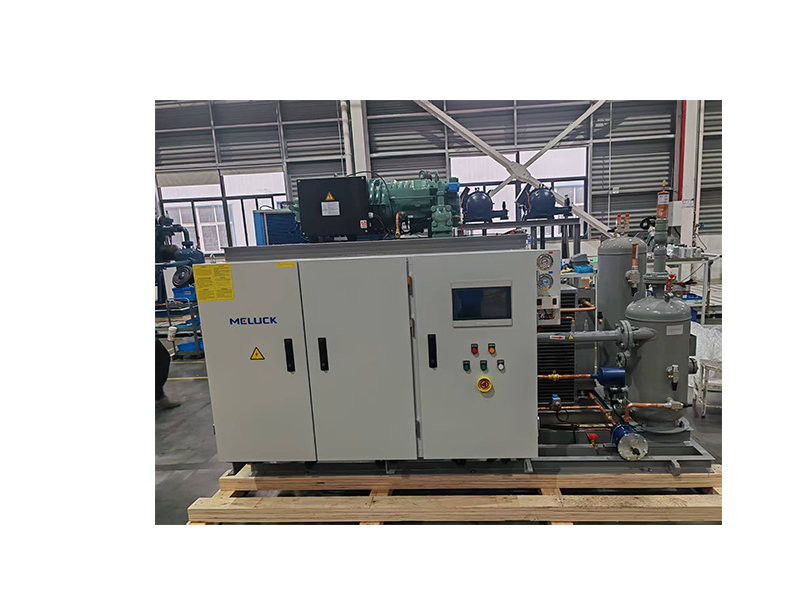
The range separates into families by evaporating temperature rather than by horsepower. Single-stage low-temperature reciprocating units, built on Bitzer compressors such as the 4HE-18Y, 4GE-23Y and 6GE-34Y, serve freezer rooms from -18°C to -30°C and remain the most economical choice for that band. Two-stage semi-hermetic packages at 16HP and 20HP extend the envelope to about -50°C evaporating and suit blast freezers, IQF lines and cold seafood work. Screw compressor condensing units built on CSH and HSN machines cover -25°C to -40°C at large capacity with PLC touchscreen control and optional remote monitoring.

Catalogue ratings deserve scrutiny at this level. A capacity printed at a mild ambient overstates what the same unit delivers in a hot plant room, and the gap widens as suction pressure falls.
Catalogue capacity quoted at a mild ambient rarely survives a hot plant room, and the gap widens at low suction pressure. <Selecting a Condensing Unit for Tropical Climates> covers how ambient conditions change condensing unit selection.
Matching the machine to the actual duty, rather than to the label, is the decision that matters. A 20HP two-stage package is a sensible answer for a -40°C to -45°C blast freezer or a holding room at around -50°C evaporating. It is not the answer for a room that must be held at -55°C air temperature, where the required coil temperature leaves no working margin.
Room Side Choices That Decide Whether -55°C Holds
The condensing unit cannot carry a deep freezer on its own. Coil selection, envelope quality and door discipline determine whether the compressor ever reaches a stable condition.
Start with the evaporator. A blast freezer cooler from the DJ series, with high airflow and generous surface, keeps the difference between room air and coil small, which protects both capacity and product surface. Fin spacing has to suit the defrost cycle, and the fan motors add heat directly to the room. Ask what defrost method the quotation assumes and how the drain is protected against freezing, because a blocked drain stops a deep freezer faster than a worn compressor.
The envelope comes next. PIR panels with a B1 fire rating suit high-specification builds, PUR panels with camlock joints suit faster installation, and both are only as good as their thickness and their sealing. Below -40°C, vapour barriers, penetration seals and floor insulation with a heater mat stop frost heave and moisture migration into the panel core. A door rated to -40°C is not automatically a -55°C door; heated frames, anti-sweat control and a realistic door cycle count belong in the design.
Controls finish the job. Probe placement, high and low temperature alarms, logging for audit, and remote notification decide whether a small fault becomes a claim. Specify what the alarm does and who receives it before commissioning.
Ambient, Power, and Installation Checks Before Order
Ambient conditions compound the difficulty of low-temperature duty. A condenser working in a 43°C plant room rejects heat at a higher condensing temperature, which raises the pressure ratio again on a duty point that already has little margin. Recirculation between condenser banks, dust on coils, and a unit squeezed into a corner all have the same effect as a hotter day, and none of them appear in a catalogue table.
Airflow around an air-cooled condenser decides whether the rating on the sheet is reachable on site. <Condensing Unit Installation Clearance: Key Spacing Rules> covers the spacing rules that keep condenser air moving.
Power supply deserves the same care. Confirm voltage, phase and frequency before the order rather than after delivery, check starting current against the available supply, and decide whether a soft starter is needed. In deep-freeze duty the low mass flow through the suction line makes oil return sensitive to pipe sizing, riser height and trap placement, so the piping layout belongs in the same review as the compressor selection. Insulation and vapour sealing on cold lines, evacuation and leak testing, and a documented pull-down test with door cycles should all be written into the delivery scope.
Writing the RFQ for a -55°C Condensing Unit
Most disappointing quotations trace back to an enquiry that named one temperature. A short, precise request produces comparable offers and exposes suppliers who are quoting a standard package against an ultra-low duty.
| RFQ field | What to request | Why it matters |
|---|---|---|
| Temperature reference | Room air, evaporating or product core, plus the design difference you expect | A -55°C room quoted against -55°C evaporating will not hold the room |
| Capacity at the duty point | kW at stated evaporating and condensing temperatures, with the design ambient | Horsepower alone hides the capacity lost at low suction pressure |
| Ambient and location | Maximum summer ambient, indoor or outdoor, coastal or dusty | Condensing temperature drives the pressure ratio and the power draw |
| Defrost and drainage | Method, cycle length, drain heat tracing | Frozen drains and ice build-up stop a deep freezer sooner than compressor faults |
| Envelope and doors | Panel type and thickness from the load calculation, door size and cycles | Infiltration and panel heat gain set the load the unit must cover |
| Power and controls | Voltage, phase, 50 or 60 Hz, alarm and remote monitoring | Mismatched supply and missing alarms are avoidable commissioning failures |
Reject an enquiry line such as "one Bitzer condensing unit that reaches -55°C, 20HP, please send price". Replace it with a statement of the evaporating and condensing temperatures you need, the capacity required at that point, the ambient design, the refrigerant you intend to use, the defrost method, and the power supply. The answer becomes comparable across suppliers instead of being reduced to horsepower.
Acceptance checks should close the loop: verify capacity at the agreed duty point, record the empty-room pull-down curve, run a holding test with realistic door cycles, confirm a full defrost completes and the drain clears, and test the alarm path to the person on call.
What a Zoned Bitzer Project Shows About Ultra-Low Temperature Planning
A recent multi-temperature facility in Manta, Ecuador, shows how zoning and compressor matching work in practice, and where its lessons stop. The plant combines five zones: three blast freezing rooms at -35°C, each 7 by 5 by 4 metres with a Bitzer 40HP system; a frozen store at -18°C measuring 14 by 12 by 6 metres on a 30HP system; an ice storage room at -10°C on 7HP; a processing room held at 5°C to 10°C on 25HP; and a 10 tonne per day flake ice plant feeding the line.
The project report records a closed loop from landing to export, lower spoilage than the previous manual setup, and stable quality on export shipments. It also records improved power consumption against the scattered equipment it replaced.
The limit of the example matters more than its results. The coldest zone runs at -35°C, so the installation does not demonstrate a -55°C room and should not be read as one. What it does show is that no single compressor serves a whole plant, and that each zone is sized against its own duty. Extending the same logic to -55°C adds one decision rather than one more horsepower figure: whether the room is held by cascade or screw compound equipment, and whether blast freezing at a colder coil would deliver the product quality without holding the store that cold.
Zoning a plant by process step keeps each compressor matched to the duty it actually sees. <Ecuador Multi-Temperature Cold Storage Project> covers the Manta installation in more detail.
Send the Duty Point and Get a Capacity Table
If you are planning a deep-freeze room or a blast freezer, send the four values that decide the machine: the temperature reference you actually need, the room size with product type and daily load, the design ambient at your site, and your power supply. With those, Shanghai Meluck Refrigeration Equipment Co., Ltd can return a capacity table at your duty point rather than a horsepower guess, and state plainly whether the duty needs a two-stage reciprocating package or a colder circuit. Contact David Zhang at meluck@meluckcooling.com or +8617369893087.
FAQ
Can one Bitzer condensing unit hold a room at -55°C?
Usually not. Holding a room at -55°C air temperature requires an evaporating temperature several kelvin colder, often near -60°C, which sits outside the normal envelope of a two-stage reciprocating package rated to about -50°C. Options at that point are cascade systems or screw compound units with an economizer. A two-stage unit is a better fit for blast freezing with a -55°C coil or for holding a room around -45°C to -50°C.
Is -55°C evaporating the same as -55°C storage?
No, and confusing the two is the most common error in ultra-low temperature enquiries. Evaporating temperature describes the refrigerant boiling in the cooler. Storage temperature describes the air in the room, which must stay warmer than the coil for heat to flow. A unit quoted at -55°C evaporating typically holds a room around -45°C to -50°C depending on coil design and load.
Should I choose two-stage compression or a cascade system?
Choose two-stage when the evaporating temperature stays around -50°C or warmer, when first cost and service simplicity matter, and when local technicians know reciprocating machines. Choose cascade when the room itself must be held at -55°C or colder, when product quality depends on that hold, and when you can support two refrigerant circuits with qualified service. Capacity at the duty point, not the compressor type, should decide the question.
Which refrigerant is used at these temperatures?
Low-temperature circuits commonly run on R-404A, R-507A or a lower-GWP blend such as R-449A or R-452A. Blends with glide behave differently on charging and leak top-up, and component compatibility has to be confirmed with the compressor selection. Fix the refrigerant before the quotation, because it changes capacity, discharge temperature and the service procedure.
If you're interested, check out these related articles:
Green Coffee Storage: Temperature and Humidity Control
Cold Room for Food Service: Compact Energy Efficient Options
Cold Storage Projects in Ghana for Food and Agriculture
Cold Storage Financing in Emerging Markets: Leasing Guide
Garlic Cold Storage Room: Humidity and Temperature Control
With over 15 years of experience as a MELUCK refrigeration engineer, I specialize in the design of cold storage, chillers, ice makers, and cold chain energy-saving systems, providing technical support to distributors and engineering companies worldwide.

meluck