
Grape Cold Storage: Temperature and Humidity Control Guide
After harvest, grapes are still alive. They respire, lose moisture, and continue biochemical processes that can turn a premium crop into a rejected shipment within days. Getting temperature and humidity right in cold storage is not about hitting a textbook number. It requires understanding how your refrigeration equipment interacts with the product under real operating conditions. I learned this early on when a fruit exporter in South America saw nearly 15% spoilage before we redesigned their cold room airflow pattern. The cooling capacity was adequate; the distribution was not. Proper grape cold storage temperature and humidity control depends as much on equipment configuration and room design as it does on set points.
What Temperature Do Grapes Need in Cold Storage?
Grapes for fresh market or wine production require storage temperatures between -0.5°C and 0°C with a tolerance of ±0.5°C. This narrow band slows respiration to a minimum while keeping tissue just above the freezing point. Wine grapes held for crushing may tolerate slightly higher temperatures around 2°C to 4°C for short periods, but any deviation beyond these ranges accelerates quality loss.
Table grapes are more sensitive. At 5°C, respiration rate doubles compared to 0°C, consuming sugar and reducing shelf life. Below -1°C, ice crystals form inside the berries, rupturing cell walls. The damage is not always visible immediately but becomes obvious as the fruit warms and softens into a waterlogged mess.

The refrigeration system must maintain temperature stability even during loading, defrost cycles, and door openings. I have seen facilities where the compressor was sized correctly for the calculated heat load but could not recover temperature quickly enough after a loading shift. The result was a 2°C to 3°C swing that repeated daily, and berry firmness declined measurably over two weeks. For grape cold storage, we specify condensing units with at least 10% to 15% capacity margin above the calculated peak load, not to waste energy but to handle real-world operation. Bitzer reciprocating compressors in the 5HP to 20HP range typically provide the reliability and rapid pull-down needed for medium-scale grape storage rooms.
Why Temperature Monitoring Needs More Than One Sensor
A single thermostat in the return air stream does not tell you what is happening at the pallet core. We recommend at least three temperature sensors: one in the supply air, one in the return air, and at least one probe placed in a grape cluster near the center of the room where airflow is weakest. Digital controllers with data logging let you review overnight temperature traces and catch drift before it becomes a quality problem.
Why Humidity Control Makes or Breaks Grape Preservation
Grapes are 80% to 85% water by weight. Storage at the wrong humidity causes either shrivel from moisture loss or mold from condensation. The target relative humidity for grape cold storage is 90% to 95%. Below 85%, stem browning and berry shrivel accelerate noticeably within the first week. Above 97%, any surface condensation creates conditions for Botrytis cinerea to establish.
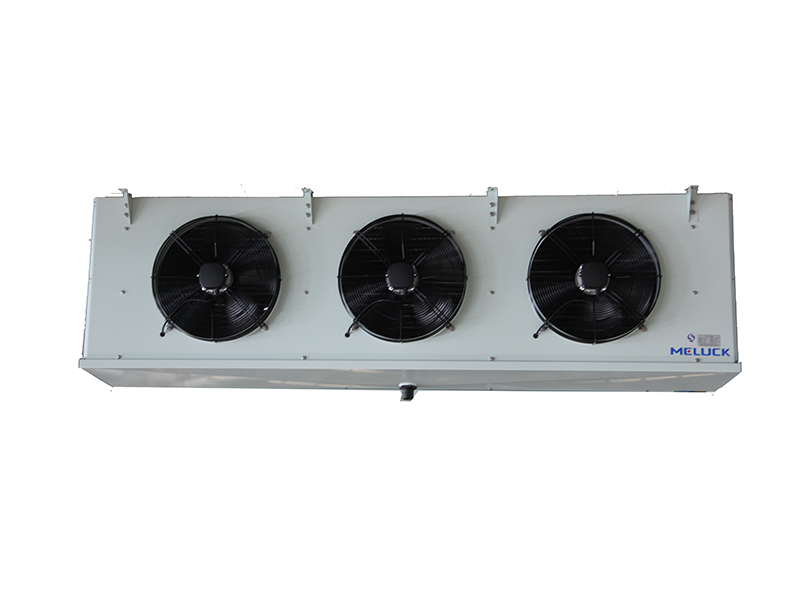
The real challenge is that humidity and temperature are coupled. A small temperature drop of 1°C can push local relative humidity past the dew point, forming water droplets on grape surfaces. This is why evaporator selection matters so much. A unit with too high a temperature difference between the coil surface and room air removes excessive moisture, drying the product. An evaporator matched too tightly to the sensible load may not pull enough latent heat, leaving humidity uncontrolled.
| Storage Condition | Temperature Range | Relative Humidity | Typical Storage Life |
|---|---|---|---|
| Fresh table grapes | -0.5°C to 0°C | 90–95% | 2–12 weeks depending on variety |
| Wine grapes (short-term) | 2°C to 4°C | 85–90% | 3–7 days before crushing |
| Wine grapes (extended) | -0.5°C to 0°C | 90–95% | 4–8 weeks |
| Dried grapes (raisins) | 5°C to 10°C | 60–70% | 6–12 months |
For grape rooms, we use evaporators with a temperature difference of 5°C to 7°C rather than the 8°C to 10°C common in general cold storage. A closer TD means gentler moisture removal and more stable humidity. The coil surface stays cold enough to condense moisture from the air but not so cold that it strips humidity aggressively. In a grape cold room I commissioned in Southeast Asia, switching from a standard 8°C TD evaporator to a 6°C TD unit reduced weight loss from 3.5% to under 1.5% over four weeks of storage. The client recovered the modest cost difference within a single season through reduced product shrinkage.
How Condensation Forms and How to Stop It
Condensation in grape storage rarely comes from the refrigeration system running too cold. It typically appears when warm, humid outside air enters the room during loading or when the defrost cycle releases moisture back into the space. Insulated cold room doors with good seals and a properly sized defrost heater with drain pan management prevent most condensation events. In high-humidity tropical locations, we also specify PIR cold room panels with a vapor barrier on the warm side to prevent moisture migration through the insulation itself.
If your grape storage involves frequent door openings, adding a strip curtain inside the door and scheduling loading during cooler hours makes a measurable difference. If your program involves high-throughput operations where door openings are unavoidable, it is worth confirming the defrost and humidity control strategy for your specific room configuration before finalizing equipment selection. Reach out at meluck@meluckcooling.com with your room dimensions and daily throughput volume; we can verify whether your planned setup will hold humidity stable under real operating cycles.
Cold Room Equipment That Delivers Stable Grape Storage Conditions
Grape storage rewards simplicity in system design but punishes shortcuts in component selection. A reliable cold room for this application needs three things: stable refrigeration capacity, humidity-friendly evaporator performance, and insulation that does not degrade under high humidity.

For the condensing unit, medium-temperature Bitzer reciprocating compressors in the 4HP to 20HP range match most commercial grape storage rooms from 20 to 200 square meters. I specify Bitzer because the semi-hermetic design handles the continuous run cycles that grape storage demands without the thermal fatigue issues that can shorten compressor life. In one project for a fruit exporter in Peru, two Bitzer 20HP condensing units maintained a 17m × 12m cold room at 10°C ±0.5°C for avocado pre-cooling and storage. The same platform, sized appropriately, delivers the tighter 0°C ±0.5°C band that grapes require.
For smaller operations, monoblock refrigeration units simplify installation and keep capital costs low. For rooms under 30 cubic meters, a well-matched monoblock can hold grape storage temperature adequately, though I recommend adding a small auxiliary evaporator fan for airflow distribution rather than relying on the integrated fan alone.
Insulation and Panel Selection for High-Humidity Rooms
Cold room panels for grape storage must perform in an environment where internal relative humidity sits at 90% to 95% continuously. PIR panels with a minimum thickness of 100mm for chiller applications provide the thermal stability and fire resistance that modern standards require. PUR panels at 100mm thickness are also effective and cost less, though PIR offers better long-term dimensional stability in humid conditions.
Panel joint design directly affects both thermal performance and humidity control. Cam-lock or slip-joint connections with factory-applied gaskets minimize air leakage and moisture ingress at seams. Air leakage through panel joints raises the latent heat load on the evaporator and forces the compressor to work harder, increasing both energy consumption and temperature fluctuation. We have measured a 15% to 20% reduction in cooling load when upgrading from poorly sealed panel joints to properly gasketed PIR panels in a tropical climate fruit storage room.
Airflow and Loading: The Practical Side of Grape Cold Room Design
Air must reach every grape cluster in the room. That sounds obvious, but I have audited too many grape cold rooms where pallets were stacked tight against walls or packed so densely that center temperatures ran 3°C to 4°C warmer than the edges. Stale, humid pockets inside densely loaded pallets are where mold problems begin.

Design the room with at least 300mm clearance between pallets and walls, and 150mm between pallet rows, to allow air circulation. Ceiling-mounted air coolers should direct airflow across the top of the stored product and down through the aisles, not straight down onto the top layer of grapes. Direct impingement dries the surface and can cause localized chilling injury.
Stack grapes in vented containers, never in solid-wall bins without airflow openings. Plastic field lugs with side perforations work well. For bulk bin storage, use bins with at least 15% open area on all sides. The container choice affects humidity uniformity inside the room more than most operators realize. Solid bins block airflow and create microclimates where humidity can swing 10% to 15% above or below room average.
Pre-Cooling Before the Main Cold Room
Grapes arriving from the field at 25°C to 30°C carry a significant heat load. Placing warm grapes directly into a cold room set at 0°C overwhelms the refrigeration system and causes a prolonged pull-down period during which humidity drops sharply as the evaporator runs at full capacity. Forced-air pre-cooling that brings the fruit to within 2°C of storage temperature before the grapes enter the main cold room solves this problem. If a separate pre-cooling room is not practical, load the cold room in stages over several hours and set the controller to a gradual pull-down profile rather than an aggressive set point.
Avoiding Common Grape Storage Failures Through Equipment Selection
Most grape storage problems trace back to one of three equipment-related causes: undersized refrigeration, evaporator mismatch, or insulation specified based on cost rather than performance. These failures are predictable and avoidable.
The first sign of an undersized system is temperature creep during hot afternoons. The compressor runs continuously but cannot hold set point. The grape temperature rises slowly, respiration accelerates, and shelf life erodes. This is not a control setting issue; it is a capacity shortfall that requires either adding condensing unit capacity or reducing room heat load through better insulation or reduced infiltration.
Evaporator mismatch shows up as either excessive dehydration or high humidity swings. An evaporator with too large a coil surface for the compressor capacity cycles frequently and does not remove enough moisture during its short run times, leading to high humidity and condensation risk. An undersized evaporator runs longer and colder, pulling too much moisture from the air. Matching evaporator capacity to both the sensible and latent cooling load of the specific grape variety and room configuration is detail work that pays back in product quality.
In a tomato cold storage project we completed in Myanmar, the client initially reported mold issues in a room that measured correct temperature. The problem was humidity exceeding 98% overnight because the evaporator was oversized for the room, running only 30% of the time and never pulling enough moisture. After rebalancing the system with a properly matched evaporator, humidity stabilized at 90% to 92%, and mold incidence dropped to near zero. The same dynamic applies to grape storage, where mold is the primary spoilage risk.
If you are planning a new grape cold room or troubleshooting an existing one, send your room dimensions, current equipment specifications, and the storage problems you are seeing to meluck@meluckcooling.com. We can identify whether the issue is equipment configuration, airflow design, or control strategy before you invest in changes that may not solve the real problem.
Common Questions About Grape Cold Room Storage
What is the ideal storage temperature for wine grapes versus table grapes?
Wine grapes destined for crushing within a few days can be held at 2°C to 4°C without significant quality loss. Table grapes for fresh market require -0.5°C to 0°C with tight control to maximize shelf life, which can extend from 2 to 12 weeks depending on variety. The difference is economic: table grape value depends on visual appearance and firmness, while wine grapes tolerate more variation since they are processed quickly.
How long can grapes be stored in a cold room?
It depends on variety, maturity at harvest, and storage conditions. Under optimal conditions of -0.5°C to 0°C and 90% to 95% relative humidity, Thompson Seedless grapes can store 8 to 12 weeks, Red Globe 8 to 14 weeks, and Crimson Seedless 10 to 16 weeks. Wine grape varieties generally have shorter storage windows of 1 to 8 weeks because they are harvested at higher maturity and are more susceptible to mold.
Does a grape cold room need a separate humidifier?
In most grape cold rooms, the evaporator handles both cooling and dehumidification. Adding a dedicated humidifier is rarely needed if the evaporator is properly matched to the room load and a TD of 5°C to 7°C is maintained. Ultrasonic or steam humidifiers introduce their own challenges, including mineral dust deposits on fruit and added heat load. We generally recommend solving humidity problems through evaporator selection and airflow design rather than adding equipment.
Can I store grapes together with other fruits?
Multi-use cold rooms work if the temperature and humidity requirements overlap. Grapes at 0°C and 90% to 95% RH share conditions with apples and pears, so combination storage is feasible. However, grapes produce very low ethylene and are sensitive to ethylene from other fruits. Apples and pears emit significant ethylene that can accelerate grape senescence. If combining crops, maintain ethylene levels below 0.1 ppm through ventilation or ethylene scrubbing, and never store ethylene-producing fruits directly above grapes where airflows can mix.
What is the most common mistake in grape cold room design?
The most frequent error I encounter is designing the refrigeration system around average conditions rather than peak load. A cold room that holds temperature perfectly on a mild day falls short when outdoor temperatures hit seasonal highs or when a full harvest arrives for cooling. Adding capacity margin and verifying performance under maximum heat load and maximum product load prevents the kind of failures that show up when the crop is at its most valuable. If you are evaluating equipment specifications for a new grape storage room, share your peak harvest volume and local climate data with us at meluck@meluckcooling.com or call +8617369893087. We will confirm whether the proposed system can handle your worst-case operating day, not just the average one.
If you're interested, check out these related articles:
Chiller Room Solutions -10C~10C - Meluck
Blast Freezer Room Solutions -40C~-60C - Meluck
Myanmar Potato Seed Cold Storage Project - Meluck
With over 15 years of experience as a MELUCK refrigeration engineer, I specialize in the design of cold storage, chillers, ice makers, and cold chain energy-saving systems, providing technical support to distributors and engineering companies worldwide.

meluck