
Cámara frigorífica para cítricos: del diseño a la exportación
Una cámara frigorífica para cítricos es una de las formas más rápidas de reducir las pérdidas poscosecha y mejorar la calidad de exportación, pero si el diseño pasa por alto la humedad y el flujo de aire, ni siquiera el mejor equipo de refrigeración salvará la fruta. En mis quince años diseñando cámaras frigoríficas para regiones tropicales y subtropicales, he visto a centrales de empaque perder envíos completos porque una cámara frigorífica se dimensionó como una cámara frigorífica para productos agrícolas en general, sin tener en cuenta los patrones de respiración sensibles de naranjas y limones. Esta guía describe los pasos prácticos de diseño —desde los valores de consigna de temperatura y la selección del aislamiento hasta el dimensionamiento de la unidad condensadora— que ayudan a los exportadores de cítricos a construir una cámara que conserve la calidad desde la central de empaque hasta el puerto.
¿Cuáles son las condiciones óptimas de temperatura y humedad para los cítricos en cámaras frigoríficas?
Las naranjas y los limones son productos vivos. Tras la cosecha siguen respirando, generando calor y perdiendo humedad. El objetivo de una cámara frigorífica para cítricos es ralentizar este proceso sin causar daños por frío. Para la mayoría de las variedades de naranja, el punto óptimo es de 4 °C a 7 °C con una humedad relativa del 85–90 %. Los limones, de piel más fina, prefieren de 10 °C a 13 °C y una humedad ligeramente superior, en torno al 90–95 %. Si su planta de empaque manipula ambas frutas, considere un diseño con zonas a distintas temperaturas o cámaras separadas, porque mantener los limones a las temperaturas de las naranjas durante más de unos pocos días provocará picado y podredumbre.
| Tipo de cítrico | Temperatura de almacenamiento | Humedad relativa | Vida útil de almacenamiento aprox. |
|---|---|---|---|
| Naranjas (Valencia, Navel) | 4 °C – 7 °C | 85 % – 90 % | 4 – 8 semanas |
| Limones | 10 °C – 13 °C | 90 % – 95 % | 2 – 6 semanas |
| Pomelos | 10 °C – 12 °C | 85 % – 90 % | 4 – 6 semanas |
| Limas | 9 °C – 10 °C | 85 % – 90 % | 3 – 5 weeks |
These numbers are not just guidelines. I’ve seen exporters in South America lose 15% of their harvest before shipping because they relied on a room set to 2°C, thinking colder was safer, and the fruit developed internal browning within days. Temperature stability matters as much as the setpoint. A correctly insulated and controlled room should stay within ±0.5°C of the target.
How to Design a Citrus Cold Storage Room for Export?
A chiller room for citrus starts with the building envelope. In tropical export regions — Ecuador, Kenya, Vietnam — the ambient temperature can exceed 35°C. If your insulation is undersized, the refrigeration system runs continuously and humidity plummets, drying out the fruit. We use high-density polyurethane (PUR) or PIR panels at least 100 mm thick for chiller rooms in hot climates. PIR panels with a B1 fire rating are increasingly common in large export facilities because they provide better thermal resistance and safety compliance.

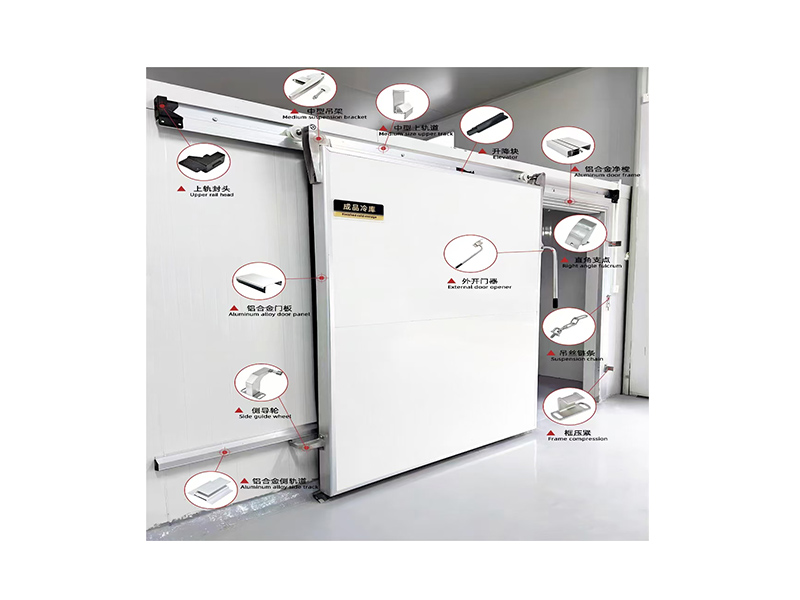
The floor is often neglected. Citrus packinghouses have constant forklift traffic and wet cleaning. I recommend a reinforced insulated floor with a vapor barrier, not a thin sandwich panel laid on concrete. For the door, a puerta corredera manual with heated frame and high‑density insulation minimizes cold air loss during loading and unloading. In one of our avocado projects in Peru, switching from a hinged door to a heavy‑duty sliding door reduced cool air loss by nearly 20%, and the same principle applies to any high‑throughput citrus room.
Room layout should follow the workflow: fruit enters at one end after precooling, moves through storage, and exits at the shipping bay. Keep the stacking height consistent and leave a 30–40 cm air gap between the top of the product and the ceiling to let the air coolers circulate air evenly. A room too tall for its width creates temperature stratification; fruit at the top can be 2–3°C warmer than the bottom.
Why Does Airflow and Humidity Control Make or Break Citrus Quality?
In a citrus cold room, humidity and airflow work together. Without adequate airflow, even a correctly sized evaporator cannot pull moisture from the coil and distribute it uniformly. The result: fruit near the air cooler stays fresh, but boxes in corners develop shrivel and weight loss.
Forced‑air circulation is essential. Ceiling‑mounted air coolers with DL series evaporators designed for chiller duty deliver high airflow at low velocity, which is gentler on the fruit. Plan for an air change rate of 40–60 times the room volume per hour for citrus storage if the room is loaded with palletized bins; a higher rate is needed if the product is densely packed in cartons.
Control de la humedad often means adding moisture, not removing it. In many tropical-night conditions, the evaporator dehumidifies aggressively because it has to run long cycles to handle the ambient heat load. A simple humidifier — ultrasonic or spray — linked to the room controller will keep the humidity above 85% without over‑cooling. I’ve seen a 5% weight loss in oranges over two weeks in a low‑humidity cold room, which directly translates to lost revenue on export.
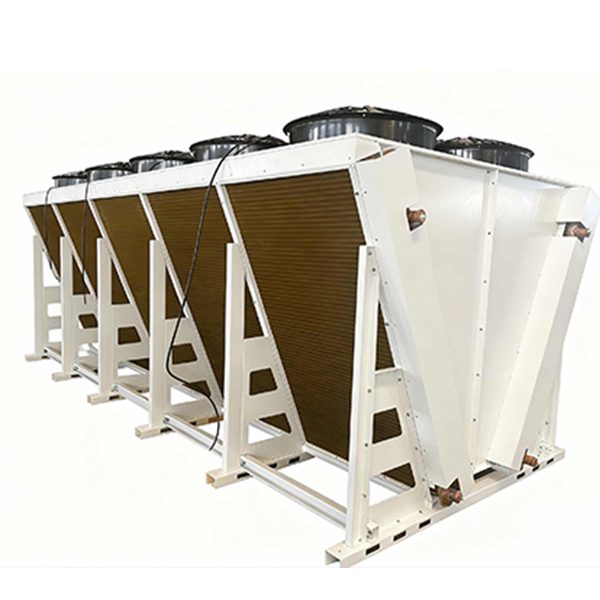
Defrost strategy also affects humidity. Electric defrost on the evaporator coils should be short and timed so that the room temperature doesn’t spike. A hot‑gas defrost system is more energy‑efficient and better for humidity stability, but it adds complexity to the pipework. For a dedicated chiller room running above 0°C, simple off‑cycle defrost is often enough.
If you’re retrofitting an existing room and cannot change the evaporator placement, consider hanging fabric air ducts. They distribute cool air along the length of the ceiling without creating direct drafts on the produce. In a tomato cold room we upgraded in Myanmar, this single change reduced temperature variation between the front and back of the room from 4°C to less than 1°C.
How to Select Refrigeration Equipment for a Citrus Cold Room in Hot Climates?
The condensing unit is the heart of the system, and in hot climates you cannot simply pick a unit based on the room’s nominal cooling load. Ambient temperature derating is critical: a condensing unit rated at 15 kW at 32°C ambient might deliver only 11 kW at 42°C — and that’s a failure waiting to happen.
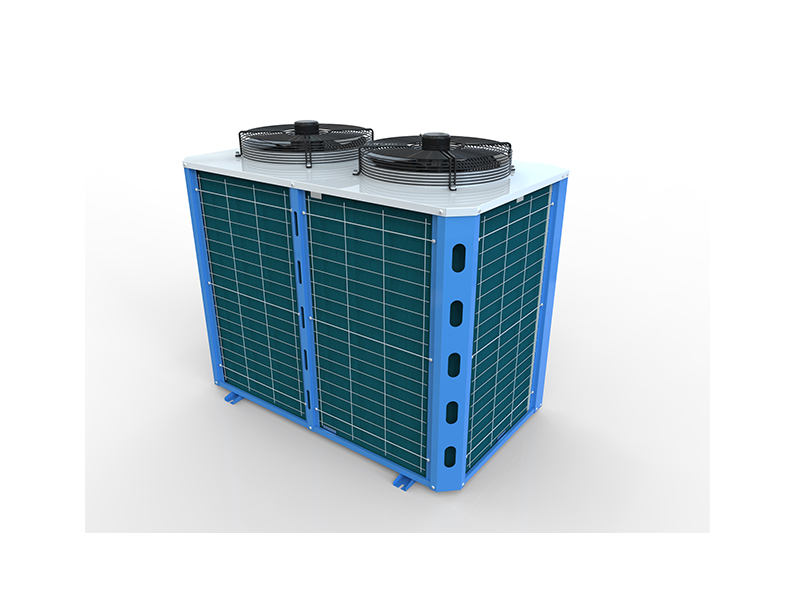
For citrus chiller rooms up to about 200 m³, a medium‑temperature reciprocating condensing unit in the 10 HP to 20 HP range is typical. We use Bitzer semi‑hermetic compressors for almost all our fruit storage projects. They hold up under continuous operation, and spare parts are available internationally, which is not always the case with some budget brands. A 15 HP Bitzer unit (such as the 4PE‑15Y) with a remote air‑cooled condenser will comfortably serve a 150–200 m³ room holding oranges at 5°C in a 40°C ambient, assuming proper insulation and normal product throughput.
Evaporator matching is just as important. A chiller room holding fresh citrus needs a fin spacing of about 4–6 mm on the evaporator coil. Any tighter and the coil will frost in extended cycles; any wider and the heat exchange surface is reduced. DL series air coolers from MELUCK’s own line have been used in dozens of fruit chiller rooms across Latin America and Africa, and they consistently maintain temperature uniformity when the room layout allows good airflow.
For a quick reference, this table outlines a general starting point for equipment sizing based on room volume and storage temperature:
| Room Volume (m³) | Storage Temp (°C) | Suggested Bitzer Unit (HP) | Typical Air Cooler |
|---|---|---|---|
| 60 – 80 | 4 – 7 | 5 – 6 HP (4DES‑6Y) | DL‑30 |
| 80 – 150 | 4 – 7 | 9 – 12 HP (4PE‑12Y) | DL‑55 |
| 150 – 250 | 4 – 7 | 15 – 20 HP (4PE‑15Y or 4NE‑20Y) | DL‑80 |
| 250 – 400 | 4 – 7 | 25 – 30 HP (4GE‑23Y or 6HE‑28Y) | DL‑100 × 2 |
These figures assume a well‑insulated room with normal product loading. Actual heat load depends on the daily throughput, fruit respiration, and fresh air infiltration, so a proper load calculation is always required before ordering equipment.
If your cold room will be located in a region where the daytime ambient temperature regularly exceeds 38°C, it is worth getting a second opinion on your equipment sizing. We’ve taken over several projects where the original supplier used a temperate‑climate sizing chart and the room never pulled down. For a no‑obligation review of your heat load estimate, send your room dimensions and daily fruit intake to meluck@meluckcooling.com.
What Export Compliance and Maintenance Practices Keep a Citrus Cold Room Running?
Export buyers audit cold rooms for phytosanitary compliance and temperature consistency. The first thing an inspector checks is whether the chiller room has a continuous digital temperature log with alarm notifications. A simple controller with a data logger and SMS alert on temperature deviation costs very little and prevents a lot of problems. Some destination markets in the EU and Middle East also require a certificate showing the cold room has held the fruit at the correct temperature for the full storage period.
Cleaning is often the weakest link. Citrus fruit sheds spores that can accumulate on panels and evaporator coils. Monthly cleaning of the evaporator fins with a mild detergent, and periodic fogging with a food‑safe sanitizer, will keep mold from colonizing the cold room. The floor drains should be sloped and screened to prevent standing water, which breeds bacteria and attracts fruit flies.
Maintenance of the refrigeration system should be scheduled around harvest seasons. Before the high season, check the condenser coil for dust and debris, verify refrigerant charge, and test the defrost heater. A variable refrigerant leak is common in older systems and easily detected by a drop in suction pressure. If caught early, a leak repair takes a few hours; if ignored, the compressor can fail, and a room full of export citrus can warm past the critical limit in less than six hours.
For a packhouse planning to grow, invest in a modular design from the start. A cold room built with camlock or slip‑joint panels can be extended by adding panel rows and a second evaporator, without a full rebuild. I’ve seen packhouses start with a 100 m² room and expand to 300 m² within two seasons, simply by planning the wall placement and equipment layout with expansion in mind.
When you’re building a citrus cold storage room that needs to meet export standards, the difference between a system that works and one that fails comes down to the details we’ve covered: insulation, airflow, humidity, equipment derating, and maintenance. Don’t inherit someone else’s mistakes. If you share your site conditions and daily throughput with our team at meluck@meluckcooling.com or call +8617369893087, we will deliver a custom heat load analysis and equipment recommendation within 48 hours, based on the same methods used in fruit cold room projects across South America, Africa, and Asia.
Key Questions Every Citrus Exporter Should Ask About Cold Storage
Is a multi‑temperature room for oranges and lemons practical?
It can work if you separate the zones physically and use independent evaporators and temperature controllers, but in practice, cross‑contamination of warmer air from the lemon zone to the orange zone is hard to prevent. The better solution is two smaller rooms, or a single room with removable partition walls and a dedicated air cooler for the higher‑temperature section. In projects we’ve supported, the extra cost of two small rooms usually pays back by the second season because fruit quality is more consistent and buyers notice.
How much post‑harvest loss is normal for citrus cold storage?
With a properly designed cold room, loss from deterioration during storage should stay under 3–5%. If you’re seeing 10–15% loss, the problem is rarely the fruit itself; it’s either temperature instability, low humidity, or inadequate precooling before the fruit enters the chiller room. A data logger that records temperature in three zones of the room for one week will quickly tell you where the weak spot is.
Do I need special certification for the EU market?
For Europe, your cold room must comply with the general hygiene regulations (EC No. 852/2004) and temperature monitoring requirements. Some buyers also audit against the GlobalG.A.P. cold chain module, which requires documented temperature records, cleaning logs, and maintenance schedules. Meeting these standards is straightforward if the room has a digital controller with logging capability from day one.
How often should I perform preventive maintenance on the cold room?
A monthly check of door seals, drain lines, and evaporator fins will catch most small problems before they cause a breakdown. Twice a year — before the start of the main season and at the end — a qualified technician should verify the refrigerant charge, clean the condenser coil, and calibrate the temperature sensors. If your facility is in a coastal area, clean the condenser monthly because salt spray accelerates coil corrosion.
If you’re comparing different supplier proposals and want to be sure the refrigeration capacity matches your actual load, send your floor plan and throughput data to meluck@meluckcooling.com. We’ll help you verify the equipment sizing against the real conditions your room will face, not just the brochure numbers.
Si le interesa, consulte estos artículos relacionados:
Soluciones para salas de refrigeración -10C~10C - Meluck
Almacenamiento en frío con precooling de aguacate en Perú - Meluck
Con más de 15 años de experiencia como ingeniero de refrigeración de MELUCK, me especializo en el diseño de almacenamiento en frío, enfriadoras, máquinas de hielo y sistemas de ahorro energético para la cadena de frío, y presto soporte técnico a distribuidores y empresas de ingeniería de todo el mundo.

meluck