
Конденсаторные агрегаты с дистанционным управлением: более разумное управление холодильными камерами
Конденсаторные агрегаты с дистанционным управлением превратились из нишевого дополнения в практическую необходимость для операторов холодильных камер, которые не могут допустить ни одного колебания температуры. Когда партия авокадо портится из-за того, что холодильная камера температура ночью поднялась выше 10°C, финансовые потери ощущаются сильнее, чем первоначальная стоимость умной панели мониторинга. Моя команда внедряла системы дистанционного управления на базе ПЛК в многозонных проектах холодового хранения от Эквадора до Египта, и закономерность неизменна: объекты, которые внедряют real‑time monitoring and alarms cut post‑harvest and processing losses by more than half.
What Remote Control Condensing Units Do for Cold Room Operations
A remote control condensing unit puts the whole refrigeration system—compressor, condenser fans, defrost heaters, and temperature sensors—under a single networked controller. Instead of staff walking into a cold store every two hours to read a dial, a facility manager can check chiller and freezer temperatures from a mobile phone. The panel logs data continuously, sends alarms when a setpoint drifts, and often lets you adjust parameters remotely.
For a cold room that handles multiple temperature zones, this is more than a convenience. A single PLC can manage a скороморозильный аппарат running at -35°C, a frozen storage hold at -20°C, and a packaging area held at 5 °C, all from one interface. That level of visibility closes the gap between “we think the room is stable” and “we have proof it stayed within range all night.”
Preventing Spoilage and Export Rejection with Real‑Time Monitoring
Temperature excursions are the silent profit‑killer in a cold chain. Fresh produce, seafood, and processed foods that sit outside spec for even a few hours can fail an export inspection or arrive with shortened shelf life. Remote control acts as an early warning system, not a retrospective autopsy.
In an avocado cold storage project we commissioned in Peru, post‑harvest losses were running at about 15% before any remote monitoring was in place. After installing Bitzer condensing units with networked controllers and ceiling air cooler sensors tied to a remote panel, the facility stabilized its 10 °C storage within ±0.5 °C, and rejections dropped below 4%. The alarm setup meant the night‑shift team could react within minutes instead of discovering a problem at the next walk‑through.
The same principle showed up in a French fries processing plant in Egypt, where скороморозильная заморозка at -35 °C, packaging at 5–10 °C, and frozen storage at -20 °C all run under the supervision of a single PLC network. Product loss and quality defects fell to under 2% once remote monitoring took manual drift out of the equation.
Why Temperature Excursions Cost More Than You Think in Export Cold Chains
Importing countries often require documented temperature logs for every consignment. When a cooler drifts above the allowed range, even briefly, the entire lot can be detained or downgraded. Remote control condensing units generate time‑stamped, tamper‑proof records that satisfy EU, US FDA, and Gulf standard audits without scrambling for paper charts after the fact.
How Smart Alarms Prevent Loss Before It Happens
Remote panels can be programmed to send tiered alerts: a soft warning when the temperature rises to within 2 °C of the upper limit, an urgent notification if it breaks the limit, and an automatic compressor or fan speed adjustment if configured. In several projects, the maintenance team got a call before the room reached dangerous levels, saving product that would have been written off by morning.
If your cold room serves export markets and a single compliance failure could block a container, it is worth examining how remote monitoring can be integrated with your existing condensing units. Reach out at meluck@meluckcooling.com to discuss your specific cold chain setup.
How Smart Panels Integrate Into Multi‑Zone Cold Room Systems
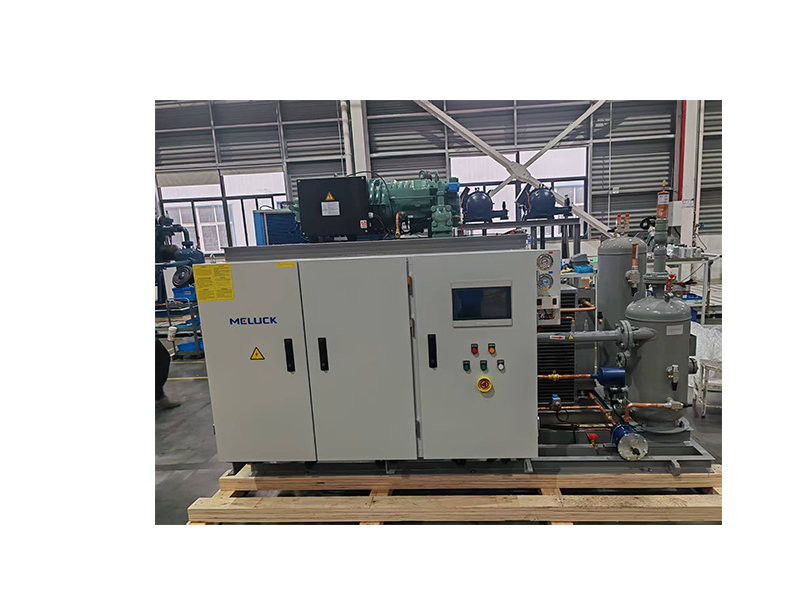
The practical side of remote control condensing units lies in the PLC and sensor network. A typical Bitzer screw or reciprocating condensing unit we supply can be ordered with a pre‑integrated PLC that handles compressor staging, defrost cycles, and condenser fan speed based on real‑time sensor data. Communication runs over Modbus or Ethernet to a local touchscreen, and from there either to a building management system or a cloud gateway.
PLC and Sensors: The Brain Behind Remote Condensing Unit Control
Temperature sensors in the cold room, pressure transducers on the suction and discharge lines, and current monitors on the compressor give the PLC a full picture. If a condenser fan fails and head pressure climbs, the controller can reduce compressor loading or trigger a maintenance alarm before a high‑pressure trip shuts down the system entirely. For operators, the remote panel is the single pane of glass that replaces a dozen separate gauges.
Adding Remote Access to an Existing Cold Room
A cold room already fitted with a modern condensing unit that has a digital control board can usually be upgraded with a remote communication module. Older electromechanical units may need a retrofit controller kit. The key is confirming that the condensing unit’s safety logic can pass through the new panel without bypassing built‑in protections—something that should always be reviewed with the equipment supplier’s engineering team.
Real‑World Results: Cold Room Projects That Prove the Value
The table below captures a few cold chain installations where remote control condensing units shifted outcomes.
| Facility | Продукция | Key Risk Without Remote Control | After Integration | Measured Impact |
|---|---|---|---|---|
| Peru avocado pre‑cooling room | Fresh avocados | Spoilage from temperature drift, up to 15% loss | Remote PLC with ±0.5 °C control, instant alarms | Rejection rate below 4% |
| Egypt multi‑zone French fries plant | Frozen French fries | Inconsistent blast freezing, packaging area temperature swings | Networked Bitzer PLCs across -35 °C, 5 °C, and -20 °C zones | Defects under 2% |
| Myanmar tomato cold storage | Fresh tomatoes | Mold and rapid spoilage, limited storage time | Remote‑enabled Bitzer unit with ceiling evaporator at 8–12 °C | Shelf life extended, market‑timing flexibility improved |
Key Considerations When Choosing a Remote Control Solution
Not every remote panel fits every cold room. If the condensing unit cannot communicate digitally, the integration cost may push the project past its budget. Three points I always raise with buyers:
- Controller compatibility – Bitzer condensing units with onboard PLCs simplify the setup; separate third‑party controllers can work but need careful integration with the safety chain.
- Connectivity redundancy – A local data logger must continue recording even if the internet drops, and critical alarms should reach someone via SMS or local siren, not just an app notification.
- Response protocol – A remote panel is worthless unless the facility has a clear on‑call procedure. The technology spots the problem; people fix it.
Remote control condensing units also depend on a reliable power supply. In regions with frequent grid instability, pairing the controller with a small UPS or a backup energy source keeps the monitoring alive during short outages.
Questions to Ask Your Condensing Unit Supplier About Remote Monitoring
- Does your unit natively support Modbus or BACnet, or does it need an adapter?
- Will the remote panel allow me to export temperature logs in a format accepted by food safety auditors?
- Can the system send tiered alarms and escalation rules, not just a single “fault” message?
- What local support do you offer for commissioning the remote interface?
Making the Business Case: Moving Forward with Remote Control
The cost of adding a remote monitoring panel to a condensing unit typically ranges between 5% and 10% of the equipment price—a figure that is quickly absorbed if the system prevents a single rejected export container or one weekend of unscheduled spoilage. In the cold chain projects I have tracked, the payback period is often measured in months, not years.
For buyers evaluating their next cold room or upgrading an existing one, starting the conversation with a clear list of required control features makes the quoting process smoother. We regularly assist distributors and end‑users in matching the right Bitzer remote‑ready condensing unit to their cold room zones, and we can provide reference performance data from similar installations in your climate region. Contact our engineering team at meluck@meluckcooling.com or call +8617369893087 to share your cold room specs and layout—we will help you build a tailored remote control solution that fits your operational demands.
Common Questions About Remote Control Condensing Units
Can I retrofit remote control on an existing cold room condensing unit?
It depends on the unit’s control board. Many modern Bitzer reciprocating and screw compressors already include digital I/O ports, making a retrofit with a communication module straightforward. Older electromechanical units may require an external controller and additional sensor wiring. Before investing, have a technician confirm the electrical and communication interfaces on your current condensing unit.
What happens if the internet connection drops?
The local PLC continues operating the refrigeration system independently, and all temperature and alarm data is stored in onboard memory. Once the connection is restored, the log syncs back to the remote platform. If the panel has a cellular backup module, critical alarms still reach personnel via SMS. The cold room itself stays within control regardless of network status.
Will automatic temperature logging satisfy HACCP auditors?
Yes. A remote control panel that records time‑stamped temperature data at regular intervals and generates exportable PDF or CSV reports meets the documentation requirements of most food safety schemes, including HACCP, BRC, and IFS. The key is setting the recording frequency and retention period to match the auditor’s expectations, which we configure during commissioning.
Is remote monitoring only affordable for large industrial cold rooms?
Even smaller cold rooms handling high‑value products—berries, specialty coffee, seafood—benefit from remote control. Entry‑level cloud‑connected controllers are now available at a fraction of the cost of full industrial PLCs, and the avoided loss from a single batch often covers the hardware. The right question is not “can I afford remote monitoring?” but “can I afford a temperature excursion without it?”
If you are unsure whether your current or planned cold room is compatible with remote control, share your condensing unit model and temperature requirements with us. Our engineers can verify compatibility and propose a system that matches your cold chain scale and budget. Email meluck@meluckcooling.com for a detailed consultation.
Если вам интересно, ознакомьтесь с этими статьями по теме:
Решения для цехов пищевых производств - Meluck
Решения для шоковых морозильных камер -40C~-60C - Meluck
Проект холодильного склада для картофеля фри в Египте - Meluck
Решения для холодильных камер -10C~10C - Meluck
Имея более чем 15-летний опыт работы инженером по холодильному оборудованию MELUCK, я специализируюсь на проектировании холодильных складов, чиллеров, льдогенераторов и энергосберегающих систем холодовой цепи, обеспечивая техническую поддержку дистрибьюторам и инжиниринговым компаниям по всему миру.

meluck